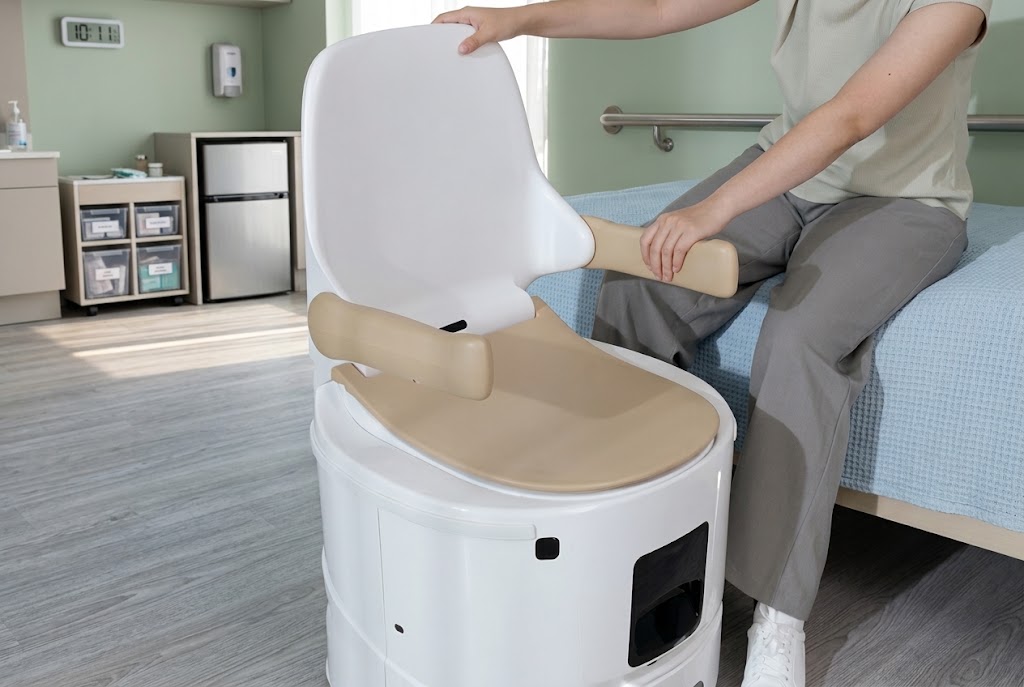
Imagine lying in bed and needing to use the toilet.
For most people, the solution is simple: get up and walk to the bathroom.
But for an elderly person with weak legs, a patient recovering from surgery, or someone with severe mobility problems, that short journey can be difficult, exhausting—and sometimes dangerous.
Now imagine that the toilet simply comes to you.
That is the striking idea behind Xiaoban, a small robotic toilet developed in China that can move across a room, navigate around obstacles and position itself beside a user. Summoned by voice command or remote control, the machine can travel to where it is needed before eventually returning to its docking station.
It looks like something from a science-fiction movie.
But in a fascinating way, it is actually the latest chapter in a story that began thousands of years ago.
Because the history of the toilet is, in many respects, the history of human ingenuity itself.
For more than 6,000 years, people have been trying to make one unavoidable biological necessity safer, cleaner, more private and more convenient.
And China’s latest robotic toilet may represent the most extraordinary development yet.
It Started With a Hole in the Ground
Long before smart toilets, heated seats and artificial intelligence, there was simply the pit.
At the ancient Banpo settlement near present-day Xi’an, archaeologists discovered evidence of simple waste pits associated with one of China’s Neolithic communities, dating back thousands of years.
It was a primitive solution, but an important one.
Human beings were beginning to separate the places where they lived from the places where they deposited waste.
That distinction would become one of the foundations of urban civilization.
The basic principle was simple: contain the waste rather than leave it wherever nature happened to take it.
But the ancient toilet was not without danger.
Sometimes, the pit itself could become a death trap.
When the Toilet Became Part of the Farm
Ancient Chinese ingenuity eventually produced a remarkably practical arrangement known as the pigsty-privy.
Instead of treating human waste as something that simply had to be removed, the system incorporated it into an agricultural cycle.
A raised privy could be positioned above a pigpen, allowing human waste to fall below. Some of the material could be consumed by pigs, while the mixture of animal manure and other organic matter could ultimately be used as fertilizer.
From a modern perspective, the practice raises obvious health concerns.
But within the context of ancient agriculture, it demonstrated something remarkable: the toilet could be integrated into the wider economy of the household.
Waste could become a resource.
The toilet was no longer merely a place to dispose of something unpleasant.
It had become part of a system.
Yet there were still dangers.
According to the Zuo Zhuan, Duke Jing of Jin died in 581 BCE after falling into a privy.
Thousands of years before anyone worried about bathroom grab rails or fall-detection sensors, the humble toilet had already claimed a life.
Read Also: Is AI Taking Over Jobs? The Future of Work in Kenya and What Every Worker Needs to Know
China Had Flush Toilets More Than 2,000 Years Ago
For generations, the popular history of the flush toilet has focused heavily on Europe.
Sir John Harington is often associated with the development of an early modern flush toilet in England in the 16th century.
But archaeological discoveries in China have pushed the story much further back.
In 2022, archaeologists working at the Yueyang archaeological site near Xi’an reported fragments of what researchers identified as a manual flush toilet dating back roughly 2,400 years to the Warring States period.
The toilet was discovered at the remains of what was believed to have been a palace complex.
Its design was surprisingly familiar.
A toilet pan was connected to a pipe leading away from the structure, with water apparently poured through the system manually to carry waste away.
In other words, more than two millennia ago, somebody had already asked a question that remains central to toilet engineering today:
How can we make the waste disappear without making the user deal with it?
The answer was water.
Centuries later, flushing would become a defining feature of modern sanitation.
But the underlying idea was already there.
From Necessity to Luxury
As Chinese civilization developed, the toilet also became a reflection of social status.
For ordinary people, sanitation was primarily a practical concern.
For the wealthy and powerful, however, almost everything could become an expression of privilege—including the bathroom.
Historical accounts describe elaborate toilet arrangements among members of the Chinese elite.
Cleaning implements could receive extraordinary attention. Wealthy households could afford servants to attend to personal sanitation. The bathroom became another place where the difference between the powerful and everyone else could be displayed.
The contrast could be astonishing.
At one end of society were ordinary people relying on extremely basic sanitation.
At the other were rulers and aristocrats surrounded by attendants and elaborate personal conveniences.
The toilet had become more than a biological necessity.
It had become a symbol of status, privacy and power.
Then Came the Modern Bathroom
Eventually, the toilet underwent another enormous transformation.
Waste disposal became increasingly connected to water, drainage systems and municipal sanitation.
The toilet moved indoors.
Plumbing replaced pits.
Sewage systems carried waste away.
Bathrooms became private spaces rather than outdoor necessities.
And technological development continued.
Toilets gained automatic flushing, heated seats, bidet functions, sensors, deodorization and increasingly sophisticated electronic controls.
The humble toilet was becoming a machine.
But there was still one assumption that almost every toilet shared:
The person had to come to it.
China’s Xiaoban challenges that assumption.
Read Also: Adolf Hitler: The Architect of Ruin – A Comprehensive Historical Analysis
Enter the Little Companion
Xiaoban—roughly translated as “Little Companion”—takes the smart toilet concept in a radically different direction.
Instead of remaining permanently attached to one location, the toilet itself is mobile.
The device is designed to navigate through a room, avoid obstacles and travel toward the person who needs it.
It can reportedly be summoned through voice commands or a remote control.
Sensors help it understand its surroundings and move safely through the environment.
And once it has completed its task, it can return to its docking station.
This is where the technology becomes particularly interesting.
Xiaoban is not simply a commode with wheels.
The system incorporates functions associated with modern smart toilets, including washing, warm-air drying and automated cleaning. Its docking system is designed to handle waste and recharge the machine.
The result is something remarkably unusual:
a self-propelled private bathroom.
The Toilet That Comes to You
There is an amusing simplicity to the idea.
Humanity has spent thousands of years improving the toilet.
We built pits.
Then we built systems to contain waste.
We connected toilets to water.
We developed sewage networks.
We brought toilets indoors.
We automated flushing.
We added bidets, heated seats and sensors.
And now, apparently, we have reached the point where the toilet itself can move.
The question has effectively changed from:
“How do I get to the toilet?”
to:
“Why should I have to?”
That is more than a novelty.
It could have enormous implications for elderly care.
Read Also: Ilya Sutskever Shares His Vision of AI’s Future
A Toilet Designed Around Human Limitations
For a young, healthy person, walking 10 or 15 metres to the bathroom is barely worth thinking about.
For someone in their 80s, however, the calculation can be completely different.
Weak muscles, poor balance, arthritis, neurological conditions, recovery from surgery or general frailty can transform a simple nighttime bathroom visit into a serious challenge.
Falls are particularly concerning among older people.
A technology that allows someone to use a toilet without repeatedly making a difficult journey could therefore provide something more important than convenience.
It could provide independence.
And perhaps even more importantly, it could provide dignity.
Needing assistance with basic bodily functions can be one of the most emotionally difficult aspects of aging or disability.
A machine that allows someone to perform that function more independently addresses a deeply human problem.
A 6,000-Year Pattern
Seen against the long history of sanitation, Xiaoban begins to look less bizarre.
The toilet has repeatedly evolved around three fundamental objectives:
1. Safety
Ancient pits could be dangerous.
Modern bathrooms introduced their own risks, particularly for people with mobility problems.
Robotic navigation and automated assistance represent another attempt to make the bathroom safer.
2. Sanitation
Ancient agricultural systems sought ways to manage waste.
Flush toilets transported it away.
Modern sewage systems treat it.
Smart toilets automate cleaning.
Xiaoban continues the same centuries-old mission using sensors, pumps, automated cleaning and other technologies.
3. Dignity
Perhaps this is the most important evolution of all.
The toilet began as a basic necessity.
It became a marker of wealth.
The modern bathroom became a symbol of privacy.
And technologies such as Xiaoban push the idea further: sanitation technology should accommodate people who cannot easily accommodate themselves to conventional infrastructure.
From the Emperor’s Throne to the Elderly Person’s Bedside
There is an extraordinary symmetry here.
Thousands of years ago, elaborate toilets could demonstrate the extraordinary privileges enjoyed by kings and emperors.
Today, cutting-edge toilet technology is beginning to address a completely different form of privilege: the ability to remain independent despite physical limitations.
That makes Xiaoban more interesting than its novelty might initially suggest.
The machine may cost around $4,000, putting it firmly in the luxury-technology category for now.
But technologies often begin as expensive curiosities before becoming cheaper and more widely accessible.
The smartphone was once a luxury.
Flat-screen televisions were once extraordinarily expensive.
Electric vehicles were once niche products.
Whether robotic toilets follow the same path remains to be seen.
What Happens When the Toilet Becomes a Robot?
The fascinating question is not whether Xiaoban is the final form of the toilet.
It almost certainly isn’t.
The more interesting question is what happens when ordinary household objects become increasingly autonomous.
A toilet that can find you today could eventually become a broader personal-care robot tomorrow.
It could monitor usage.
It could detect changes in health.
It could alert caregivers when something appears unusual.
It could integrate with smart-home systems.
And perhaps, eventually, it could become part of a wider ecosystem of machines designed to help elderly people remain in their homes rather than moving into institutional care.
That is where the seemingly strange story of a moving toilet becomes much bigger.
Read Also: The Historical Menace of the Slave Trade: A Comprehensive Examination
The Revolution Is Not Really About Toilets
At first glance, China’s robotic toilet looks almost comical.
A toilet rolling across the bedroom sounds like something invented for a futuristic comedy.
But beneath the humour lies a profound technological principle:
The best technology does not simply ask people to adapt. It adapts itself to people.
That principle has been quietly driving toilet innovation for thousands of years.
The ancient pit solved containment.
The pigsty-privy integrated waste into agriculture.
The ancient flush toilet used water to transport waste.
Modern plumbing removed it from the home.
The smart toilet automated many of the functions.
And now the robotic toilet is beginning to remove the need for the user to travel to the toilet at all.
Six thousand years after humanity first began digging dedicated places for human waste, the direction of travel is remarkably clear.
The toilet has been getting smarter.
It has been getting cleaner.
It has been getting safer.
And now, in China, it is getting legs—or at least wheels.
The throne no longer waits for the king.
The throne comes to you.
Never Miss a Story: Join Our Newsletter