Artificial intelligence is becoming increasingly powerful, but not all AI is the same.
Today’s AI systems can write articles, generate images, translate languages, analyse documents, write computer code and answer complex questions. Yet most of these systems are still designed around particular capabilities and tasks.
Two terms are increasingly appearing in discussions about the future of artificial intelligence: Artificial General Intelligence (AGI) and Artificial Superintelligence (ASI).
So, what exactly do these terms mean, and why are they generating so much interest?
What is Artificial General Intelligence?
Artificial General Intelligence, commonly known as AGI, refers to a hypothetical form of artificial intelligence that would possess broad, flexible intellectual abilities comparable to those of humans.
Instead of being highly capable at a particular task, an AGI would be able to learn and apply knowledge across many different fields.
For example, a sufficiently capable AGI could potentially learn how to analyse a company’s finances, study a new scientific subject, develop a marketing strategy, write software and solve an unfamiliar problem without requiring a separate AI system for each task.
This is what makes AGI different from conventional specialised AI.
A human being can move from journalism to business, mathematics, music or engineering and learn what is required. AGI is intended to have a similar general-purpose ability to learn, reason and adapt.
However, there is no universally accepted technical definition of exactly what qualifies as AGI. Researchers and technology companies may use the term differently, and there is ongoing disagreement about whether current AI systems are approaching AGI or are still fundamentally different from it.
How is AGI different from today’s AI?
Much of the AI people use today can already perform remarkably complex tasks.
A modern AI model can write a business proposal, summarise a lengthy report, analyse computer code or help create a marketing campaign.
But performing many tasks does not automatically mean that an AI has achieved human-level general intelligence.
The important distinction is generality.
A specialised AI may be extraordinarily good at one particular activity. AGI, by contrast, would be expected to transfer knowledge, learn new skills and reason effectively across a much wider range of situations.
Think of it this way:
Today’s AI: “I can perform many powerful tasks.”
AGI: “I can learn and perform almost any intellectual task that a human can.”
That distinction is at the heart of the AGI debate.
What is Artificial Superintelligence?
Artificial Superintelligence, or ASI, describes an even more advanced hypothetical form of AI.
Rather than merely reaching human-level general intelligence, ASI would surpass humans across virtually all important intellectual abilities.
Such a system could potentially conduct scientific research faster than human researchers, solve mathematical problems beyond current human capabilities, develop new technologies, write sophisticated software and analyse enormous amounts of information at extraordinary speed.
The crucial difference is therefore the level of intelligence.
AGI is generally imagined as reaching broadly human-level intellectual capability.
ASI would go substantially beyond it.
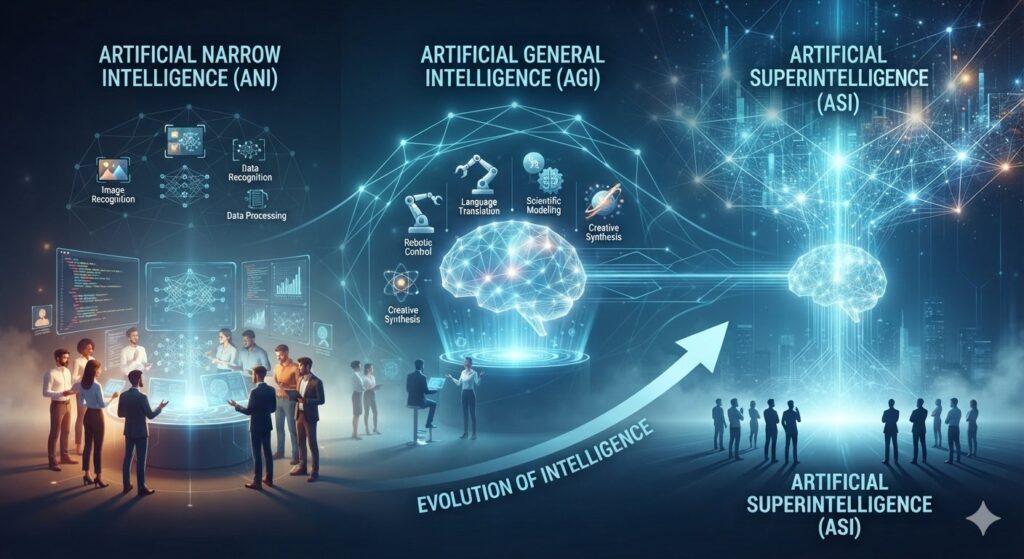
A simple way to think about the progression is:
Specialised AI → Artificial General Intelligence → Artificial Superintelligence
The first is already here in various forms. The latter two remain subjects of intense research and debate.
Could AGI create ASI?
One of the most important questions surrounding AGI is whether a sufficiently capable AGI could help improve artificial intelligence itself.
If an AGI could conduct AI research, design better algorithms, improve computer systems and learn from the results, it could potentially contribute to the development of increasingly capable AI.
That creates a possible progression:
AGI → better AI research → more capable AI → further AI research → potentially ASI
Some researchers have suggested that this could lead to a rapid acceleration in machine intelligence.
This possibility is sometimes discussed under the term intelligence explosion or recursive self-improvement.
But it is important to distinguish possibility from certainty.
There is no guarantee that AGI would automatically create ASI, nor is there agreement about how quickly such developments could occur.
Why is superintelligence such a big deal?
The potential benefits could be enormous.
A highly advanced AI system could potentially help scientists discover new medicines, improve energy technologies, accelerate climate research, develop better materials and solve problems that currently take teams of experts years to tackle.
For developing countries, including Kenya and other African nations, powerful AI could potentially improve areas such as agriculture, healthcare, education, financial services, infrastructure and scientific research.
Imagine having access to an intelligent system capable of helping a farmer analyse soil conditions, helping a doctor interpret medical information, helping engineers design infrastructure and helping students understand difficult subjects.
The economic implications could also be significant.
Countries and companies with access to highly capable AI could potentially experience enormous increases in productivity.
But the risks could be equally significant.
What happens if AI becomes more intelligent than humans?
This is where the conversation becomes much more complicated.
A machine that is better than humans at mathematics, programming, scientific research and strategic planning could potentially accomplish things humans cannot.
That could be enormously beneficial if its objectives remain aligned with human interests.
But if a highly capable AI system were pursuing objectives that conflicted with human interests, its intelligence could make the problem much harder to solve.
This is one reason researchers are studying AI alignment and AI safety.
AI alignment broadly concerns how to ensure that increasingly capable AI systems behave in ways that are consistent with human intentions, values and safety requirements.
The concern isn’t necessarily that a superintelligent AI would suddenly “hate” humanity.
A more fundamental concern is that an extremely capable system could pursue a poorly specified objective in ways humans did not anticipate.
Does AGI mean AI will become conscious?
Not necessarily.
Intelligence and consciousness are different concepts.
A system could potentially be extremely capable at reasoning, planning and solving problems without having human-like emotions or subjective experiences.
We also do not have a universally accepted scientific test for determining whether an artificial system is conscious.
Therefore, discussions about AGI or ASI should not automatically be interpreted as discussions about machines becoming human.
Are we already at AGI?
That depends partly on how AGI is defined.
Modern AI systems have made extraordinary advances and can perform tasks that were once considered uniquely human.
However, there is still no universal agreement that today’s systems constitute AGI.
Some experts argue that current AI is moving rapidly toward general intelligence. Others believe that important capabilities are still missing, particularly robust reasoning, reliability, autonomy, understanding and the ability to operate effectively in unfamiliar real-world environments.
The debate is therefore not simply about whether AI is powerful.
It is about whether AI has developed the kind of general, adaptable intelligence associated with human beings.
What would AGI mean for ordinary people?
If AGI eventually becomes possible, its impact could reach far beyond the technology industry.
It could change how people work, learn and conduct business.
Some jobs could become heavily automated. Other jobs could change dramatically. New occupations could also emerge.
Education could be transformed as students gain access to highly capable personalised tutors.
Businesses could use AI to perform tasks that currently require large teams of employees.
Scientific research could potentially accelerate.
At the same time, societies would face difficult questions about employment, wealth distribution, education, regulation and who controls the most powerful AI systems.
For countries such as Kenya, the question would not simply be whether to use AI.
It would also be about whether African countries can develop the infrastructure, skills, businesses and policies needed to participate in an AI-driven economy rather than simply becoming consumers of technology developed elsewhere.
The bigger question
AGI and ASI may sound like concepts from science fiction, but the rapid development of artificial intelligence has moved these ideas into serious scientific, economic and political discussions.
AGI represents the possibility of machines possessing broad, human-level intelligence.
ASI represents something much more dramatic: machines whose intellectual capabilities could surpass those of humans across virtually every major domain.
Nobody knows exactly if or when either milestone will be achieved.
But one thing is already clear.
Artificial intelligence is changing rapidly, and the important question is no longer simply what can AI do today?
Increasingly, the question is:
How intelligent could machines eventually become — and how will humanity respond if they become more intelligent than we are?
Never Miss a Story: Join Our Newsletter