The transatlantic slave trade stands as one of history’s most profound moral catastrophes—an epoch-defining enterprise that reshaped continents, destroyed countless lives, and left wounds that continue to resonate through modern societies. Between the 16th and 19th centuries, more than 12.5 million individuals were forcibly taken from Africa and transported across the Atlantic Ocean. This staggering figure represents not merely statistics but human beings—fathers, mothers, children, warriors, healers, and artisans—all reduced to commodities in a system of unprecedented brutality.
The tragedy of the slave trade was, as scholar Robin Blackburn described it, a “different species of slavery”. Unlike the artisan slavery of antiquity, which typically involved small numbers of slaves working on modest estates or as domestic servants, the transatlantic slave trade industrialized human bondage on an unprecedented scale. It created vast plantation systems in the Americas that fed Europe’s near-insatiable appetite for sugar, coffee, tobacco, and cotton—commodities that would fundamentally reshape global consumption patterns and economic structures.
This article delves deep into the historical menace of the slave trade, tracing its origins, examining its devastating impacts across three continents, analyzing the economic and political forces that sustained it, exploring the resistance that challenged it, and chronicling the long and complex struggle that ultimately led to its abolition. From the first Portuguese slaving expeditions in the 1440s to the final abolition of slavery in Brazil in 1888, this is a story of exploitation and resilience, greed and conscience, inhumanity and liberation.
The Origins and Mechanics of the Trade
The Genesis of the Atlantic Slave Trade
The transatlantic slave trade did not emerge from a vacuum. Slavery had existed in various forms across human civilizations for millennia, with slavery practices in Africa predating European contact by centuries. African societies had long utilized slave labor in agriculture, domestic service, and even as soldiers and administrators. However, the arrival of Portuguese explorers along the West African coast in the 15th century would fundamentally transform the nature and scale of human enslavement.
The year 1442 marks a pivotal moment in this tragic history. Two captains serving under Portugal’s Prince Henry the Navigator returned to Lisbon with twelve African slaves, an event now widely regarded as the beginning of the transatlantic slave trade. By the second half of the 15th century, Portuguese slavers had captured and transported an estimated 30,000 African slaves. These early ventures were relatively modest in scale, but they established patterns that would expand dramatically in the centuries to come.
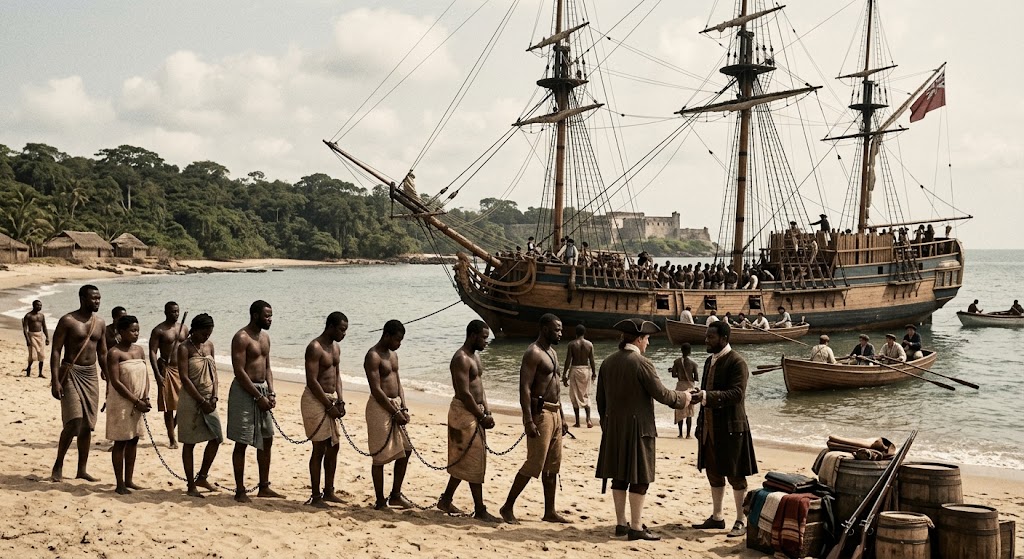
The Portuguese established trading posts along the African coast, forging relationships with local African leaders who would supply slaves in exchange for European goods—most notably firearms, textiles, and manufactured items. This exchange created a devastating logic: European firearms fueled African conflicts, which in turn produced prisoners of war who could be sold into slavery, generating wealth that purchased more firearms, perpetuating a cycle of violence and enslavement.
The Triangular Trade System
By the 16th century, a complex commercial system had emerged that historians would later term the “triangular trade.” This system connected three continents in a web of exchange that would define Atlantic commerce for nearly four centuries.
The first leg of the triangle began in Europe, where ships loaded with manufactured goods—textiles, metals, beads, and firearms—sailed for the West African coast. These goods were exchanged with African rulers and merchants for enslaved captives, who had often been taken in wars or raids in the African interior.
The second, and most infamous, leg was the Middle Passage: the horrific voyage across the Atlantic Ocean during which captive Africans were packed into ships’ holds under conditions of unimaginable squalor and brutality. More than 2 million individuals lost their lives during this crossing, victims of disease, starvation, suffocation, suicide, or violence at the hands of their captors. Those who survived arrived in the Americas as property, stripped of their names, languages, religions, families, and identities.
The third leg of the triangle carried slave-produced commodities—sugar, tobacco, cotton, rum, and coffee—back to European markets, where they generated enormous profits that financed further expansion of the entire system.
Two Major Routes
The transatlantic slave trade developed along two primary routes. The larger of the two operated south of the equator, dominated by Portugal and later independent Brazil. This route connected Brazil with Portugal’s African colonies of Mozambique and Angola. Through this southern corridor, nearly half of all slaves transported across the Atlantic—more than 5 million individuals—embarked for the Americas.
The second route operated north of the equator in the triangular pattern described above. This route involved multiple European powers—Britain, France, Spain, the Netherlands, and Denmark—and connected West African trading posts such as Elmina on the Gold Coast (modern Ghana) and Ouidah on the Slave Coast (modern Benin) with Caribbean and North American destinations.
The Scale of Human Trafficking
The magnitude of the transatlantic slave trade is almost incomprehensible. The Trans-Atlantic Slave Trade Database has documented that more than 12.5 million Africans were forcibly embarked for the Americas between the 16th and 19th centuries. Of these, approximately 10.7 million survived the Middle Passage and landed in the Americas.
These numbers varied dramatically across different periods. In the 16th century, while the slave trade was established, the numbers remained relatively modest. Brazilian records show that in 1549, African laborers were already working in Brazilian plantations, but fewer than 30,000 Africans entered the colony during the 16th century. Indigenous populations still provided substantial labor in many areas during this early period.
However, the 17th century witnessed a dramatic escalation. Beginning in 1595, Spain formally permitted African slaves as laborers in its American colonies. Between 1595 and 1640, Spanish America imported an average of 2,880 slaves annually; by the early 19th century, this figure had risen to more than 6,600 per year. By the 18th and 19th centuries, the pace of importation had accelerated still further, with Brazil alone receiving nearly 2 million African slaves during this period.
The cumulative impact was transformative. During the 16th and early 17th centuries, Africans came to constitute the majority of the population in most American colonies, building the infrastructures of the Western Hemisphere through their forced labor. It was only after the Industrial Revolution and the age of steam had transformed transportation that large-scale European migration began in the mid-19th century, allowing Europeans to displace Africans as the largest population group colonizing the New World.
The Horrors of the Middle Passage
The Middle Passage stands as perhaps the most brutal chapter in human history. Enslaved Africans were packed into ships’ holds with terrifying density, chained in positions that made movement nearly impossible. Conditions were designed for maximum profit, not human survival.
Captives faced constant threats: disease spread rapidly in the confined, unsanitary conditions; starvation was common as provisions ran low; dehydration claimed countless lives; and violence from crews was routine. Many enslaved individuals chose suicide over continued suffering, jumping overboard or refusing to eat. Those who resisted were subject to brutal punishment designed to break their will and intimidate others into compliance.
The mortality rates of the Middle Passage were staggering. Overall, approximately 15% of enslaved captives died during the Atlantic crossing, with rates sometimes exceeding 20 or 30 percent on particularly brutal voyages. These deaths were accepted as a cost of doing business, factored into the economic calculations of slave traders.
Economic Foundations and Global Impact
The Rise of Plantation Economies
The slave trade was intimately connected to the development of plantation agriculture in the Americas. As European colonial powers established colonies in the Caribbean, Brazil, and North America, they discovered that indigenous populations were either insufficient in number or unwilling to provide the labor required for large-scale agricultural production. African slavery provided a solution.
The emergence of plantation economies was most dramatic in the Caribbean and Brazil, where sugar cultivation became the engine of colonial wealth. Sugar was an extraordinarily labor-intensive crop that required extensive land, substantial capital investment in processing facilities, and a large, disciplined workforce. African slaves, forcibly transported from their homelands and stripped of their social support systems, provided ideal labor from the perspective of planters.
The scale of plantation agriculture was immense. In Brazil, African slaves worked vast sugar plantations in the northeastern regions of Bahia and Pernambuco. These plantations dominated the landscape and the economy, with enslaved laborers performing every task from planting and harvesting cane to processing it into sugar and rum. Similar systems emerged throughout the Caribbean and the American South.
The Economics of the Slave Trade
The economic significance of the slave trade has been the subject of intense scholarly debate. Some historians have argued that profits from the slave trade provided crucial capital for European industrialization. Others have contended that the trade’s economic benefits were substantially overrated, with only modest profits accruing to slave traders themselves.
The most significant beneficiaries of the slave trade, some economists argue, were consumers in Europe who gained access to slave-produced commodities—sugar, tobacco, coffee, and later cotton—at substantially lower prices than would have been possible without slave labor. As one study noted, European consumers were “given the chance to purchase dental decay and lung cancer at somewhat lower prices” through the slave trade. This framing, while sardonic, captures the moral calculus of an economic system that traded human suffering for marginal improvements in European living standards.
The slave trade also had profound economic effects on Africa. The introduction of firearms fueled internecine warfare and political instability, as African rulers competed to capture prisoners for sale to European traders. The drain of millions of productive individuals devastated communities, disrupted economies, and distorted political development across vast regions. While some African elites profited substantially from the trade, the overall impact on African societies was catastrophic.
The Transformation of the Americas
Demographic Transformation
The forced migration of millions of Africans transformed the demographic landscape of the Americas. In many regions, Africans and their descendants became the numerical majority. This was particularly true in the Caribbean sugar islands and in Brazil, where African populations dominated throughout the colonial period.
The indigenous populations of the Americas, devastated by disease and exploitation, were gradually supplemented and in many areas replaced by African laborers. The demographic shift was so profound that, by the time large-scale European migration began in the mid-19th century, African-descended populations had already established deep roots throughout the hemisphere.
The Enslaved Experience
The lives of enslaved people in the Americas varied dramatically depending on time, place, and the nature of their work. However, certain commonalities unite the enslaved experience across the hemisphere.
In the plantation economies, slaves worked grueling hours under brutal conditions. In the sugar fields of the Caribbean and Brazil, labor was particularly harsh, with slaves working 18 to 19 hours daily during harvest seasons. They were treated as “livestock,” subjected to physical punishment, and denied basic human dignity. Families were routinely separated through sale, with mothers and fathers forced to watch their children sold away to distant plantations.
Despite these horrors, enslaved people maintained their humanity through resistance, culture, and community. They preserved elements of African languages, religions, and traditions, creating syncretic cultures that blended African and European influences. They formed families and communities, maintained spiritual practices, and resisted their bondage in countless ways, from subtle acts of defiance to open rebellion.
The Long Road to Abolition
Seeds of Dissent
Abolition of the slave trade and slavery was neither inevitable nor quick. It required centuries of resistance, moral awakening, political maneuvering, and economic transformation.
The anti-slavery movement gained momentum during the Age of Revolution in the late 18th and early 19th centuries. The American Revolution and the French Revolution, with their declarations of human rights, inspired abolitionist thinking on both sides of the Atlantic. The French Declaration of the Rights of Man raised fundamental questions about the compatibility of slavery with claims of universal rights, and these ideas “were internalised throughout the Americas”.
Slave Resistance and Rebellion
Perhaps the most significant force driving abolition was resistance by enslaved people themselves. Slaves consistently refused to accept their condition, engaging in acts of resistance ranging from day-to-day defiance to organized rebellion.
The Haitian Revolution (1791-1804) stands as the most dramatic example. A successful slave revolt in the French colony of Saint-Domingue led to the establishment of the world’s first Black republic. The Haitian Revolution sent shockwaves through the slave-holding societies of the Americas, demonstrating that enslaved people could overthrow their oppressors.
Other revolts followed. In the United States, slave rebellions such as those led by Gabriel Prosser (1800), Denmark Vesey (1822), and Nat Turner (1831) struck fear into slaveholders while inspiring Black communities and white abolitionists. Each revolt, though suppressed, contributed to the growing conviction that the slave system was unsustainable.
The British Abolition Movement
Great Britain played a pivotal role in the abolition of the transatlantic slave trade, though this role was neither as straightforward nor as purely moral as some earlier histories suggested. In 1807, Britain—which by that time was the world’s largest slaving nation, transporting every second enslaved individual destined for the New World—outlawed the slave trade in its colonies.
The debate over why Britain moved from being the largest slaving nation to its abolition has occupied historians for generations. What became known as the “Williams vs. Drescher” debate pitted moral explanations against economic ones. Did British abolition result from rising humanitarian sentiment and the effectiveness of the abolitionist movement? Or did it reflect Britain’s changing economic interests—particularly the declining profitability of its slave colonies relative to its industrializing domestic economy?
More recently, historians have emphasized a third factor: the agency of enslaved people themselves. Through resistance, rebellion, and flight, slaves made slavery increasingly untenable in the Age of Revolution. The Haitian Revolution demonstrated that slave societies were vulnerable to violent overthrow, making continued slavery appear not just immoral but dangerously unstable.
British abolitionist efforts extended beyond the British Empire. The campaign led by Thomas F. Buxton advocated free trade and the colonization of the African interior with freed Christian slaves. Buxton’s efforts contributed to strengthening the British naval squadron patrolling the West African coast and to signing anti-slave-trade treaties with African states.
International Measures Against the Slave Trade
Following the British lead, other nations gradually took action against the slave trade. In 1839, the British Anti-Slavery Society was founded by Joseph Sturge, and Buxton established the African Civilization Society to promote abolition.
A series of international agreements sought to suppress the trade. In 1841, Britain, France, Austria, Prussia, and Russia agreed to extend rights of search and seizure to halt the slave trade, although France subsequently refused to ratify the treaty. The Webster-Ashburton Treaty of 1842 committed Britain and the United States to maintaining a joint naval force off the African coast to suppress the slave trade.
Britain pressed Spain and Brazil to end their slave trades through a series of treaties. Spain signed agreements to end the Cuban slave trade in 1817 and again in 1835, though enforcement was inconsistent. In 1842, Britain secured the right to search ships suspected of slaving. The 1845 Anglo-French treaty called for a combined anti-slave-trade squadron of twenty-six cruisers, though France did not adhere to its terms.
On the African coast and in the Indian Ocean, Britain negotiated numerous treaties with local rulers. In 1845, Oman restricted its slave trade to its Arabian and East African possessions, granting Britain rights of search and seizure. Tunisia abolished the slave trade in 1846, and the Ottoman Empire prohibited the Persian Gulf slave trade in 1847.
Other nations followed. Persia banned the maritime slave trade in 1848. France emancipated slaves in its colonies in 1848 and established Libreville in Gabon as a settlement for freed slaves in 1849.
The U.S. Struggle Against Slavery
The United States presents a complex case in the history of abolition. While the Constitution of 1787 protected slavery, the importation of slaves was banned in 1808 through legislation passed in 1807. However, the domestic slave trade continued, and slavery expanded dramatically in the southern states.
The American abolitionist movement gained momentum in the 19th century. In the 1830s, William Lloyd Garrison and others launched the American Anti-Slavery Society and published the Liberator, calling for immediate emancipation. The “Underground Railroad”—a network of safe houses and secret routes—helped thousands of enslaved people escape to freedom in the North and Canada, though this was of limited scale compared to the total enslaved population.
Harriet Beecher Stowe’s novel Uncle Tom’s Cabin (1852) galvanized public opinion against slavery in the North, presenting the horrors of slavery in vivid, emotionally accessible terms. John Brown’s 1859 raid on Harpers Ferry represented the radical edge of the abolitionist movement, with Brown hoping to spark a general slave uprising.
The Civil War (1861-1865) ultimately settled the slavery question in the United States. President Abraham Lincoln issued the Emancipation Proclamation in 1862, freeing slaves in rebel territory effective January 1, 1863. The Thirteenth Amendment, ratified in December 1865, formally abolished slavery throughout the United States.
The Final Abolitions
While Britain and the United States acted decisively in the 19th century, other nations continued to maintain slavery for decades.
Spain had little choice but to begin dismantling slavery in Cuba following the Ten Years’ War (1868-1878), a violent rebellion for independence in which abolition became a major issue designed to attract slaves to the revolutionary cause. The Cuban slave trade finally ended in 1867.
Brazil, which imported more enslaved Africans than any other nation in the Americas, held out longest. Under sustained domestic and international pressure, Brazil finally abolished slavery in 1888, without the cataclysmic violence that characterized abolition in the United States and Cuba, though through a process driven by political pressure rather than armed conflict.
A Comprehensive Chronology of Abolition
To fully appreciate the scale and complexity of abolition efforts, it is worth examining the chronology of measures against slavery and the slave trade that unfolded across the 19th century:
1807: Britain passes the Slave Trade Act, prohibiting British subjects from participating in the slave trade.
1808: The United States bans the importation of slaves.
1817: Spain signs a treaty with Britain agreeing to end the Cuban slave trade (though enforcement remains weak).
1833: Britain passes the Slavery Abolition Act, providing for gradual emancipation throughout its colonies.
1835: Spain again agrees to end the Cuban slave trade.
1839: The British Anti-Slavery Society is founded. Buxton establishes the African Civilization Society.
1841: Britain, France, Austria, Prussia, and Russia agree to extend rights of search and seizure to suppress the slave trade, though France refuses to ratify.
1842: The Webster-Ashburton Treaty commits Britain and the United States to joint naval suppression of the African slave trade.
1843: The legal status of slavery is abolished in India, though full emancipation would take time.
1845: An Anglo-French treaty calls for a joint anti-slave-trade squadron, though France does not adhere.
1845: Britain signs a treaty with Oman restricting the slave trade and securing rights of search and seizure.
1846: Tunisia abolishes the slave trade.
1847: The Ottoman Empire prohibits the Persian Gulf slave trade and closes public slave markets in Constantinople.
1848: Persia bans the maritime slave trade. France emancipates slaves in its colonies.
1849: France establishes Libreville as a settlement for freed slaves. Britain strengthens its consular presence in West Africa.
1850: Brazil begins to enforce its slave trade abolition.
1851: Britain deposes the ruler of Lagos for refusing to act against the slave trade and signs anti-slave-trade treaties with several West African states.
1854: Portugal decrees an end to slavery in its territories. Egypt bans public slave markets (though private trade continues).
1857: The Ottoman Empire prohibits the slave trade throughout its domains, though enforcement is lacking.
1862: The Treaty of Washington grants Britain rights of search and seizure against suspected slave ships.
1865: The Thirteenth Amendment abolishes slavery in the United States.
1867: Cuba ends its slave trade.
1873: Zanzibar bans public slave markets under British pressure.
1874: Britain abolishes slavery on the Gold Coast following its defeat of Asante.
1888: Brazil abolishes slavery, the last nation in the Americas to do so.
The Legacy of the Slave Trade
Demographic and Cultural Legacy
The transatlantic slave trade left an indelible mark on the Americas. Its legacy is visible in the faces, cultures, languages, and religions of populations from Nova Scotia to Tierra del Fuego. African-descended populations have contributed profoundly to the cultural heritage of the Americas, influencing music, cuisine, religion, literature, and political thought.
The demographic distribution of African-descended populations in the Americas remains a direct legacy of the slave trade. Brazil, with its huge Afro-Brazilian population, reflects the scale of Portuguese slave-trading to that region. The Caribbean, with its predominantly African-descended populations, bears witness to the sugar plantation system that made African slavery central to its economy.
Persistent Inequality
The economic and social inequalities that characterize many societies in the Americas have roots in the slave system. The concentration of wealth, land, and political power in white hands, and the systematic deprivation of opportunities for Black populations, cannot be understood without reference to centuries of slavery.
The legacy of slavery has been compounded by subsequent systems of racial discrimination, including Jim Crow segregation in the United States, apartheid in South Africa, and subtler forms of exclusion elsewhere. Slavery’s effects on wealth accumulation—who had access to education, property, and opportunity—have persisted across generations.
Contemporary Slavery
As Jean Allain reminds us, “Slavery did not start with the transatlantic slave trade, nor did it stop with its abolition”. Contemporary forms of slavery, including human trafficking, forced labor, debt bondage, and child labor, continue to afflict millions of people worldwide.
In 1772, a British judge declared that England was “a soil whose air is deemed too pure for slaves to breathe in it.” Yet in 2009, Britain found it necessary to legislate specifically to criminalize slavery, demonstrating that the abolition of legal slavery does not eliminate the practice. Modern slavery often operates without legal recognition, in the shadows of informal economies, and requires continued vigilance and legal action to combat.
Read Also: The Rwandan Genocide: A Descent into the Abyss and the Long Road to Rebirth
Conclusion: Remembering and Learning
The International Day for the Remembrance of the Slave Trade and its Abolition, established by UNESCO, aims to “inscribe the tragedy of the slave trade in the memory of peoples”. This memory serves multiple purposes: honoring the millions who suffered and died, acknowledging the legacy that persists, and reminding us of the capacity for cruelty that exists within human societies.
The abolition of the transatlantic slave trade and slavery was one of humanity’s greatest moral achievements, demonstrating that systems of oppression can be dismantled through sustained effort. Yet it came too late for millions, and its legacy remains visible today in racial inequalities, economic disparities, and cultural divisions.
Understanding the history of the slave trade requires recognizing the humanity of those who were enslaved—their resistance, their culture, their families, and their aspirations. It requires acknowledging the roles of African elites who facilitated the trade, European powers who profited from it, and American planters who built wealth upon it. It requires studying the economic, political, and social structures that enabled such systematic exploitation to develop and persist for centuries.
Most importantly, remembering the slave trade and its abolition demands that we remain vigilant against all forms of human trafficking and exploitation. The forces that drove the transatlantic slave trade—greed, consumer demand for cheap goods, racial prejudice, and indifference to the suffering of others—remain present in contemporary societies. Understanding how such a monstrous system could develop and persist is essential to ensuring that it is never repeated.
As we remember the millions of Africans who were transported across the Atlantic, the millions more who died in that process, and the generations who built the economies of the Americas through their forced labor, we also honor those who fought against slavery—enslaved people who resisted, abolitionists who campaigned, and ordinary citizens who came to recognize the immorality of the system. Their struggle demonstrates that social change is possible, that moral progress can occur, and that human dignity is worth fighting for.
Never Miss a Story: Join Our Newsletter