
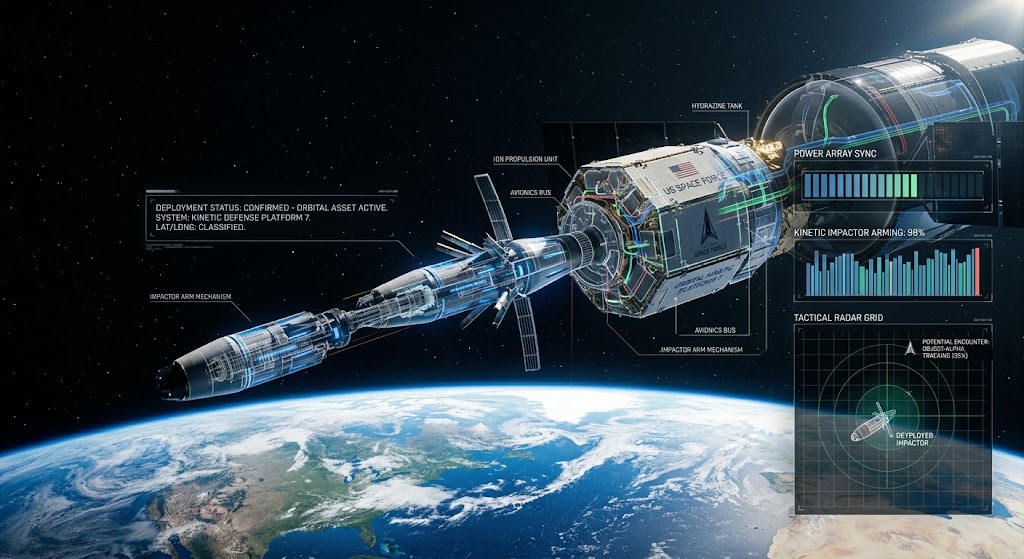
The United States has acknowledged that it has deployed weapons in orbit capable of defending its military forces against hostile action in space—a development that could mark a major turning point in the future of warfare.
The announcement, made by U.S. Air Force Secretary Troy Meink, did not reveal the weapons’ design, number, location or operational details. However, the Pentagon’s description of the systems as “on-orbit space control weapons” is significant.
It suggests that space is no longer being treated merely as a support environment for military operations on Earth. It is increasingly becoming a battlefield in its own right.
The implications extend far beyond the United States, Russia and China. As modern economies and national-security systems become more dependent on satellites, a conflict in space could eventually affect communications, navigation, weather forecasting, financial systems and civilian infrastructure across the world.
Read Also: The Great Silicon Divide: Inside the Fractured War for Artificial Intelligence
From satellite support to space control
For decades, satellites have played a critical role in modern warfare. They provide secure communications, intelligence, surveillance, navigation, missile warning and weather information.
A military operation that appears to take place on land, at sea or in the air may depend heavily on systems operating hundreds or thousands of kilometres above Earth.
The new U.S. announcement indicates a further step: the development of capabilities intended not merely to use space, but to control access to it and deny adversaries the ability to exploit it.
That distinction is strategically important.
A country that can protect its own satellites while disrupting an opponent’s could gain a decisive advantage before conventional forces even engage.
The battlefield of the future may therefore begin with a contest over who can see, communicate, navigate and coordinate most effectively.
The next war may begin with satellites
A major conflict between technologically advanced powers may not begin with tanks crossing a border or missiles striking cities.
It could begin with attempts to disrupt the systems that make modern military operations possible.
These could include jamming communications, interfering with satellite navigation, attacking ground stations, disabling reconnaissance systems or disrupting missile-warning networks.
The objective would be to create confusion and reduce an opponent’s ability to make accurate decisions.
A military may still possess aircraft, ships and missiles, but their effectiveness could be severely reduced if commanders cannot communicate with their forces or determine what is happening on the battlefield.
This creates a new strategic reality: a country could lose its ability to understand a war before it loses its ability to fight one.
Defensive weapons can also become offensive tools
Washington has described the orbital weapons as defensive, saying they are intended to protect U.S. forces against hostile action.
But in space, the distinction between defensive and offensive capabilities is not always clear.
A system capable of disabling an enemy satellite could be used to protect an American spacecraft. It could also be used to disrupt an adversary’s communications, intelligence gathering or military coordination.
The same technology could therefore serve both defensive and offensive purposes.
This is why the phrase “space control” deserves attention. It implies the ability to influence whether an adversary can freely use space-based systems during a conflict.
The announcement may be intended to deter potential attacks. However, it could also encourage rival powers to accelerate their own counter-space programmes.
Read Also: US Confirms Deployment of Orbital Space Weapons in Historical Shift
A new arms race above Earth
The United States is not entering an empty arena.
Russia and China have developed increasingly sophisticated space capabilities, including systems designed to interfere with, approach or potentially attack satellites.
The United States has previously raised concerns about Russian anti-satellite developments, while China has demonstrated growing capabilities in space operations and satellite technology.
The new American announcement could therefore intensify an already developing competition.
Washington may argue that orbital weapons are necessary to protect its forces and deter aggression. Beijing and Moscow may interpret the same development as evidence that the United States is preparing to dominate space.
That could create a familiar cycle:
One country develops a new capability for protection. Its rivals respond with countermeasures. The original country then expands its programme to address the new threat.
The result is an arms race in which each side claims to be responding defensively.
The danger of a “use it or lose it” conflict
Space warfare could also create dangerous incentives for pre-emptive action.
If a country believes an adversary is preparing to attack its military satellites, it may fear that waiting will leave its forces blind or disconnected.
That could encourage it to strike first.
The problem is made more complicated by the dual-use nature of many satellites. A spacecraft may support military operations while also providing civilian communications, navigation, weather information or commercial services.
An attack on such a system could therefore produce consequences far beyond the battlefield.
It might disrupt emergency communications, aviation, maritime navigation, financial timing systems or humanitarian operations.
A limited military action in space could quickly become an international crisis.
Space debris could turn victory into disaster
Physical attacks on satellites carry another danger: orbital debris.
Destroying a spacecraft can create thousands of fragments travelling at extremely high speeds. Those fragments may damage or destroy other satellites, including systems belonging to the attacking country.
A chain reaction of collisions could make certain orbital regions increasingly hazardous or unusable.
This is often associated with the Kessler syndrome, a scenario in which collisions generate more debris, leading to further collisions.
For that reason, future space warfare may increasingly involve non-destructive methods such as jamming, cyberattacks, spoofing and other forms of interference.
But non-destructive does not mean harmless.
A satellite that is rendered useless during a military operation may be just as strategically valuable as one that has been physically destroyed.
The rise of manoeuvrable and autonomous spacecraft
The traditional satellite follows a relatively predictable orbit and performs a defined mission.
Future military spacecraft may be designed to manoeuvre, inspect other satellites, avoid threats or interfere with an adversary’s systems.
This could create a new form of military competition in which the movement of spacecraft becomes strategically significant.
A country may no longer ask only where an enemy satellite is located. It may also ask why it is changing its orbit and whether it is approaching a sensitive asset.
Artificial intelligence could make these operations faster and more complex.
AI systems may help militaries analyse satellite movements, identify threats, coordinate constellations and respond to disruptions.
However, faster decision-making also creates risks. An automated system could misinterpret an ambiguous manoeuvre as hostile, potentially escalating a crisis before human commanders fully understand what has happened.
The Golden Dome connection
The orbital-weapons announcement comes as the United States advances its Golden Dome missile-defence initiative, which includes plans for space-based interceptors.
The Congressional Budget Office has estimated that some components of such a system could cost up to $542 billion over 20 years, illustrating the enormous scale of the proposed investment.
This suggests that Washington’s broader vision is not limited to placing a few weapons in orbit.
It involves an integrated architecture connecting satellite surveillance, missile warning, tracking, communications, interception and space control.
If developed successfully, such a system could strengthen U.S. defences. But it could also make space an even more important target for rival military powers.
What does this mean for Kenya and Africa?
For countries such as Kenya, the implications are not limited to military security.
Modern economies increasingly depend on space-based infrastructure, even when they do not own military satellites.
Satellite services support telecommunications, internet connectivity, aviation, maritime transport, weather forecasting, disaster response and national security.
A major disruption to satellite systems could therefore affect civilian life and economic activity far beyond the countries directly involved in a conflict.
Kenya’s growing digital economy and dependence on communications infrastructure make space security an increasingly relevant national issue.
African countries may need to pay greater attention to resilient communications, cybersecurity, backup navigation systems and international cooperation.
The question is no longer simply whether a country owns satellites.
It is whether it can continue operating when the systems above Earth become contested.
Read Also: Meet Panther: The Chinese Robot Designed to Cook, Clean and Make Beds
International law faces a difficult test
The 1967 Outer Space Treaty prohibits placing nuclear weapons and other weapons of mass destruction in orbit. However, it does not prohibit every form of conventional space weapon or anti-satellite activity.
That leaves important legal questions.
Would temporarily disabling a satellite be treated differently from physically destroying it? What happens when a commercial satellite is used for military purposes? How should countries respond to a cyberattack on a satellite network?
These questions are becoming more urgent as military technology advances.
The treaty framework was created before modern satellite constellations, autonomous spacecraft, commercial space networks and artificial intelligence existed.
Without clearer international rules, countries may increasingly rely on deterrence, secrecy and military signalling rather than shared agreements.
The future of warfare is becoming increasingly dependent on networks
The United States’ announcement does not mean that a space war is imminent.
It does, however, demonstrate that space is becoming an operational domain in which major powers intend to compete directly.
The future battlefield may not be defined only by the number of tanks, aircraft or missiles a country possesses.
It may also be defined by the resilience of the networks that make those weapons effective.
A military that cannot communicate, navigate or detect incoming threats may struggle to use even its most advanced conventional weapons.
That is why orbital weapons represent more than another category of military hardware.
They signal a future in which control of information, communication and coordination may become as important as control of territory.
The next major military competition may be fought not only on land, at sea and in the air, but also in the invisible infrastructure above Earth.
And for the rest of the world, including Africa, the challenge will be ensuring that a conflict among space powers does not become a crisis for everyone who depends on the systems they control.
Never Miss a Story: Join Our Newsletter