The Man Who Became a Metaphor for Evil
Adolf Hitler is not merely a historical figure; he is a universal symbol of absolute evil, a dark archetype against which all subsequent tyranny is measured. His name conjures images of swastikas, goose-stepping soldiers, concentration camps, and the systematic industrialization of murder. Yet, to understand Hitler is not to excuse him, but to confront the uncomfortable truth that he was not a supernatural demon who descended upon Germany from another realm. He was a human being—deeply flawed, consumed by pathological hatreds, and shaped by the historical currents of his time. His rise and fall represent the most catastrophic failure of modern civilization: the collapse of a democratic republic into genocidal dictatorship, and the unleashing of a world war that claimed upwards of 70 million lives.
This article seeks to provide a comprehensive examination of Hitler’s life, ideology, and legacy. It explores his obscure origins, the psychological wounds that forged his worldview, the political maneuvering that brought him to power, the mechanisms of control he established, the horrific implementation of his racial policies, his fatal military blunders, and the enduring, dangerous resonance of his ideas in the contemporary world. Hitler’s story is a cautionary tale of how fear, resentment, and charismatic leadership can dismantle the guardrails of civilization.
Part I: The Formative Years – Obscurity and Resentment (1889–1913)
Childhood and Family Dynamics
Adolf Hitler was born on April 20, 1889, at 6:30 PM in the Gasthof zum Pommer, a small inn in Braunau am Inn, a town on the border between Austria and Germany. He was the fourth child of Alois Hitler and Klara Pölzl, though three of his siblings had died in infancy. This pattern of infant mortality was common in the era, but it left Klara, a doting and protective mother, deeply anxious about young Adolf’s health. Alois, by contrast, was a stern, domineering, and emotionally distant figure. A customs official who had risen from humble peasant origins through sheer ambition, Alois demanded absolute obedience and frequently subjected his son to harsh beatings. Hitler later recalled that his father’s brutality taught him to be “hard” and unyielding—traits that would define his leadership style.
Alois’s sudden death in 1903, when Hitler was 13, was a turning point. The boy, who had been a mediocre student and openly rebellious, was freed from his father’s oppressive authority. Klara, now a widow, indulged her son’s whims, allowing him to drop out of school at age 16 and refuse any form of steady employment. Hitler developed an inflated sense of his own genius, particularly his talent as an artist, and convinced himself that he was destined for greatness—a conviction that masked a deep insecurity and fear of failure.
The Vienna Years: The Crucible of Hatred
In 1907, Hitler moved to Vienna to apply to the Academy of Fine Arts. His dream was to become a professional painter, but the academy rejected his application twice, citing his lack of aptitude for figure drawing and his over-reliance on architectural subjects. This rejection was a catastrophic blow to his fragile ego. He would later describe it as the greatest humiliation of his life, one he could never forgive.
Penniless and increasingly despondent, Hitler drifted into a life of poverty. He spent years—from 1909 to 1913—living in men’s hostels and flophouses, selling small watercolor paintings of Vienna’s landmarks to Jewish art dealers just to survive. It was in these squalid conditions that Hitler’s worldview hardened into a poisonous, paranoid ideology. Vienna was then a cosmopolitan capital of the Austro-Hungarian Empire, a city teeming with ethnic diversity, intellectual ferment, and social tension. Hitler was particularly influenced by the populist anti-Semitism of Mayor Karl Lueger, who successfully mobilized working-class resentment against Jewish financiers and liberal intellectuals. He also devoured the racist pseudoscience of the era, including the writings of Arthur de Gobineau and Houston Stewart Chamberlain, who argued for the innate superiority of the “Aryan” race.
Crucially, Hitler developed the belief that Jews were not merely a religious group but a distinct and malevolent race engaged in a global conspiracy to destroy “Aryan” civilization. He saw them as the puppet masters behind both capitalism and communism, a dual threat that required a total and final solution. This hatred was not born of personal experience—he had no direct, traumatic encounters with Jews—but was an intellectual and emotional construct he adopted to explain his own failures and the chaotic state of the world. By the time he left Vienna in 1913 to escape conscription into the Austrian army, he had become a hardened anti-Semite, a German nationalist, and a bitter enemy of democratic liberalism.
Part II: The Great War and Political Awakening (1914–1924)
Baptism by Fire: World War I
When World War I erupted in August 1914, Hitler was living in Munich, having fled Vienna to avoid military service. He immediately volunteered for the Bavarian army, seeing the war as a glorious opportunity to prove his courage and escape his aimless civilian life. He served as a regimental runner on the Western Front, a dangerous job that involved carrying messages between command posts through heavy artillery and machine-gun fire. He was twice decorated for bravery, receiving the Iron Cross, Second Class in 1914 and the Iron Cross, First Class in 1918—a rare distinction for a non-officer. Yet despite his courage, he was never promoted beyond corporal, as his superiors considered him lacking in leadership qualities and too eccentric for command.
The war profoundly shaped Hitler’s identity. It was the first time in his life he had felt a genuine sense of belonging and purpose. The camaraderie of the trenches, the shared suffering, and the stark division between the soldiers at the front and the “shirkers” at home all reinforced his nationalist fervor. The armistice of November 1918, which brought Germany’s surrender, was a psychological earthquake. Hitler was temporarily blinded by a mustard gas attack in October, and he was recovering in a field hospital when news of the armistice reached him. Like many soldiers, he wept with rage and despair. He refused to accept that the German army had been defeated on the battlefield. Instead, he embraced the “stab-in-the-back” myth—the notion that the army had been betrayed by Jewish and socialist politicians at home who had stabbed the soldiers in the back. This conspiracy theory would become the cornerstone of Nazi propaganda.
The Birth of the Nazi Party
Returning to Munich, Hitler remained in the army as a political informant, tasked with monitoring radical political groups. In September 1919, he was sent to investigate a small, far-right organization called the German Workers’ Party (DAP). During a meeting, Hitler was so impressed by the party’s nationalist and anti-Semitic platform that he decided to join. He quickly discovered that he had an extraordinary talent for public speaking—a gift that would become his primary weapon.
Hitler’s speeches were not intellectual arguments; they were emotional performances. He spoke in a raw, guttural voice, modulating his tone from a whisper to a scream, whipping his audiences into a frenzy. He offered simple, absolute answers to complex problems: the Jews were the cause of all evil, the Treaty of Versailles was a crime against the German people, and only a strong Führer could restore the nation to greatness. His charisma drew increasing crowds, and by 1920, he had transformed the tiny DAP into the National Socialist German Workers’ Party (NSDAP)—the Nazi Party.
In July 1921, Hitler consolidated his leadership by threatening to resign unless he was granted dictatorial powers over the party. His gambit succeeded, and he was declared the Führer of the Nazi Party, with absolute authority over its decisions and direction. To enforce his will, he established the Sturmabteilung (SA), a paramilitary organization of brown-shirted thugs who disrupted political meetings, attacked communists, and created an atmosphere of street violence.
The Beer Hall Putsch and Mein Kampf
Emboldened by the chaos of hyperinflation and political instability in 1923, Hitler decided to emulate Mussolini’s March on Rome. On November 8, 1923, he and his SA stormed a beer hall in Munich where Bavarian officials were holding a meeting. He fired a pistol into the ceiling, declared a national revolution, and forced the officials to pledge support at gunpoint. The next day, he led a march of 3,000 supporters through Munich, intending to seize the city. But the police and army were waiting. A volley of shots rang out, and 16 Nazis and 3 policemen fell dead. Hitler escaped but was arrested two days later.
His trial became a propaganda bonanza. Hitler used the courtroom as a stage, attacking the Weimar Republic and proclaiming his love for Germany. The trial garnered national and international attention, and Hitler emerged as a martyr for the nationalist cause. He was sentenced to five years in prison but served only nine months in relative comfort in Landsberg Castle. It was during this time that he dictated the first volume of Mein Kampf (“My Struggle”) to his loyal deputy, Rudolf Hess.
Mein Kampf is a sprawling, turgid, and hate-filled manifesto that lays out Hitler’s ideological program in brutally clear terms. He argued for the racial superiority of the “Aryan” master race, condemned Jews as “parasites” whose elimination was necessary for human survival, and proposed a policy of Lebensraum (“living space”)—the conquest of Eastern Europe and the Soviet Union to provide territory for German settlers. The book sold poorly at first, but it would later become the bible of the Nazi movement. It contains, in plain view, the blueprint for the Holocaust and the war, though many contemporaries dismissed it as the ravings of a failed revolutionary.
Part III: The Rise to Power (1924–1933)
The Strategy of Legality
The failed putsch taught Hitler a critical lesson: he could not overthrow the German state by force. Instead, he would have to destroy it from within, using the very mechanisms of democracy to dismantle it. This strategy of “legality” would be the foundation of his political approach for the next decade. He would exploit the weaknesses of the Weimar Republic—its fragile coalition governments, its proportional representation system, and its lack of popular legitimacy—to maneuver the Nazis into power.
Throughout the mid-1920s, the Nazi Party remained a fringe movement. In the 1928 federal elections, it won only 2.6% of the vote, a humiliating result. But the Great Depression, which began with the Wall Street Crash of 1929, transformed Germany’s political landscape. The collapse of the German economy was catastrophic: industrial production fell by 40%, unemployment soared to over 6 million, and the government’s austerity policies led to widespread hunger and despair. The democratic parties were blamed for the crisis, and the Communists and Nazis both made massive electoral gains.
In the July 1932 elections, the Nazis won 37.4% of the vote, becoming the largest party in the Reichstag (parliament). However, they still lacked an absolute majority, and Hitler refused to join any coalition unless he was made Chancellor. President Paul von Hindenburg, a conservative war hero, despised Hitler, dismissing him as a “Bohemian corporal” and a demagogue. But the political deadlock was paralyzing; chancellors came and went, none able to form stable governments.
The Appointment
A series of backroom intrigues finally brought Hitler to power. Franz von Papen, a conservative politician, believed he could use Hitler as a puppet, controlling him while the Nazis provided the mass support that the traditional right lacked. Hindenburg was reluctantly persuaded, and on January 30, 1933, he appointed Adolf Hitler as Chancellor of Germany. It was a legal, constitutional transfer of power. There was no coup, no revolution, no foreign invasion. A nation of poets, philosophers, and scientists had handed its destiny to a demagogue.
The moment was captured in photographs: Hitler standing at a window in the Chancellery, waving to the torchlit columns of his SA supporters marching through the Brandenburg Gate. A young Joseph Goebbels, the party’s propaganda chief, wrote in his diary: “It was like a dream. We were all drunk with the great event.” A few days later, Goebbels would write: “Now we have power. The whole Reich is ours. We have to finish it.”
Part IV: Dictatorship and Gleichschaltung (1933–1939)
The Enabling Act and the End of Democracy
Hitler moved with breathtaking speed to consolidate his power. On February 27, 1933, the Reichstag building burned down in a mysterious fire. The Nazis immediately blamed the Communists, and Hitler used the arson as a pretext to suspend civil liberties. The Reichstag Fire Decree, signed by Hindenburg, allowed the regime to arrest political opponents, ban newspapers, and conduct searches without warrants. Thousands of communists, social democrats, and trade unionists were rounded up and sent to the first concentration camps.
In March 1933, Hitler called for new elections in which he demanded an “Enabling Act”—a constitutional amendment that would grant his cabinet the power to pass laws without parliamentary approval. To ensure its passage, the SA and SS surrounded the Reichstag building, intimidating opponents. The Communists were already banned, but Hitler needed the support of the Center Party, a Catholic party, which he secured by promising to protect the rights of the Church (a promise he would later break). The Enabling Act passed with 444 votes to 94. It was the legal instrument that ended German democracy. All other political parties were soon dissolved, and on July 14, 1933, the Nazi Party was declared the only legal party in Germany.
The Night of the Long Knives
Hitler’s consolidation of power was not complete. The SA, led by Ernst Röhm, was a revolutionary paramilitary force that threatened the discipline of the regular army and Hitler’s own authority. Röhm spoke openly about a “second revolution” that would redistribute wealth and purge the conservative elites. The army leadership demanded that Hitler rein in the SA, and Hitler saw an opportunity to secure their loyalty.
On the “Night of the Long Knives” (June 30 – July 1, 1934), Hitler personally led a purge of the SA leadership. Röhm and hundreds of his followers were arrested and summarily executed. Also killed were conservative critics, including the former Chancellor Kurt von Schleicher. The violence was brutal, but it was sanctioned by the cabinet after the fact. The army swore an oath of personal loyalty to Hitler, not to the state or the constitution. When Hindenburg died in August 1934, Hitler combined the offices of President and Chancellor, declaring himself the Führer and absolute dictator of Germany.
The Machinery of Control: Propaganda, Terror, and Volksgemeinschaft
Hitler’s dictatorship rested on three pillars: propaganda, terror, and the promise of a unified national community—the Volksgemeinschaft.
Joseph Goebbels, Minister of Propaganda, orchestrated a relentless campaign of indoctrination. Radio, film, newspapers, and mass rallies were all harnessed to glorify Hitler and the Nazi Party. Hitler was portrayed as the savior of the nation, the Führer whose will was the ultimate law. The annual Nuremberg rallies, captured in Leni Riefenstahl’s film Triumph of the Will, were carefully staged spectacles designed to overwhelm participants with a sense of awe and collective belonging.
Terror was administered by Heinrich Himmler’s SS and the Gestapo (secret state police). The regime created a vast network of informants, and ordinary Germans were encouraged to report “anti-social” behavior or political dissent. The concentration camps, which housed political prisoners, were brutal places of torture and death. The legal system was perverted; the regime established “Special Courts” and the “People’s Court” to bypass regular judicial procedures and impose draconian sentences on opponents.
The Volksgemeinschaft was a powerful vision of racial unity. Hitler promised to heal the divisions of class, religion, and region by creating a pure, “Aryan” national community. This was an inclusive promise for “good” Germans, but it had an exclusive, destructive flip side: those who did not belong—Jews, Roma, homosexuals, the disabled, Jehovah’s Witnesses, and political opponents—were systematically marginalized, stripped of their rights, and ultimately targeted for extermination.
Foreign Policy Successes and the Road to War
Hitler’s domestic consolidation was matched by aggressive foreign policy maneuvers designed to overturn the Treaty of Versailles and expand German living space. His strategy was to test the resolve of the international community with a series of increasingly bold provocations.
- 1935: He openly reintroduced conscription and began building a massive army, in direct violation of Versailles.
- 1936: He ordered German troops to march into the Rhineland, a demilitarized zone that was a buffer between Germany and France. The French and British did nothing to stop him.
- 1938: He forced the Anschluss, the annexation of Austria, into the German Reich. Later that year, he demanded the Sudetenland, a German-speaking region of Czechoslovakia. British Prime Minister Neville Chamberlain, pursuing a policy of appeasement, agreed to Hitler’s demands in the Munich Agreement, believing he had secured “peace for our time.” Hitler was privately contemptuous of Chamberlain’s weakness.
- March 1939: He broke his promise and took the rest of Czechoslovakia. On September 1, 1939, Germany invaded Poland, and Britain and France declared war. The Second World War had begun.
Hitler’s foreign policy successes were not the result of luck but of a calculated willingness to gamble and a profound understanding of his opponents’ reluctance to fight. Each victory emboldened him, confirming his belief in his own infallibility. The lesson he drew was that the Western democracies were weak, decadent, and unfit to stand in the way of Germany’s destiny.
Part V: The War and the Holocaust (1939–1945)
Blitzkrieg and the Conquest of Europe
In the early years of the war, Hitler’s military genius (and the brilliance of his generals) seemed to validate his self-image as a strategic mastermind. The Blitzkrieg (“lightning war”) tactics—combining rapid armored advances with close air support—overwhelmed Poland in weeks. In May 1940, Germany launched a stunning offensive through the Ardennes forest, bypassing the supposedly impregnable Maginot Line and trapping the British and French armies in Belgium. The Netherlands, Belgium, and France fell in just six weeks. Hitler danced a jig when he heard news of the French surrender.
However, his strategic decision-making soon revealed fatal flaws.
- The Miracle at Dunkirk: Hitler inexplicably ordered a halt to his advancing Panzer divisions, allowing the British Expeditionary Force to evacuate from the beaches of Dunkirk. This decision, likely driven by a desire to keep the army out of the marshy, canal-crossed terrain and Hermann Göring’s assurances that the Luftwaffe could finish the job, saved Britain’s army and deprived Germany of a decisive victory.
- The Battle of Britain: Turning his attention to the isolation of Britain, Hitler launched a massive aerial offensive. But he changed the target from the radar stations and airfields to London in an act of retaliation for a British bombing raid on Berlin. This allowed the RAF to recover and win the battle, forcing Hitler to postpone Operation Sea Lion, the invasion of Britain.
Operation Barbarossa: The Fatal Gambit
Despite the failure to subdue Britain, Hitler turned east. In June 1941, he launched Operation Barbarossa, the invasion of the Soviet Union—the war of racial annihilation he had always planned. He saw the Soviet Union as a vast, undeveloped territory ripe for exploitation, its Slavic population as subhuman Untermenschen (“subhumans”) to be enslaved or exterminated to make way for German settlers.
The invasion was initially successful; the German army smashed into the Soviet Union, encircling and destroying entire Soviet armies. But Hitler’s interference in military operations, his refusal to allow strategic retreats, and his underestimation of Soviet resilience were disastrous. The winter of 1941/42, the vast distances, and the Soviet ability to mobilize millions of troops turned the tide. The defeat at the gates of Moscow and the devastating loss of the Sixth Army at Stalingrad in early 1943 broke the back of the German Wehrmacht.
The Holocaust: Industrialized Murder
Even as the war turned against Germany, Hitler’s commitment to the “Final Solution of the Jewish Question” remained absolute. The Holocaust was not a consequence of the war; it was the war’s ideological core. The mass murder of Jews, Roma, and other “undesirables” was pursued with bureaucratic efficiency and fanatical intensity, often diverting vital military resources to the task of killing civilians.
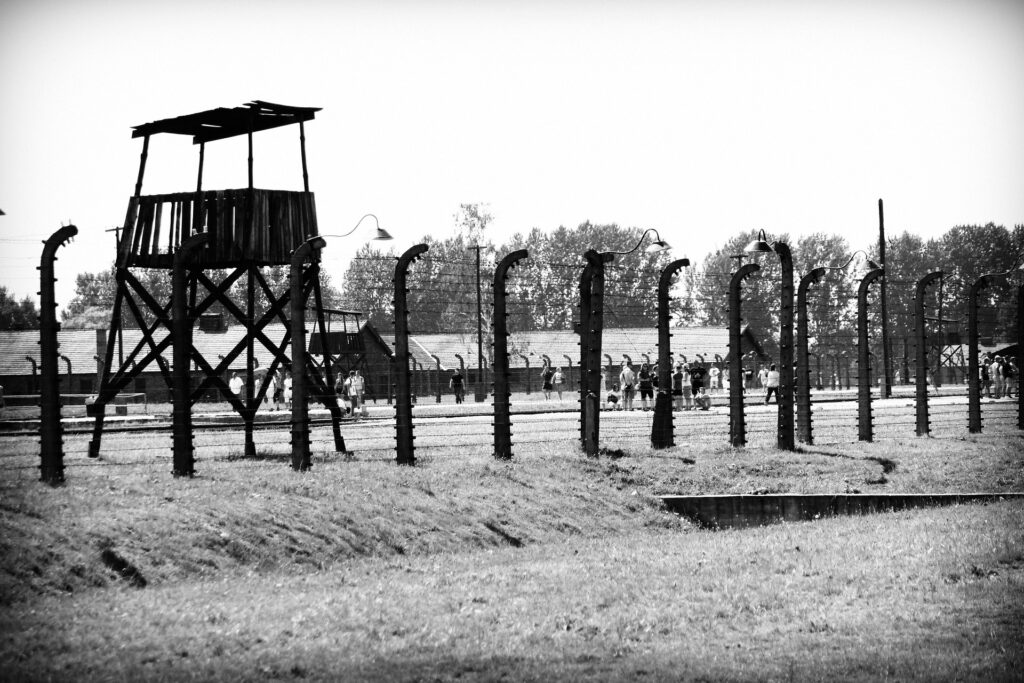
The systematic extermination was carried out in six extermination camps: Auschwitz-Birkenau, Chelmno, Belzec, Sobibor, Treblinka, and Majdanek. Jews from across Nazi-occupied Europe were transported in cattle cars, stripped of their possessions, separated from their families, and gassed in chambers disguised as showers. The bodies were burned in crematoria, and the ashes were buried or scattered. By the end of the war, approximately six million Jews had been murdered, along with millions of others—Poles, Soviet prisoners of war, disabled individuals, homosexuals, and political dissidents.
Hitler himself rarely spoke publicly about the Holocaust, but his inner circle knew his will. In a speech to his Gauleiter (regional leaders) in October 1943, he declared: “We have the duty to carry out the extermination of the Jewish people… If the German people have sacrificed 10,000 of their best men, then the Jew must pay for it with his existence.” This was the logical culmination of his lifelong obsession, the translation of Mein Kampf‘s fantasies into industrial reality.
The Twilight of the Gods: Military Defeats
From 1943 onward, Hitler’s grip on reality became increasingly tenuous. He retreated to his “Wolf’s Lair” headquarters in East Prussia, where he micromanaged military operations from a distance, refusing to accept the advice of his generals. His “no retreat” orders cost Germany hundreds of thousands of lives. The D-Day landings in June 1944 opened a second front in the West, and the failed assassination attempt by Colonel Claus von Stauffenberg in July 1944 (the July 20 Plot) only deepened his paranoia.
By early 1945, the Soviet Red Army was closing in on Berlin from the east, and the Allies were advancing from the west. Hitler decided to remain in Berlin, staging a final stand that would destroy the city rather than surrender it. He retreated to the Führerbunker, a subterranean complex of concrete rooms beneath the Reich Chancellery, while above ground the city was being reduced to rubble by artillery and aerial bombardment.
Part VI: The End and Its Aftermath (1945–Present)
Suicide and the Bunker Drama
In the final days of April 1945, Hitler’s behavior oscillated between manic hope and despair. He clung to the fantasy that the German army could launch a successful counterattack, and he fired officers who contradicted him. But the walls were closing in. On April 28, he learned that Himmler had tried to negotiate a surrender with the Allies, which he regarded as the ultimate betrayal.
On April 29, 1945, at 1:00 AM, Hitler married his longtime companion, Eva Braun, in a brief civil ceremony in the bunker. He then dictated his last will and testament, a rambling document in which he blamed the Jewish people for the war and exhorted future Germans to continue the fight. He evinced no remorse for the devastation he had caused, writing that “I die with a joyful heart in the knowledge of the incomparable deeds of our soldiers.”
On April 30, 1945, at approximately 3:30 PM, Hitler bit into a cyanide capsule and simultaneously shot himself in the temple. Eva Braun also swallowed poison. Their bodies were taken to a bomb crater in the garden of the Reich Chancellery, doused with gasoline, and set ablaze. Soviet forces found the remains days later, and a fragment of Hitler’s jawbone was used to positively identify his death.
The Legacy of Hitler: A Living Warning
The immediate response to Hitler’s death was one of profound relief across the Allied world. But his legacy of destruction did not end with him. The division of Germany and the onset of the Cold War were direct consequences of his war, and the scars of the Holocaust are still etched into the conscience of humanity.
Hitler’s impact on the 20th century is almost impossible to quantify. He transformed a democratic nation into a genocidal dictatorship, launched the deadliest war in history, and presided over the most systematic mass murder ever committed. As historian Sir Ian Kershaw wrote, “Never in history has such ruination – physical and moral – been associated with the name of one man.”
Yet the most troubling aspect of Hitler’s legacy is the persistence of his ideology. Neo-Nazism, white supremacism, and far-right extremism continue to draw inspiration from his writings. The global rise of authoritarian leaders, the manipulation of nationalist resentment, and the targeting of minorities for political gain are echoes of the strategies Hitler used to gain power. His life is not merely a historical artifact but a living warning.
Lessons from the Abyss
To study Hitler is to confront uncomfortable questions. How could a nation as cultured and educated as Germany produce such a monster and follow him into the abyss? The answer lies not in German exceptionalism—the German people were not uniquely evil—but in the fragility of democratic institutions and the susceptibility of populations to fear, propaganda, and charismatic authority. Hitler’s rise was made possible by the failures of democracy, the economic desperation of the Great Depression, and the willingness of traditional elites to make a deal with the devil.
The lesson is urgent: democracy requires constant vigilance. It requires robust institutions, a free press, independent courts, and an educated citizenry willing to challenge demagogues. When these guardrails are weakened, when scapegoating replaces reasoned debate, and when hatred is normalized, the conditions for tyranny are born. Hitler’s Germany is not an aberration; it is a warning.
Conclusion: The Eternal Warning
Adolf Hitler died a lonely, broken man in a concrete bunker, having left a continent in ruins and a people in shame. His “Thousand-Year Reich” lasted just twelve years, a fleeting moment of terror that has cast a shadow over the remainder of the century and beyond. His name is a synonym for the worst excesses of human cruelty, a benchmark against which all dictatorships are measured.
But Hitler’s story is not just a story of evil. It is a story of how evil is built—slowly, incrementally, through words that become actions, through policies that become atrocities, through the complicity of ordinary people who looked away. It is a reminder that the forces of hatred, nationalism, and authoritarianism do not die with their leaders; they mutate and find new forms.
To remember Hitler is to keep the memory of his victims alive—the six million Jews, the millions of others who perished, and the generations scarred by the war. It is to ensure that “never again” is not just a slogan but a solemn commitment. As the philosopher George Santayana famously wrote, “Those who cannot remember the past are condemned to repeat it.” The life and death of Adolf Hitler are the darkest pages of that past, and they demand our unflinching attention.
Never Miss a Story: Join Our Newsletter