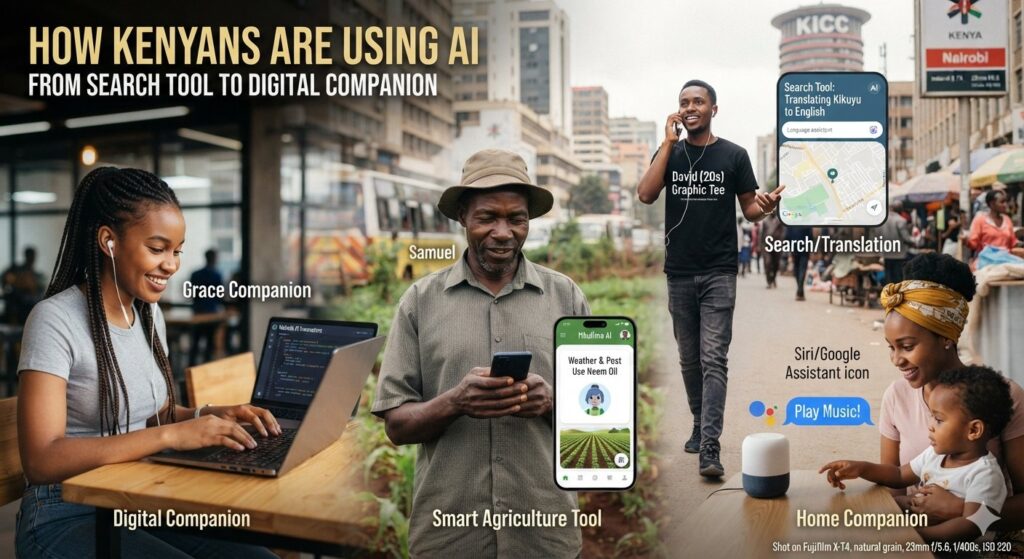
Artificial intelligence is rapidly becoming part of everyday life in Kenya, but Kenyans are not using it only to search for information or write documents.
They are asking AI for career advice, business ideas, emotional support, relationship guidance and help with their daily work. Some are even beginning to treat AI as a companion.
That is among the key insights emerging from new research by Nendo, a Kenyan digital research and strategy company led by Mark Kaigwa.
The findings offer a glimpse into how artificial intelligence is actually being used by Kenyans—and they suggest that the country’s relationship with AI is becoming much more personal.
ChatGPT leads, but Kenyans are using several AI platforms
According to Kaigwa, ChatGPT remains the leading AI platform among the Kenyans surveyed.
But it is not alone.
Meta AI emerged as another major platform, helped largely by its integration into WhatsApp, Facebook and Instagram. Gemini also has significant reach, particularly because of the dominance of Android smartphones in Kenya.
Other platforms being used include Grok, Microsoft Copilot, Claude and DeepSeek.
Grok, in particular, has gained attention among Kenyans who use X, formerly Twitter. Some users have turned to Grok to fact-check statements by politicians and government officials or to participate in ongoing public debates.
The findings therefore do not necessarily identify one platform as “the best AI.”
Instead, they show which AI tools Kenyans are actually choosing to use and what they are doing with them.
The research covered 18 Kenyan counties
Kaigwa explained that the research was not designed to represent every Kenyan.
Instead, Nendo worked with a research partner to speak to people who were already online, had smartphones and, importantly, were already using AI.
The research covered 18 counties, including Nairobi, Kiambu, Nakuru, Uasin Gishu, Turkana and Marsabit.
Participants were aged between 18 and 55.
This distinction is important because previous international research has produced seemingly contradictory findings about Kenya’s AI adoption.
In 2025, one widely circulated survey suggested that Kenya had exceptionally high ChatGPT usage. But research by Pew Research Center painted a very different picture, finding that many Kenyans had little or no familiarity with artificial intelligence.
Kaigwa’s research therefore focused on a different question: among Kenyans who are already using AI, what are they actually using it for?
The answers are revealing.
Research remains the biggest use of AI
The most common use was still relatively familiar.
About 77 percent of respondents said they use AI for research and gathering information.
In that sense, AI is replacing some of what people previously did with Google.
Instead of opening multiple browser tabs and going through numerous links, users can ask an AI chatbot a question and receive a consolidated response.
But that is where the similarity with traditional search begins to end.
Kenyans are increasingly asking AI to do things that they would previously have discussed with another person.
Kenyans are turning to AI for career advice
Career guidance emerged as one of the most important uses of AI, particularly among younger users.
People are asking AI to help them write job applications, prepare cover letters, improve their CVs and identify skills they should develop.
Others are using AI as a personal career adviser.
The appeal is obvious. Unlike a human career adviser who may only know a small part of someone’s background, an AI system can be given information about a person’s education, experience, ambitions and previous conversations.
The more information users provide, the more personalized the interaction can become.
For young Kenyans navigating an increasingly competitive job market, this makes AI an easily accessible source of career assistance.
AI is becoming an emotional companion
Perhaps the most striking finding is that Kenyans are not using AI only for practical tasks.
They are also using it for emotional support.
According to the research, 72 percent of women and 68 percent of men surveyed said they had turned to AI for emotional support.
Users are discussing romantic relationships, personal problems and other private issues with AI.
This represents a significant shift.
Google was traditionally a place where someone went to find information. AI can become a place where someone goes to have a conversation.
For some users, that conversation can become surprisingly personal.
Kaigwa described a growing phenomenon in which people privately consider AI a friend or companion—a place where they can “exhale and unload” without necessarily having the same interaction with another human being.
Voice interaction could accelerate this trend.
Instead of typing questions, users can speak to AI and receive spoken responses. Some systems can increasingly communicate in Swahili and other African languages, including switching between languages during conversations.
That makes the technology feel less like a machine and more like a conversational partner.
But AI does not always understand Kenyan culture
There is a major limitation.
AI may know a great deal, but it does not always understand Kenya.
About 25.1 percent of respondents said they had received AI advice that felt wrong for Kenyan culture or values.
One example involved a Kenyan woman planning a traditional Kalenjin koito ceremony.
She used AI to help with the budget, invitations, messaging and other preparations. But when she asked for assistance with the food menu, the system suggested foods such as pizza and rice rather than reflecting the traditional foods associated with the ceremony.
The problem was not necessarily that the AI was malfunctioning.
It was that the data on which many AI systems are trained contains vastly more information about globally dominant cultures and foods than about many African traditions.
A similar problem can arise with location.
Someone living in Kenya may receive advice to “take a walk along the beach,” despite living far from the coast.
These seemingly small mistakes expose a much bigger issue: AI still has significant gaps when it comes to African context.
Africa remains an AI blind spot
Kaigwa argues that Africa needs to move beyond simply consuming AI technologies developed elsewhere.
Kenya has enormous potential to develop AI solutions designed around its own problems, languages and cultural realities.
One promising area is voice.
As AI becomes better at understanding Kenyan accents, Swahili, vernacular languages and code-switching between languages, it could become significantly more useful to people who are not comfortable interacting with technology primarily through written English.
This could be particularly important in areas such as agriculture, healthcare information, education, small business and financial services.
The technology would not merely be available in Kenya.
It would begin to understand Kenya.
Kenyans are using AI to make money and run businesses
The research also found people turning to AI for ideas on how to generate income.
Some users ask AI to suggest business opportunities based on their circumstances.
But this is another area where cultural and economic context matters.
An AI may recommend businesses that require significant capital, expensive equipment or infrastructure that is unavailable to the person asking the question.
A Kenyan entrepreneur may therefore have to push back and explain their actual circumstances.
For example, someone who makes money by buying and selling goods may need AI to suggest opportunities that fit a trading model rather than recommending businesses requiring millions of shillings in capital.
The lesson is simple: the quality of the answer depends heavily on the quality of information given to the AI.
The next stage is AI that does things for you
The biggest change may be happening now.
AI is gradually moving from answering questions to carrying out instructions.
This is often described as agentic AI.
Instead of asking AI to tell you how to book a restaurant, you could eventually ask it to find an appropriate restaurant, check your calendar, contact the restaurant, make the reservation and notify the person you are meeting.
Kaigwa gave an example of using an AI agent to arrange a meeting with a client.
The system searched for restaurants, checked availability, considered his calendar and prepared an email to the client. It eventually required human intervention to complete the booking, but much of the work had already been done.
That points toward a future where AI becomes less of a chatbot and more of a digital assistant capable of executing tasks.
Even ordinary Kenyans are already experimenting with this.
One example from the research involved a table-banking official who photographs records and uses AI to organize information and help with follow-ups.
Another emerging use involves AI inside WhatsApp groups, where users can ask it to identify outstanding payments or organize information from conversations.
But there is a danger: Are we becoming too dependent on AI?
The rapid adoption of AI also raises a difficult question.
What happens when people begin asking AI to do so much thinking for them that they stop developing their own ability to think critically?
Kaigwa acknowledged this concern, particularly for younger generations.
The human mind, he argued, is like a muscle. People need to struggle with problems, make mistakes, write badly, receive corrections and work through difficult questions.
If AI provides an immediate answer every time, some of those experiences could disappear.
This is why even technology professionals are deliberately creating situations where they do not use AI.
Kaigwa said his team sometimes returns to pen and paper despite being deeply involved in technology.
The objective is not to reject AI.
It is to ensure that humans remain capable of thinking without it.
The real AI revolution may be about relationships
Perhaps the most important lesson from the Kenyan experience is that AI is no longer simply a technology product.
It is becoming part of people’s relationships with information, work and even themselves.
A Kenyan can use ChatGPT to research a topic in the morning, Meta AI to answer a WhatsApp question, Gemini to help with a document, Grok to check a political claim and an AI voice assistant to discuss a personal problem later in the day.
That is a very different relationship from the one people had with search engines.
And the next phase could be even more significant.
With smart glasses, voice assistants and increasingly capable AI agents, people may soon interact with AI continuously throughout the day without opening an app or typing a prompt.
The AI could know where they are going, what they have scheduled, who they are meeting and what needs to be done next.
The question for Kenya is therefore no longer whether AI is coming.
It is already here.
The bigger question is whether Kenyans will merely become heavy users of technologies developed elsewhere—or whether Kenya will develop AI systems that understand its people, languages, cultures and economic realities well enough to help shape the country’s future.
The answer could determine whether Kenya remains simply a consumer of the AI revolution or becomes one of the places helping to define it.
Never Miss a Story: Join Our Newsletter