Imagine waking up to find that your breakfast is being prepared, your bed has already been made and the bathroom is being cleaned—not by a human housekeeper, but by a robot.
That is the vision behind Panther, a new full-size service humanoid robot developed by Chinese robotics company UniX AI. The company says the robot has already entered commercial deliveries, marking another step in the movement of humanoid robotics from laboratory demonstrations into real-world environments.
A Robot Built for Everyday Tasks
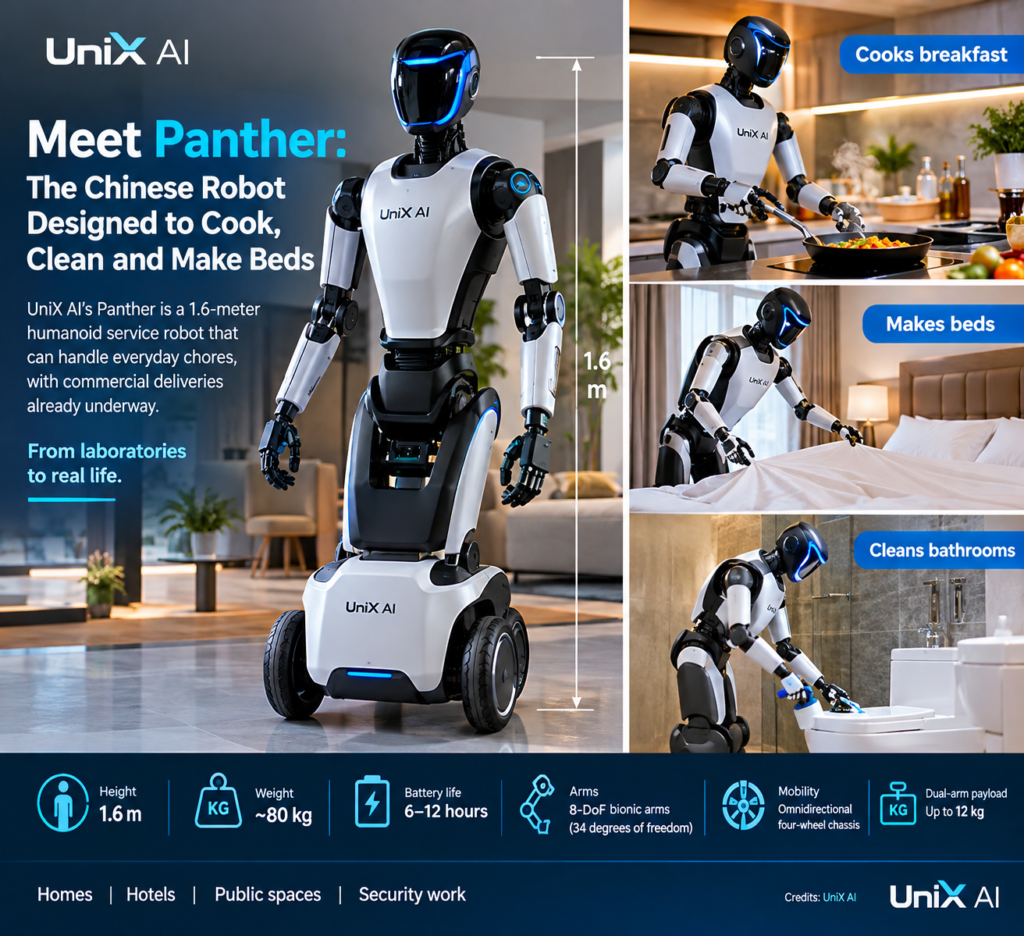
Standing approximately 1.6 meters tall and weighing about 80 kilograms, Panther is designed to operate in spaces built for humans. Unlike many humanoid robots that rely on legs, Panther uses an omnidirectional four-wheel steering and drive chassis, allowing it to move through indoor environments while its articulated arms perform tasks.
UniX AI has demonstrated Panther carrying out household activities such as making beds, preparing breakfast, cleaning surfaces and toilets, organizing objects and washing its grippers after completing a task.
The demonstrations are intended to show how the robot could assist with repetitive chores that consume time in homes, hotels and other service environments.
What Makes Panther Technically Interesting?
Panther features 34 high-degree-of-freedom joints and two 8-DoF bionic arms. These arms are designed to provide the flexibility needed to manipulate objects in different positions and environments.
Its adaptive intelligent grippers can adjust to different objects, while the robot’s perception and control systems are intended to help it interact with its surroundings.
According to UniX AI, Panther also features an 80-centimeter upper-body lift, allowing it to work closer to the ground and reach different operating heights. Its published specifications list a battery life of approximately 6–12 hours, depending on workload.
The company says the robot can support a dual-arm payload of up to 12 kilograms, although the ability to lift an object is only one part of successfully completing a household task. Handling fragile, slippery or unfamiliar objects remains a significant challenge for service robots.
Beyond the Laboratory
What makes Panther particularly noteworthy is UniX AI’s emphasis on deployment rather than demonstration alone.
The company says it has begun commercial deliveries and is positioning Panther for several environments, including homes, hotels, retail spaces, public facilities and security operations.
UniX AI has also presented Panther performing a fully autonomous tea-making demonstration, highlighting its ambition to develop robots capable of completing multi-step activities rather than simply carrying out isolated movements.
However, commercial delivery does not necessarily mean that the robot is ready to replace a human worker in every household. Real homes are unpredictable. Floors, furniture, lighting, objects and human instructions vary considerably, and tasks such as cooking and cleaning require reliable judgment, safety controls and consistent performance.
Could Robots Like Panther Become Household Assistants?
The potential applications are substantial. A capable service robot could assist elderly people, support individuals with limited mobility, help hotels manage repetitive work and perform routine cleaning or organization tasks.
For businesses, the attraction may be less about replacing people entirely and more about automating repetitive activities while allowing human workers to focus on tasks requiring communication, judgment and personal attention.
For households, however, affordability, maintenance, safety and reliability will be just as important as the robot’s technical specifications. A machine that can perform a task in a controlled demonstration must also be able to do it consistently in a busy, changing home.
Panther therefore represents more than another futuristic robot video. It reflects a growing industry effort to make embodied artificial intelligence useful in practical environments.
The question is no longer simply whether robots can move like humans. It is whether they can reliably understand their surroundings, manipulate everyday objects and complete useful tasks safely.
If companies such as UniX AI succeed, the next generation of household technology may not just sit on a countertop or respond through a screen. It may move around the home—and help run it.
Never Miss a Story: Join Our Newsletter