Most people discover their blood type when donating blood, preparing for surgery, during pregnancy or after a medical emergency.
You may know yourself as A, B, AB or O. But your blood type is more than a label used by hospitals to determine which blood you can safely receive.
Scientists have spent decades investigating whether the ABO blood group system is associated with a person’s susceptibility to certain diseases. Research has found links involving blood clots, cardiovascular disease, some cancers and infectious diseases.
But there is an important distinction: having a particular blood type does not mean you will develop a particular disease.
Your blood type is one small part of a much larger picture involving genetics, age, lifestyle, environment and other medical factors.
What Does Your Blood Type Actually Mean?
The ABO blood group system is determined by the presence or absence of A and B antigens on the surface of red blood cells.
If you have A antigens, you have blood type A. If you have B antigens, you have type B. If you have both, you are AB. If neither is present, you are type O.
There is also the Rh factor, which is why you may be described as A positive, O negative or AB positive.
These characteristics are inherited from your parents.
Their most obvious medical importance is in blood transfusion, because receiving incompatible blood can cause a serious immune reaction. But researchers have also found that ABO blood-group differences appear to influence certain biological processes in the body.
Blood Type and Blood Clots
One of the more consistently studied relationships involves blood clotting.
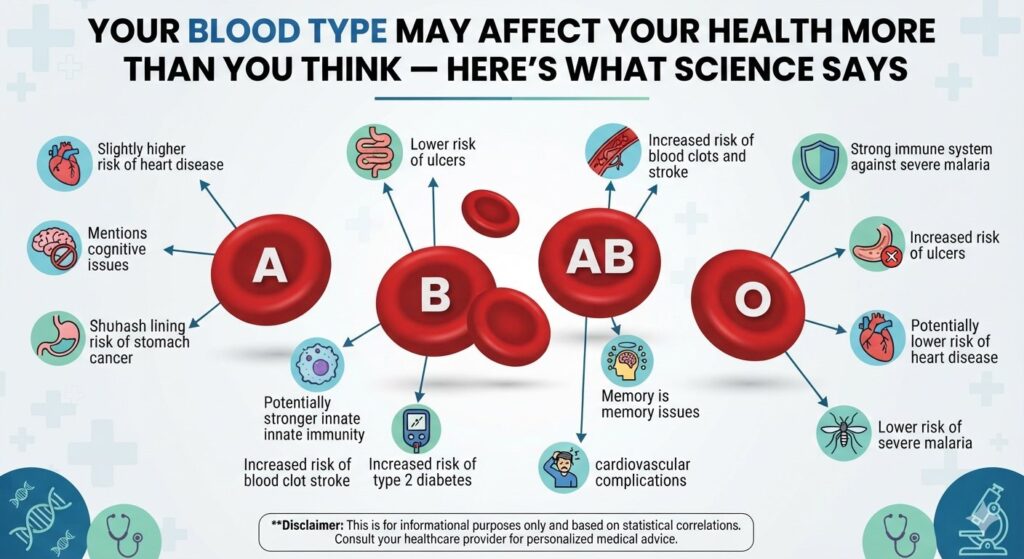
Research suggests that people with blood groups A, B or AB — collectively known as non-O blood groups — tend to have a higher risk of venous thromboembolism than people with type O.
Venous thromboembolism includes conditions such as deep vein thrombosis, in which a clot forms in a deep vein, and pulmonary embolism, when a clot travels to the lungs.
A major reason researchers have investigated this relationship is the effect of ABO blood groups on proteins involved in clotting, particularly von Willebrand factor and factor VIII. Non-O blood groups generally have higher levels of these proteins.
That does not mean someone with blood type A, B or AB should expect to develop a blood clot.
Other factors, including prolonged immobility, surgery, pregnancy, certain medications, obesity, smoking and previous clotting problems can be much more relevant to an individual’s actual risk.
What About Heart Disease?
The relationship between blood type and cardiovascular disease has also attracted considerable scientific attention.
Studies have generally found higher cardiovascular and thrombotic risk among non-O blood groups compared with type O, although the size of the association varies between studies and populations.
This is particularly interesting because the same biological mechanisms involved in blood clotting can influence cardiovascular events.
But blood type should never be viewed as a substitute for the major cardiovascular risk factors doctors routinely monitor.
Blood pressure, cholesterol, diabetes, smoking, physical activity, diet, body weight, age and family history remain critically important.
Someone with type O blood who has uncontrolled hypertension and high cholesterol cannot assume that their blood type protects them.
Does Blood Type Affect Cancer Risk?
This is one of the most interesting areas of research — and also one where headlines can easily become misleading.
Large studies have found statistical associations between ABO blood groups and certain cancers.
For example, research has repeatedly identified an association between blood group A and a higher risk of stomach cancer compared with blood group O. Other studies have reported associations involving pancreatic and several other cancers.
A 2023 analysis combining data from 127 publications and approximately 20 million participants found associations between ABO blood groups and several cancers, including stomach, pancreatic, colorectal and other cancers.
But this needs to be interpreted correctly.
Blood type A does not mean a person is going to get cancer.
Cancer develops through complex interactions involving genetic changes, age, environmental exposures, infections, lifestyle and many other factors. Blood group may influence susceptibility in certain circumstances, but it is not a diagnosis or a prediction for an individual.
Blood Type and Infections
Blood type may also influence how the body interacts with certain infectious organisms.
The reason is biological. Some pathogens interact with molecules on the surface of cells, and blood-group antigens can influence these interactions.
One particularly important area of research in Africa is malaria.
Studies have found an association between blood group O and reduced risk of severe Plasmodium falciparum malaria. Researchers believe the mechanism may involve differences in the way infected red blood cells interact with uninfected cells and form structures known as rosettes.
This does not mean people with type O cannot develop severe malaria.
It simply means that, at a population level, researchers have observed a relationship between blood group and disease severity.
That distinction is extremely important.
Blood Type and Pregnancy
Blood groups can also become particularly important during pregnancy because of the Rh factor.
A mother who is Rh-negative carrying an Rh-positive baby can develop antibodies against Rh-positive blood cells under certain circumstances. This is known as Rh incompatibility.
Modern antenatal care has effective ways of preventing serious complications associated with Rh sensitisation.
This is one reason blood-group testing is routinely important during pregnancy.
The ABO system itself can also be relevant in pregnancy, but the Rh factor is generally the more clinically significant issue when discussing haemolytic disease of the fetus and newborn.
Does Your Blood Type Determine What You Should Eat?
This is where people should be particularly careful.
You may have encountered the popular idea that people with different blood types should follow completely different diets.
The concept has attracted considerable attention, but there is not strong scientific evidence establishing that people need a special diet simply because they are type A, B, AB or O.
Your blood type should therefore not be used as a reason to eliminate nutritious foods or follow a restrictive eating plan without a medical or nutritional reason.
A healthy diet should instead take into account factors such as overall nutritional needs, age, activity level, existing medical conditions and personal dietary circumstances.
Your Blood Type Is Not Your Health Destiny
The most important message from the research is perhaps the simplest one.
Your blood type can be associated with differences in disease risk, but it does not determine your health.
Think of it as one piece of a very large puzzle.
For example, a person with a blood group associated with a somewhat higher statistical risk of blood clots can still remain healthy throughout life. Conversely, someone with a blood group associated with a lower risk of a particular condition can still develop that condition.
An umbrella review examining hundreds of blood-group associations found that many reported relationships varied considerably in strength and certainty, highlighting the need for caution when interpreting these findings.
This is why doctors do not normally diagnose disease simply by knowing a patient’s blood type.
So, Should You Find Out Your Blood Type?
Yes, knowing your blood type can be useful, particularly in situations involving blood transfusion, pregnancy and certain medical procedures.
But knowing it should not make you anxious.
If you are type A, B, AB or O, the practical lesson is not to worry about the label. Instead, pay attention to the things that have a much more direct influence on your health.
Keep your blood pressure under control. Know your cholesterol and blood-sugar levels. Maintain a healthy weight where appropriate. Stay physically active. Avoid smoking. Seek medical attention when you have concerning symptoms.
Your blood type may influence certain aspects of your biology, but your blood type is only one small part of your health story.
And as scientists continue investigating the relationship between ABO blood groups and disease, the evidence is becoming more interesting — but also more nuanced. The right question is therefore not “Which blood type is healthiest?”
It is “What does my overall health profile tell me about my individual risks, and what can I do about them?”
That is a much more useful question.
Never Miss a Story: Join Our Newsletter