



The Anatomy of a Powder Keg: Why South Africa’s Xenophobia is an Economic Crisis in Disguise
The conventional global narrative surrounding xenophobic violence in South Africa is as frequent as it is shallow: “South Africans simply hate foreign nationals.” This diagnosis is not...

The conventional global narrative surrounding xenophobic violence in South Africa is as frequent as it is shallow: “South Africans simply hate foreign nationals.”
Table Of Content
- 1. The Spatial Trap: How Apartheid Engineered Fragile Economies
- 2. The Post-1994 Shock: Hyper-Liberalization Meets Structural Imbalance
- 3. The Psychology of Scapegoating: High Unemployment + Close Proximity
- 4. The Governance Void and the Weaponization of the Border
- 5. A Continental Phenomenon, Not a South African Anomaly
- 6. Moving Beyond the Fire: Real Solutions
- The Bottom Line
This diagnosis is not only lazy; it is dangerous. It mistakes a violent symptom for the underlying disease. South Africa did not collectively wake up after 1994 and decide to harbor deep-seated malice toward fellow Africans. Rather, the country’s recurring flashes of anti-foreigner violence—most notably in 2008, 2015, 2019, and 2022—are the explosive byproducts of an unmanaged, highly volatile collision between spatial apartheid history, unbridled economic liberalization, and state failure.
To truly understand why the informal sector, particularly township spaza shops, became the frontline of this conflict, we have to look at the deeper economic architecture.
1. The Spatial Trap: How Apartheid Engineered Fragile Economies
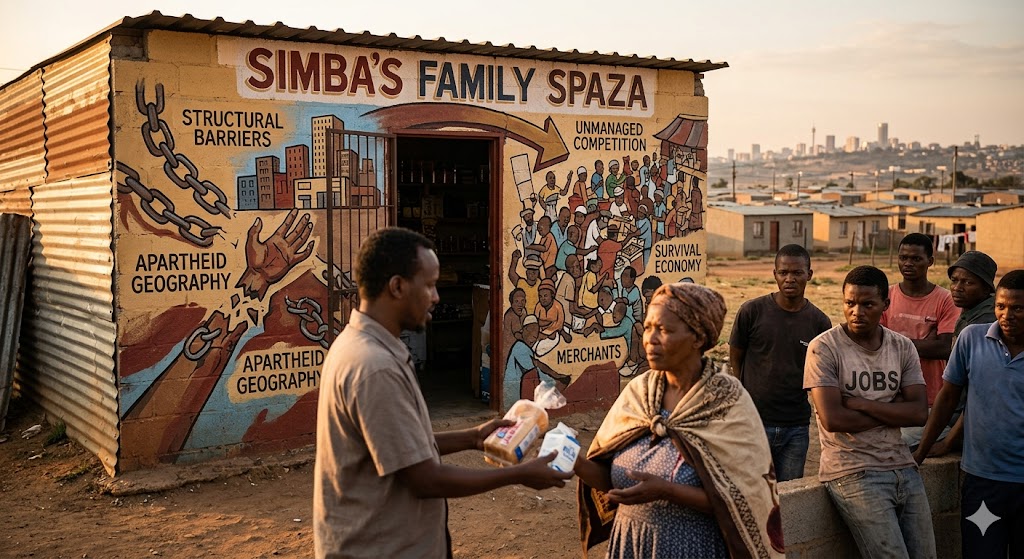
Apartheid was not merely a system of social segregation; it was an exercise in aggressive economic geography. Under the Group Areas Act and the “Homelands” policy, Black South Africans were systematically stripped of land, stripped of capital, and forced into hyper-dense, underdeveloped townships located on the bleak peripheries of major white economic hubs.
[Apartheid Spatial Design]
       │
       ▼
[Townships as "Dormitory Zones"] ──► No Commercial Infrastructure
       │
       ▼
[Informal "Spaza" Shops Emerge] ──► Survivalist Enterprises (No Capital)
Townships were explicitly designed to be “dormitory zones”—places for Black laborers to sleep before returning to work in white-owned mines, factories, and suburbs. They were never intended to possess self-sustaining economies.
- Formal retail infrastructure was prohibited.
- Access to business banking or credit lines for Black entrepreneurs was virtually non-existent.
- Local residents were barred from operating businesses in lucrative urban centers.
Consequently, the township economy evolved strictly as a survivalist ecosystem. The spaza shop (a small, informal tuck-shop run out of a room or corrugated iron shack) emerged not as an ambitious vehicle for capitalist growth, but as a desperate safety net to keep families from starvation.
When democracy arrived in 1994, the political chains were broken, but this deeply warped economic geography remained entirely intact.
2. The Post-1994 Shock: Hyper-Liberalization Meets Structural Imbalance
Following the transition to democracy, South Africa rapidly opened its borders and liberalized its markets, embracing a globalized economic model. At the same time, the country became a beacon of hope for refugees, asylum seekers, and economic migrants from war-torn or economically collapsing regions across the continent and Southern Asia (including Somalia, Ethiopia, Zimbabwe, Pakistan, and Bangladesh).
However, while the macro-economy liberalized, the micro-economy of the townships was left to fend for itself. The newly empowered state failed to implement robust regulatory frameworks for informal business ecosystems, nor did it successfully dismantle the structural barriers preventing local township entrepreneurs from accessing formal supply chains and commercial credit.
Into this regulatory vacuum stepped foreign migrant traders, who possessed profound structural and cultural advantages that local South African survivalist traders simply could not match:
| Advantage | Foreign Migrant Traders | Local Township Traders |
| Supply Chain Dynamics | Transnational networks; bulk-buying syndicates that bypass traditional wholesalers. | Sourced inventory individually from local retail supermarkets at consumer prices. |
| Capital & Credit | Internal, community-backed informal credit systems (interest-free micro-loans within migrant networks). | Heavily reliant on personal savings; completely excluded from formal banking. |
| Operational Costs | High risk tolerance; frequently sleep inside shops; shared labor costs among kin or community networks. | High overhead costs relative to scale; supporting extended families directly from daily cash flow. |
| Pricing Strategy | High-volume, razor-thin profit margins (undercutting competitors by cents). | Dependent on higher markups on low volumes just to cover daily household survival. |
When these two models collided in the tight, cash-strapped confines of the township, it wasn’t a standard textbook case of “healthy capitalistic competition.” It was a structural displacement. Local shopkeepers, already living on the margins, saw their customer bases shift overnight to cheaper, foreign-run alternatives.
In a hyper-fragile ecosystem, market optimization looks exactly like livelihood erasure.
3. The Psychology of Scapegoating: High Unemployment + Close Proximity
South Africa boasts one of the highest structural unemployment rates in the world, hovering consistently above 30%, with youth unemployment surging past a catastrophic 60%.
When millions of young people are locked out of the formal economy, experiencing severe material deprivation while living in dense proximity to relatively successful, visible small businesses owned by “outsiders,” a volatile psychological landscape emerges.
[Severe Unemployment + Exclusion] + [Visible, Localized Immigrant Success]
                               │
                               ▼
            [Structural Failures of the State Hidden]
                               │
                               ▼
             [Foreigner Becomes the Targetable Proxy]
In political economy, this is a textbook pressure point. The human brain, distressed by poverty and seeking an immediate, visible explanation for its suffering, rarely points to abstract macroeconomic policy failures or historical spatial layouts. It points to the nearest tangible variable: the foreign trader down the street who is thriving where locals are drowning.
The foreign national becomes a proxy target for a deep-seated rage that actually belongs to an unresponsive state and an unyielding corporate economic structure.
4. The Governance Void and the Weaponization of the Border
Xenophobic violence does not occur in a vacuum; it flourishes precisely where state institutions are weakest.
- The Policing Failure: In many townships, the South African Police Service (SAPS) suffers from severe under-resourcing, lack of intelligence capacity, and systemic corruption. When local disputes arise over business turf, criminal syndicates or opportunistic political actors step into the security vacuum, organizing protection rackets or instigating looting under the guise of “cleaning up the community.”
- Political Scapegoating: Rather than accounting for decades of failed service delivery, housing backlogs, and sluggish economic growth, various political elites across the ideological spectrum have learned to cynically weaponize anti-immigrant rhetoric during election cycles. By shifting the blame for collapsing public hospitals and infrastructure onto undocumented migrants, politicians effectively use xenophobia as a lightning rod to deflect accountability away from state governance failures.
5. A Continental Phenomenon, Not a South African Anomaly
While South Africa’s violence is particularly acute due to its unique apartheid baggage, this friction is visible all across the African continent where rapid urbanization outpaces job creation:
- In Ghana, recurring disputes flare up between local traders and Nigerian or Chinese immigrants over retail laws that technically bar foreigners from operating in open marketplaces.
- In Kenya, tensions occasionally boil over in Nairobi’s Eastleigh district or downtown markets regarding Somali-dominated wholesale networks undercutting local merchants.
- In Nigeria, internal regional and ethnic merchant clashes echo the same fundamental grievance: survival-driven competition over finite, unregulated marketplace real estate.
Whenever an economy becomes heavily informalized and survival depends on capturing fractions of low-income consumer spend, identity lines inevitably become the trenches in which economic warfare is waged.
6. Moving Beyond the Fire: Real Solutions
Calling for “tolerance” and hosting social cohesion workshops will never stop the cycle of violence, because you cannot preach peace to an empty stomach. If South Africa is to break this pattern, it must transition from treating xenophobia as a moral failing to regulating it as a structural economic crisis.
- Formalize and De-risk the Township Economy: The state must actively help local entrepreneurs build competitive buying cooperatives to bypass exploitative wholesale margins, leveling the procurement playing field.
- Strict, Fair, and Accessible Licensing: Implement localized municipal zoning laws that register all traders (both local and foreign), ensuring tax compliance, health standards, and fair business practices without creating an bureaucratic barrier that destroys livelihoods.
- Incorporate Migrant Capital into Shared Growth: Rather than treating migrant networks as insular threats, policy should incentivize joint ventures or mentorship pipelines where transnational supply chain expertise is integrated into the broader local community framework.
- Decisive Rule of Law: Treat xenophobic looting and incitement not as political protests or “community grievances,” but as criminal acts of economic sabotage that demand swift, uncompromised prosecution.
The Bottom Line
South Africa’s xenophobia is the tragedy of a liberated country trapped inside an unliberated economic geography. Until the township economy is transformed from a desperate survival reservoir into a structurally supported engine of shared growth, the underlying economic magma will continue to break through the social crust—and the easiest scapegoat will always catch the fire.
Never Miss a Story: Join Our Newsletter