




AI in Worship Music: A Historical Continuum of Tools, Resistance, and Acceptance
Why AI-generated music is not a rupture—but the next chapter in a long story of musical instruments Throughout history, every major leap in how humans create, record, or distribute music has followed...

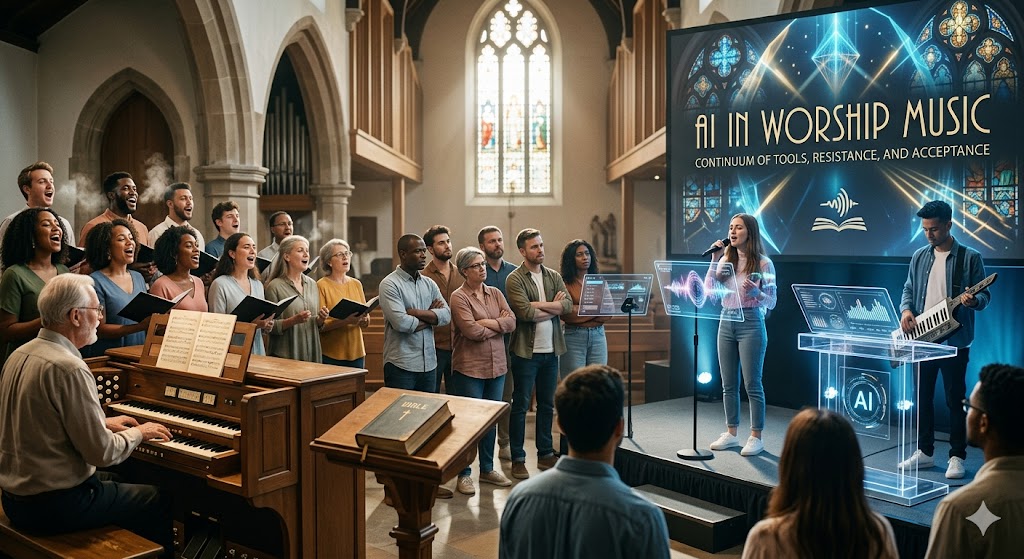
Why AI-generated music is not a rupture—but the next chapter in a long story of musical instruments
Throughout history, every major leap in how humans create, record, or distribute music has followed a surprisingly consistent pattern:
Table Of Content
- Why AI-generated music is not a rupture—but the next chapter in a long story of musical instruments
- 1. The Printed Bible: When “Technology” First Entered Sacred Space
- 2. Early Church Music: From Oral Tradition to Structured Hymns
- 3. The Organ and Early Instruments: When “Machines” Entered Worship
- 4. The Recording Revolution: Capturing Worship for the First Time
- 5. The Keyboard and Synth Era: “This is not real music”
- 6. Live Bands Still Exist—but the Landscape Has Shifted
- 7. Enter AI: The Next Creative Layer, Not the Replacement
- 8. Why Resistance Is Predictable (and Historically Consistent)
- 1. Loss of authenticity
- 2. Loss of control
- 3. Loss of human uniqueness
- 9. The Core Theological Question Is Not “What Tool?” but “Who Offers the Worship?”
- 10. The Future: Hybrid Worship Ecosystems
- A Continuum, Not a Break
- A new tool appears
- It is met with suspicion or rejection
- It becomes widespread
- It is eventually normalized—even in sacred spaces
From the printing press to the keyboard synthesizer, and now artificial intelligence, the pattern remains the same. The real question is not whether the tool is “spiritual enough,” but whether it helps humans express meaning, devotion, and creativity more effectively.
AI-generated worship music sits directly inside this historical continuum.
1. The Printed Bible: When “Technology” First Entered Sacred Space
Before discussing music, it’s important to understand the earliest major disruption in religious communication: the printing press.
When the Bible was first mass-produced, it was not immediately welcomed. In fact, it was controversial.
Before printing:
- Scripture was handwritten by scribes
- Access was controlled by institutions
- Interpretation was mediated through authority structures
With printing technology:
- Scripture became widely accessible
- Individuals could read and interpret directly
- Worship engagement changed permanently
Passages like those in Deuteronomy 6 (which emphasize teaching and passing down the Word) took on new life as households could now engage Scripture personally.
Resistance at the time was not about theology alone—it was also about control, tradition, and fear of distortion.
Yet today, printed and digital Bibles are universally accepted. What was once “disruptive technology” is now simply “how Scripture is accessed.”
2. Early Church Music: From Oral Tradition to Structured Hymns
In the earliest Christian communities, worship was largely:
- oral
- communal
- improvisational
Over time, structured hymns emerged. This was itself a technological shift—music notation became a “system” for preserving worship.
Even then, debates emerged:
- Should worship be spontaneous or structured?
- Does formal composition reduce spiritual authenticity?
But structure won.
The Psalms themselves—like Psalm 150—became foundational templates for worship expression, showing that structured poetic form and spiritual depth were never in conflict.
“Let everything that has breath praise the Lord.”
The idea of “tools shaping worship” is not new—it is embedded in Scripture itself.
3. The Organ and Early Instruments: When “Machines” Entered Worship
When pipe organs were introduced into church worship, they were controversial in some regions.
Critics argued:
- Instruments were too “worldly”
- Worship should be purely vocal
- Mechanical sound was spiritually inferior
Yet over time:
- organs became central to liturgical worship
- new sonic textures deepened congregational experience
- the instrument became a symbol of reverence, not corruption
This was one of the earliest examples of what we now recognize as a repeating pattern:
new sound technology → resistance → integration
4. The Recording Revolution: Capturing Worship for the First Time
The invention of audio recording changed everything again.
For the first time:
- Worship could be replayed
- Voices could be preserved beyond physical space
- Music became distributable at scale
But this also triggered resistance:
- “Recorded worship is not real worship”
- “Performance replaces presence”
- “Technology removes the Holy Spirit from the moment”
Yet today:
- recorded worship is global
- live streaming is normal
- entire ministries exist through digital platforms
The fear that recording would replace authenticity proved incorrect. Instead, it expanded reach.
5. The Keyboard and Synth Era: “This is not real music”
Perhaps the closest historical parallel to AI today is the entry of the electronic keyboard and synthesizer into mainstream music.
When keyboards first appeared in churches and studios:
- many musicians rejected them
- they were called “cheap substitutes” for real instruments
- producers were seen as over-centralizing creative control
- live bands criticized “machine music”
In early studio culture:
- producers and sound engineers became gatekeepers
- music creation shifted from live performance to production rooms
- some argued music had become “too manufactured”
Yet over time:
- keyboards became essential
- digital audio workstations replaced analog-only setups
- even live bands now rely heavily on programmed elements
Today:
- most worship music uses keyboard-driven composition
- even “live worship” sets are often built on layered production
- what was once “generic machine sound” is now the foundation of modern sound design
The irony is clear:
What was once criticized as artificial is now the standard language of music production.
6. Live Bands Still Exist—but the Landscape Has Shifted
It’s important to clarify something often overstated in this debate.
Live musicianship has not disappeared.
Instead:
- it has been integrated into a hybrid ecosystem
- live bands coexist with digital production
- many performances are both live and programmed simultaneously
But the production backbone has shifted:
- keyboards
- software instruments
- digital composition tools
So the question is not whether machines replaced musicians—but how they expanded the definition of musicianship itself.
7. Enter AI: The Next Creative Layer, Not the Replacement
AI-generated music is often misunderstood as “automatic worship creation.”
But in practice, AI functions more like:
- a composition assistant
- a harmonic exploration tool
- a lyrical structuring aid
- a musical ideation engine
It does not:
- possess intent
- hold belief
- offer worship
The human remains the source of:
- theological grounding
- scriptural selection
- emotional intention
- final approval
This is crucial.
If a choir takes Psalms and:
- selects a passage
- uses AI to explore melodies
- refines the arrangement
- and offers it in worship
Then AI is functioning no differently than:
- a keyboard
- a recording studio
- or a music arranger
It is a tool in the chain of expression, not the origin of worship.
8. Why Resistance Is Predictable (and Historically Consistent)
Every technological shift in worship has triggered three core fears:
1. Loss of authenticity
“Real worship is being replaced.”
2. Loss of control
“Authority over sacred expression is shifting.”
3. Loss of human uniqueness
“Machines are doing what only humans should do.”
These exact concerns were raised about:
- printed Scripture
- church instruments
- recorded music
- synthesizers
- digital production
AI is simply the latest version of the same conversation.
9. The Core Theological Question Is Not “What Tool?” but “Who Offers the Worship?”
A key biblical principle is that worship is ultimately about intent and devotion.
In 1 Samuel 16:7, the emphasis is on inward posture rather than outward form:
God looks at the heart.
This becomes the central dividing line in the AI debate.
If:
- humans choose the Scripture
- humans interpret meaning
- humans decide the arrangement
- humans offer the final worship
Then the presence of AI does not replace the worshiper.
It simply expands the expressive capacity of the worshiper.
10. The Future: Hybrid Worship Ecosystems
The most likely future is not AI-only worship or human-only worship, but hybrid systems:
- AI-assisted composition
- live musicians performing AI-influenced arrangements
- real-time adaptive worship soundscapes
- personalized hymn generation from Scripture themes
In this ecosystem:
- keyboards will remain central
- live bands will continue
- AI will become a background creative layer
- human discernment will remain the theological anchor
A Continuum, Not a Break
If history teaches anything, it is this:
What begins as controversial technology often becomes invisible infrastructure.
The printing press became Scripture itself.
The keyboard became the sound of worship.
Recording became the memory of global praise.
Digital production became the studio standard.
AI is not an exception to this pattern.
It is simply the next instrument in a long line of tools that humans have used to:
- interpret meaning
- structure sound
- and ultimately offer creativity back to God
The real continuity is not the tool itself—but the human act of worship behind it.
And that has never changed.
Never Miss a Story: Join Our Newsletter