




Where Does All Nairobi’s Poop and Urine Go? The Answer May Surprise You
Every day, more than five million people living, working, and visiting Nairobi use toilets in homes, offices, schools, shopping malls, restaurants, hospitals, and public facilities. But have you ever...

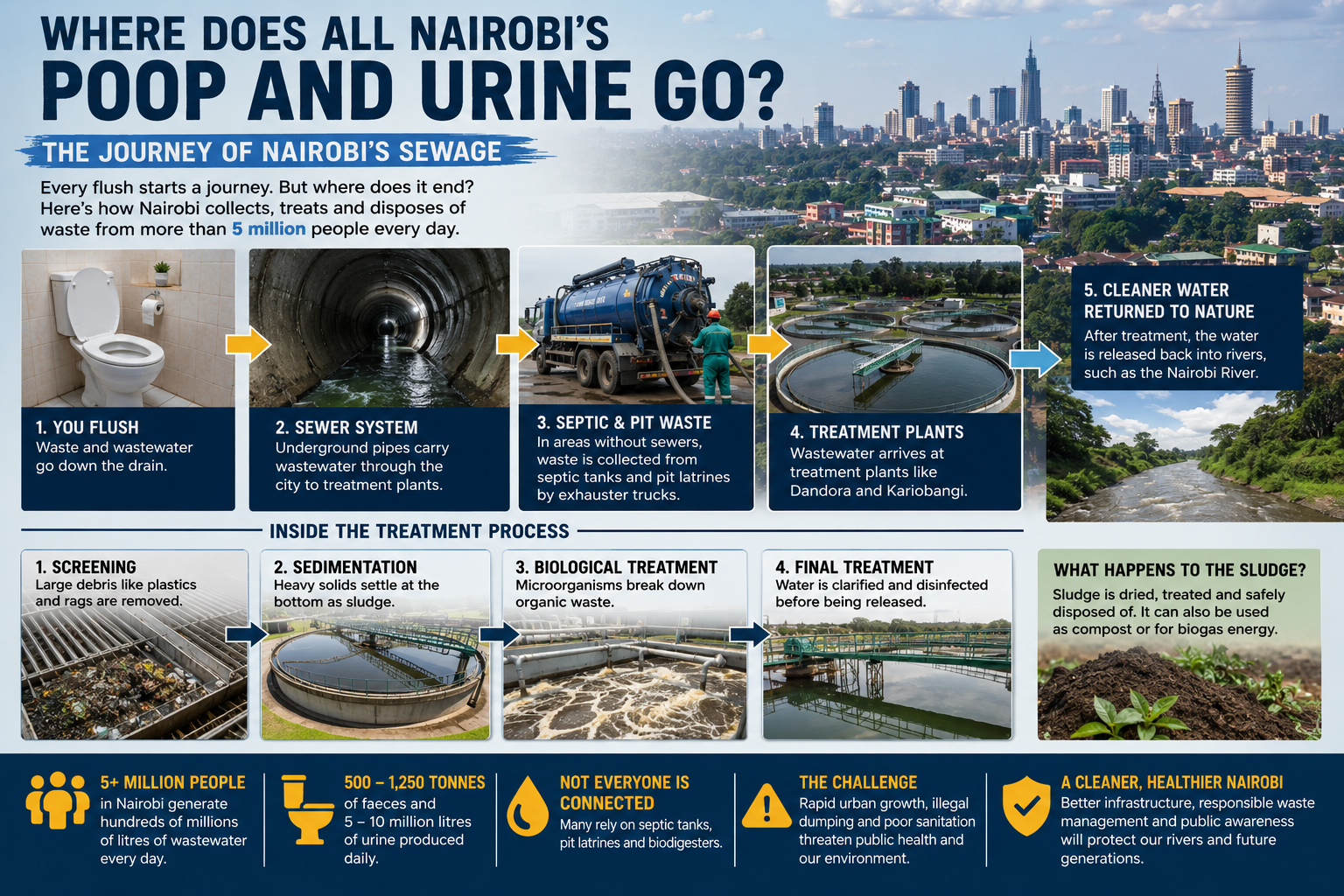
Every day, more than five million people living, working, and visiting Nairobi use toilets in homes, offices, schools, shopping malls, restaurants, hospitals, and public facilities. But have you ever stopped to ask what happens after you flush?
Table Of Content
- The Journey Begins With a Flush
- Nairobi’s Sewer Network Doesn’t Cover Everyone
- Nairobi Produces an Astonishing Amount of Human Waste
- Where Does the Waste Go?
- 1. Screening
- 2. Sedimentation
- 3. Biological Treatment
- 4. Final Treatment
- What Happens to the Sludge?
- The Challenge of Informal Settlements
- Why Proper Sewage Treatment Matters
- The Future of Nairobi’s Sanitation
- Final Thoughts
The answer is far more fascinating—and complex—than many people imagine.
From underground sewer tunnels and septic tanks to giant wastewater treatment plants, Nairobi relies on an intricate sanitation system to handle hundreds of millions of litres of wastewater daily. Yet, despite these efforts, rapid urban growth continues to put enormous pressure on the city’s ageing infrastructure.
Here’s where Nairobi’s human waste really goes.
The Journey Begins With a Flush
Every flush sends a mixture of waste into the city’s sanitation network. This wastewater contains:
- Human waste (faeces and urine)
- Toilet paper
- Water from showers and sinks
- Laundry water
- Kitchen wastewater
Together, these form what engineers call sewage or wastewater.
For properties connected to the city’s sewer network, gravity and pumping stations move the wastewater through underground pipes towards treatment facilities.
Nairobi’s Sewer Network Doesn’t Cover Everyone
While Nairobi has an extensive sewer system, it does not serve the entire city.
Older planned neighbourhoods such as the Central Business District, Upper Hill, Westlands, Parklands, Industrial Area and parts of Kilimani are connected to the public sewer network.
However, many rapidly growing estates and informal settlements rely on alternative sanitation systems, including:
- Septic tanks
- Pit latrines
- Biodigesters
- Shared community toilets
When septic tanks become full, licensed exhauster trucks pump out the waste and transport it to approved treatment plants.
Unfortunately, illegal dumping still occurs in some areas, especially where sanitation services are inadequate or expensive.
Nairobi Produces an Astonishing Amount of Human Waste
Although the exact figures vary from person to person, the average adult produces approximately:
- 100–250 grams of faeces every day
- One to two litres of urine daily
With Nairobi’s population exceeding five million, that translates into approximately:
- 500 to 1,250 tonnes of faeces every day
- 5 to 10 million litres of urine every day
When wastewater from showers, kitchens, businesses, hospitals and industries is added, the city generates hundreds of millions of litres of wastewater every single day.
Where Does the Waste Go?
Most sewage collected through Nairobi’s sewer network eventually reaches large wastewater treatment facilities located on the eastern side of the city.
At these facilities, wastewater undergoes several stages of treatment before it can safely return to the environment.
1. Screening
Large objects such as plastics, rags, bottles and sticks are removed to protect equipment.
2. Sedimentation
Heavy solids settle to the bottom, forming sludge, while lighter materials float to the surface for removal.
3. Biological Treatment
Naturally occurring microorganisms feed on organic waste, breaking it down into simpler and less harmful substances.
This process significantly reduces pollution levels.
4. Final Treatment
The treated water may undergo additional settling or disinfection before being released into nearby rivers.
While the treated water is much cleaner than when it arrived, environmental experts continue to advocate for even higher treatment standards to protect ecosystems.
What Happens to the Sludge?
The thick sludge separated during treatment isn’t simply thrown away.
Instead, it is usually:
- Dried in sludge drying beds
- Further treated to reduce harmful pathogens
- Safely disposed of
In some parts of the world—and increasingly in parts of Africa—treated sludge is also converted into fertiliser, soil conditioners or even used to generate biogas for renewable energy.
The Challenge of Informal Settlements
One of Nairobi’s greatest sanitation challenges lies in densely populated informal settlements.
Many homes are not connected to the sewer network, leaving residents dependent on pit latrines or shared sanitation facilities.
During heavy rains, overflowing drains and poor waste management can cause untreated sewage to flow into nearby rivers and streams.
This contributes to:
- Water pollution
- Disease outbreaks
- Environmental degradation
- Contamination of groundwater
Expanding sanitation infrastructure remains one of the city’s biggest development priorities.
Why Proper Sewage Treatment Matters
Effective wastewater treatment protects both people and the environment.
Without proper treatment, untreated sewage can spread diseases such as:
- Cholera
- Typhoid
- Dysentery
- Hepatitis A
It also prevents pollution of rivers, protects aquatic life and improves the quality of water used downstream for agriculture and other purposes.
The Future of Nairobi’s Sanitation
As Nairobi continues to grow, demand for modern sanitation systems will only increase.
Experts believe the city needs to:
- Expand sewer coverage into underserved neighbourhoods
- Upgrade ageing treatment plants
- Improve wastewater recycling
- Strengthen enforcement against illegal sewage dumping
- Invest in modern sanitation technologies
These improvements will help ensure that the city’s growing population can be served safely and sustainably.
Final Thoughts
Most people never think about what happens after they flush the toilet. Yet every day, Nairobi manages an enormous flow of human waste through a network of pipes, pumping stations, septic systems and treatment plants working around the clock.
While much of the city’s sewage is successfully treated before being released back into the environment, significant gaps remain. Expanding sanitation infrastructure will be critical if Nairobi is to keep pace with its rapidly growing population while protecting public health and preserving its rivers for future generations.
Never Miss a Story: Join Our Newsletter