




Are You Really “Too Acidic”? A Deep Dive Into the 5 Different Acids That Control Your Health
We blame it for heartburn. We fear it in our blood. We buy expensive water to neutralize it. Yet without it, we couldn’t digest food, fight infection, or produce energy. The human body runs on...

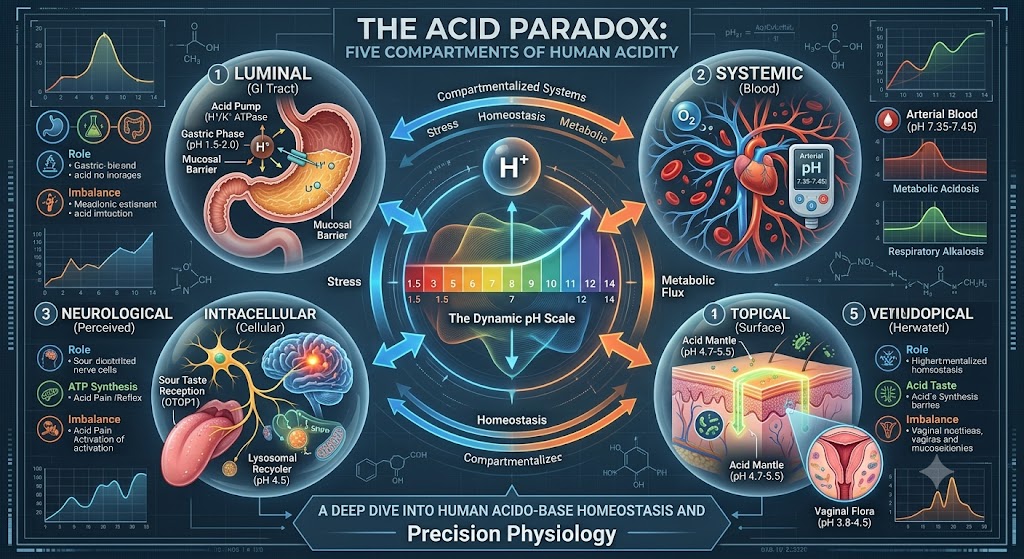
We blame it for heartburn. We fear it in our blood. We buy expensive water to neutralize it. Yet without it, we couldn’t digest food, fight infection, or produce energy. The human body runs on a delicate paradox: the same hydrogen ion that sustains life in the stomach can destroy tissue in the esophagus, fuel cancer in the cells, and erode bone from the skeleton. We don’t have one acidity problem—we have five distinct battles raging in different compartments. Understanding which one is truly attacking you is the difference between a cure and a costly mistake.
Table Of Content
- Part 1: The 5 Core Types of Human Acidity
- Type 1: Luminal (Gastrointestinal) Acidity
- Type 2: Systemic Acid-Base (Blood) Imbalances
- The Diagnostic Key: The Anion Gap
- Type 3: Intracellular (Cellular) Acidity
- Type 4: Topical (Tissue Surface) Acidity
- Type 5: Psychological & Sensory Acidity (Perceived Acidity)
- Part 2: Addressing Common Acidity Misconceptions
- Q1: Is body acidity always harmful?
- Q2: How can low stomach acid (hypochlorhydria) cause heartburn?
- Q3: Does drinking alkaline water change systemic blood pH?
- Q4: Can chronic psychological stress increase acid symptoms?
- Q5: How does chronic metabolic acidosis affect bones and minerals?
- Q6: Why does exercise-induced muscle burn feel different from heartburn?
- Part 3: The Interconnected Acidity Loop
- Part 4: Clinical Distinction — pH vs. Titratable Acidity
- Conclusion
Part 1: The 5 Core Types of Human Acidity
To understand acidity, we must abandon the myth that the body is a single vat of fluid. The human body is a master of compartmentalization, maintaining vastly different pH environments across five distinct physiological domains.
+-----------------------------------------------------------------------+
|                       THE 5 COMPARTMENTS OF ACIDITY                  |
+-----------------------------------------------------------------------+
|  1. LUMINAL (GI)         | Stomach (pH 1.5–2.0), Duodenum, Colon     |
|  2. SYSTEMIC (Blood)     | Arterial Blood (Strictly pH 7.35–7.45)   |
|  3. INTRACELLULAR        | Cytoplasm (pH 7.2), Lysosomes (pH 4.5)   |
|  4. TOPICAL (Surfaces)   | Skin Mantle (4.7–5.5), Vagina (3.8–4.5)  |
|  5. NEUROLOGICAL         | OTOP1 (Sour), TRPV1 (Acid Pain Receptors) |
+-----------------------------------------------------------------------+
Type 1: Luminal (Gastrointestinal) Acidity
This is the acid confined within the hollow spaces (lumen) of your digestive tract.
- The Gastric Phase (Stomach): Parietal cells secrete Hydrochloric Acid ($\text{HCl}$) at a harsh pH of 1.5 to 2.0. This environment is non-negotiable: it denatures complex proteins, activates the protein-digesting enzyme pepsin, neutralizes ingested pathogens, and alters mineral states for absorption (iron, calcium, and B12).
- The Mucosal Pathology: Hyperacidity isn’t strictly about producing excessive acid; it is frequently an issue of mucosal vulnerability. When the protective mucus-bicarbonate barrier thins—often caused by NSAID overuse, Helicobacter pylori infection, or elevated stress—even normal or low acid levels cause mucosal erosion.
- The Duodenal Phase: As acidic chyme enters the small intestine, the pancreas secretes bicarbonate to neutralize it to a pH of 6.0–7.0. If pancreatic secretion is impaired, acid lingers, causing duodenal ulcers.
- The Colonic Phase: Gut microbiota ferment undigested carbohydrates into short-chain fatty acids (SCFAs) and lactic acid. While beneficial in moderation, excessive fermentation—such as in Small Intestinal Bacterial Overgrowth (SIBO)—produces gas and organic acids that irritate the mucosal lining, disrupting motility.
Read Also: Tech and Touch: How AI and Robots Are Replacing Human Interaction in Healthcare
Type 2: Systemic Acid-Base (Blood) Imbalances
This refers to extracellular fluid (arterial blood), tightly constrained within pH 7.35 to 7.45. A drop below 7.35 is acidosis; a rise above 7.45 is alkalosis.
| Subtype | Primary Defect | Compensatory Mechanism | Classic Clinical Example |
| Metabolic Acidosis | Bicarbonate loss OR accumulation of non-volatile acids | Lungs hyperventilate to blow off $\text{CO}_2$ | Diabetic Ketoacidosis (DKA); Severe Diarrhea; Renal Failure |
| Metabolic Alkalosis | Gain of bicarbonate OR loss of strong acids ($\text{HCl}$) | Lungs hypoventilate to retain $\text{CO}_2$ | Prolonged Vomiting; Excess Diuretic Use; Antacid Overuse |
| Respiratory Acidosis | Lungs fail to excrete $\text{CO}_2$ (carbonic acid buildup) | Kidneys retain bicarbonate ($\text{HCO}_3^-$) to buffer blood | COPD, Severe Asthma, Opioid Overdose, Sleep Apnea |
| Respiratory Alkalosis | Hyperventilation causing excessive $\text{CO}_2$ clearance | Kidneys excrete bicarbonate to drop pH | Panic-induced Hyperventilation; High Altitude; Early Aspirin Toxicity |
The Diagnostic Key: The Anion Gap
When evaluating Metabolic Acidosis, clinicians calculate the Anion Gap ($\text{Na}^+ – [\text{Cl}^- + \text{HCO}_3^-]$) to pinpoint the underlying cause:
- High Anion Gap Acidosis: Unmeasured organic acids enter the bloodstream (e.g., L-lactate, ketoacids, or toxins like ethylene glycol).
- Normal Anion Gap (Hyperchloremic) Acidosis: Direct loss of bicarbonate (e.g., severe diarrhea or Renal Tubular Acidosis), where kidneys retain chloride to maintain electrical neutrality.
Type 3: Intracellular (Cellular) Acidity
Intracellular pH ($\text{pH}_i$) is held around 7.2, but individual organelles operate under vastly different acidic regimes.
- Lysosomes: The cell’s recycling centers require an internal pH of 4.5–5.0 to activate acid hydrolases. If this gradient breaks down, cellular debris accumulates, triggering lysosomal storage disorders.
- Mitochondrial Gradient: Mitochondria pump protons ($\text{H}^+$) into the intermembrane space to generate a concentration gradient. This proton motive force drives ATP synthase to yield energy.
- Pathological Hypoxic Acidosis: Deprived of oxygen, cells switch to anaerobic glycolysis, accumulating hydrogen ions and lactic acid. When $\text{pH}_i$ falls below 6.5:
- Enzymes like phosphofructokinase shut down, stalling remaining energy production.
- Cellular death pathways (apoptosis or necrosis) are initiated.
- The Warburg Effect in Cancer: Malignant tumors favor glycolysis even in the presence of oxygen. They pump excess lactic acid out into the extracellular matrix. This localized acidification degrades surrounding tissues, facilitating cancer invasion and metastasis.
Type 4: Topical (Tissue Surface) Acidity
This governs the defensive pH barriers covering external and semi-external organ surfaces.
- The Skin Acid Mantle (pH 4.7–5.5): An acidic film created by sebum, sweat, and microflora that inhibits pathogenic colonization. Washing with alkaline soaps ($\text{pH} > 8$) disrupts this mantle for hours, predisposing the skin to Staphylococcus aureus or fungal dermatitis. However, actual wound tissue requires a slightly alkaline environment ($\text{pH } 7.0\text{–}8.0$) for optimal cellular regeneration.
- The Vaginal Environment (pH 3.8–4.5): Healthy premenopausal flora rely on Lactobacilli converting glycogen to lactic acid. If the pH rises above 4.5, protection wanes, opening the door for bacterial vaginosis and yeast overgrowth.
- The Ocular Surface (pH ~7.4): The tear film matches systemic blood pH. Atmospheric acid exposure or improper contact lens solutions disrupt this equilibrium, predisposing the cornea to micro-abrasions.
Type 5: Psychological & Sensory Acidity (Perceived Acidity)
Acidity is also a sensory input processed by specialized neural pathways.
- Sour Taste Transduction (OTOP1): Type III taste cells feature Otopetrin-1 (OTOP1), a proton-selective ion channel. Ingested dietary acids deliver protons directly into these cells, registering as a sour taste in the brain.
- The “Acid Pain” Pathway: Heartburn pain isn’t just chemical erosion; it is an active pain signal. Hydrogen ions activate TRPV1 (transient receptor potential vanilloid 1) receptors on sensory nerve endings—the exact same receptors triggered by capsaicin in chili peppers.
- Evolutionary Aversion: Innate revulsion to extreme sourness acts as a survival mechanism against ingested toxins and microbial spoilage.
Read Also: Womb Transplants in Kenya: Should Wombs Be Taken from the Dead? Kenyan Experts Weigh In
Part 2: Addressing Common Acidity Misconceptions
Q1: Is body acidity always harmful?
No. Without stomach acid, you could not absorb essential nutrients or eliminate ingested bacteria. Without lysosomal acid, your cells would drown in cellular waste. Without an acidic skin mantle, opportunistic pathogens would proliferate unchecked. Pathology occurs when an acid escapes its designated biological compartment or exceeds homeostatic buffers.
Q2: How can low stomach acid (hypochlorhydria) cause heartburn?
When stomach acid production is inadequate ($\text{pH} > 3.0$), two things happen:
- The Lower Esophageal Sphincter (LES) fails to receive the strong acidic signal required to trigger tight closure.
- Food stalls in the stomach and ferments, creating gas pressure that forces weak acid upward into the esophagus.
Suppressing acid further with antacids may offer momentary relief while worsening the underlying digestive dysfunction.
Low Acid Production (pH > 3.0) ──> Weak LES Signal ──> Gas / Fermentation ──> Reflux
Q3: Does drinking alkaline water change systemic blood pH?
No. Stomach $\text{HCl}$ neutralizes alkaline water on contact. As the fluid enters the small intestine, pancreatic bicarbonate regulates the pH further. Systemic blood pH is controlled strictly by respiratory clearance of $\text{CO}_2$ and renal excretion of $\text{H}^+$, not by dietary intake.
Q4: Can chronic psychological stress increase acid symptoms?
Yes. Stress alters the autonomic nervous system, elevating cortisol levels. High cortisol degrades the protective gastric mucus barrier, making normal acid levels feel painful. Additionally, stress alters gut motility, delaying gastric emptying and increasing the risk of reflux.
Q5: How does chronic metabolic acidosis affect bones and minerals?
To buffer a persistent, low-grade systemic acid load, the body mobilizes calcium phosphate directly from bone tissue. Over time, this chronic buffering leads to progressive bone mineral loss (osteopenia/osteoporosis). Simultaneously, the kidneys excrete excess $\text{H}^+$ in exchange for potassium, increasing the risk of hypokalemia and calcium-based kidney stones.
Q6: Why does exercise-induced muscle burn feel different from heartburn?
The burning sensation during high-intensity exercise is caused by the accumulation of free hydrogen ions ($\text{H}^+$) from rapid ATP hydrolysis, dropping intracellular muscle pH from ~7.2 to 6.4. Lactic acid actually acts as a temporary buffer to shuttle these protons out. Exercise-induced acidity resolves within minutes of rest as metabolic recovery clears the proton load.
Read Also: Why Do We Forget Dreams So Fast? Neuroscience Behind the Morning Amnesia
Part 3: The Interconnected Acidity Loop
The body’s acidic compartments do not exist in isolation. A breakdown in one system frequently cascades through others:
[Topical Skin Barrier Failure]
       │ (Pathogen Entry / Cytokine Release)
       ▼
[Systemic Inflammation] ──> [Impaired Renal Buffer Function]
                                     │
                                     ▼
                      [Compensated Metabolic Acidosis]
                                     │
                                     ▼
                      [Bone Mineral Mobilization (Calcium Siphoning)]
                                     │
                                     ▼
                      [Kidney Stone Formation & Nephron Stress]
                                     │
                                     ▼
[SIBO / D-Lactic Acid Generation] <── [Altered Autonomic/GI Motility]
       │
       ▼
[Systemic Neurotoxicity & Central Symptoms]
Part 4: Clinical Distinction — pH vs. Titratable Acidity
When evaluating acidity, a distinction must be made between pH and Titratable Acidity:
- pH: The concentration of free hydrogen ions ($\text{H}^+$) present in a solution at a single moment.
- Titratable Acidity: The total reserve of both free and buffered acids that must be neutralized to reach a neutral pH.
Clinical Example: Citrus juice has a low pH (high concentration of free protons) but low titratable acidity, making it relatively easy for the body to neutralize. Whole milk has a nearly neutral pH, but high titratable acidity due to its protein and calcium content. Drinking milk initially buffers gastric acid, but its high titratable load triggers gastrin release, causing a severe rebound in hydrochloric acid production 30 to 60 minutes later.
Conclusion
The human body does not face a singular “acid issue.” It relies on a carefully balanced system of localized acidic environments:
- Luminal: Essential for digestion, harmful when mucosal barriers fail.
- Systemic: Strictly regulated; deviations signal underlying organ impairment.
- Intracellular: Required for energy production and waste processing, destructive when uncoupled by hypoxia.
- Topical: Crucial for barrier defense against external pathogens.
- Perceptual: Sensory pathways designed to alert the brain to potential chemical threats.
Managing acidity effectively requires identifying the specific compartment involved. The goal is rarely to eliminate acid entirely, but to restore the biological barriers and physiological systems that keep each acid in its proper place.
Never Miss a Story: Join Our Newsletter