



What If a Houthi Missile Hit Medina? The Middle East Crisis That Could Change Everything
History shows that wars can reach sacred ground. What would happen if a modern missile crossed that ultimate red line? There are military targets. There are economic targets. There are political...

History shows that wars can reach sacred ground. What would happen if a modern missile crossed that ultimate red line?
There are military targets.
Table Of Content
- History shows that wars can reach sacred ground. What would happen if a modern missile crossed that ultimate red line?
- Sacred places have been destroyed before
- Even the Prophet’s Mosque has endured catastrophe
- Medina is not just another Saudi city
- The current escalation makes the question harder to dismiss
- What if the missile actually struck Medina?
- Saudi Arabia would face enormous pressure to retaliate
- The Iran question would immediately become central
- And then comes Israel
- Would Israel secretly arm Saudi Arabia?
- America would be pulled deeper into the crisis
- The Muslim world’s response could be enormous
- The sectarian danger would be enormous
- The economic consequences would not stop at Medina
- China would have a role too
- There is another possible outcome: emergency diplomacy
- The most dangerous chain of events
- The historical warning is clear
- The real question is not whether Medina is sacred
- A hypothetical worth watching
There are economic targets.
There are political targets.
And then there are places whose destruction could change the emotional and political character of an entire war.
The Prophet’s Mosque in Medina belongs to the last category.
No missile has struck the Prophet’s Mosque. There is no verified evidence that the Houthi movement has deliberately targeted it.
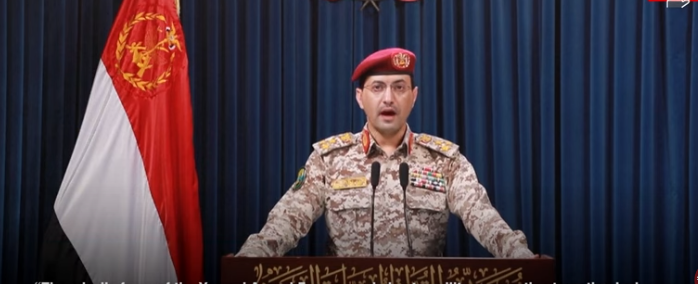
But the question has become less abstract because Saudi Arabia is currently facing an escalating Houthi campaign, and on September 16, Saudi authorities said they intercepted a Houthi drone south of Mecca before it entered the prohibited airspace around the holy city. Saudi officials described the security of Islam’s two holiest sites as a red line. The Houthis have denied targeting Islamic holy sites.
That incident raises an uncomfortable question:
What if one day a missile or drone actually got through?
And more specifically:
What if it struck Medina’s Prophet’s Mosque and caused major casualties or damage?
The answer would almost certainly extend far beyond Saudi Arabia and Yemen.
It could involve Iran, Israel, the United States, the wider Muslim world, global energy markets and the future security architecture of the Middle East.
But there is another reason this hypothetical deserves serious consideration.
History tells us that sacred places are not magically protected from war.
Sacred places have been destroyed before
It is tempting to believe that combatants will automatically spare places considered sacred by millions of people.
History provides little guarantee of that.
Jerusalem offers one of the clearest examples.
The First Temple, traditionally associated with ancient Israelite worship, was destroyed during the Babylonian conquest of Jerusalem around 586 BCE. The Second Temple was later destroyed by Roman forces in 70 CE during the suppression of the Jewish revolt.
There were also earlier episodes in which Jerusalem’s Temple became the focus of political and religious conflict. During the reign of Antiochus IV in the second century BCE, the Temple was plundered and its religious practices were forcibly altered, an episode that contributed to the Maccabean revolt.
These events occurred in a completely different historical world.
They should not be mechanically compared with a 21st-century missile war.
But they establish an important historical principle:
Sacred status has never provided an absolute guarantee against the violence of political and military conflict.
The same pattern has appeared in modern times.
In 2015, Islamic State militants destroyed the Temple of Bel at Palmyra, one of the Middle East’s important ancient religious monuments. UNESCO condemned the destruction as an attack on cultural heritage.
Religious monuments in Iraq, Syria, Afghanistan and elsewhere have similarly been damaged or destroyed during conflicts.
Sometimes the objective has been ideological.
Sometimes the site has been caught in military operations.
Sometimes destruction has been intended to erase the identity and historical memory represented by the monument.
The lesson is not that Medina is destined to suffer the same fate.
The lesson is that religious sanctity does not make a building physically immune from war.
Even the Prophet’s Mosque has endured catastrophe
There is another historical detail that makes the Medina hypothetical particularly striking.
The Prophet’s Mosque itself has survived extraordinary historical disasters.
The mosque was established in Medina during the earliest period of Islam and has subsequently undergone numerous expansions and reconstructions. Saudi Arabia’s official authority overseeing the Two Holy Mosques describes its development through the Rashidun, Umayyad, Abbasid, Mamluk and Saudi periods.
Historical accounts record a major fire in 1256 that badly damaged the mosque.
Another devastating fire occurred in 1481. Historical accounts describe extensive destruction, after which Sultan Qaitbay ordered major reconstruction. Scholarly research on the mosque’s architectural history also records the extensive damage caused by the two fires.
These were not military missile strikes.
They should not be confused with modern warfare.
But they demonstrate something significant:
The physical sanctuary has endured moments in history when its continued existence was genuinely threatened.
The difference today is technology.
A medieval fire could devastate a complex over hours.
A ballistic missile can cross hundreds of kilometres in minutes.
That changes the security calculation completely.
Medina is not just another Saudi city
This is why a missile striking Medina would be fundamentally different from another attack on Saudi Arabia.
A strike on Riyadh would primarily be an attack on the political centre of the Kingdom.
An attack on an oil facility would threaten economic infrastructure.
An attack on an airbase would constitute a conventional military escalation.
But an attack on the Prophet’s Mosque would have a meaning extending far beyond the physical structure.
The mosque is associated with the Prophet Muhammad and contains the sacred burial chamber associated with him.
For Muslims around the world, Medina is therefore not simply a Saudi city.
It is one of the central spiritual locations of Islam.
The Saudi state also has a unique responsibility for the security of the Two Holy Mosques.
That means an attack would immediately become both a national-security crisis and a religious crisis.
The current escalation makes the question harder to dismiss
The hypothetical would be much less relevant if there were no military activity near Saudi Arabia’s western cities.
There is.
Saudi Arabia has faced a series of Houthi attacks during the latest escalation.
Reuters reported on September 15 that Saudi Arabia issued security alerts covering areas including Mecca and Jeddah following a week of attacks by Iran-aligned fighters.
The following day, Saudi authorities said a Houthi drone had been destroyed south of Mecca before entering the city’s prohibited airspace.
The geographical significance is difficult to ignore.
The weapons are no longer simply part of a distant Yemen battlefield.
The conflict is reaching deeper into Saudi territory.
And that raises the possibility of a catastrophic mistake, miscalculation or deliberate escalation.
What if the missile actually struck Medina?
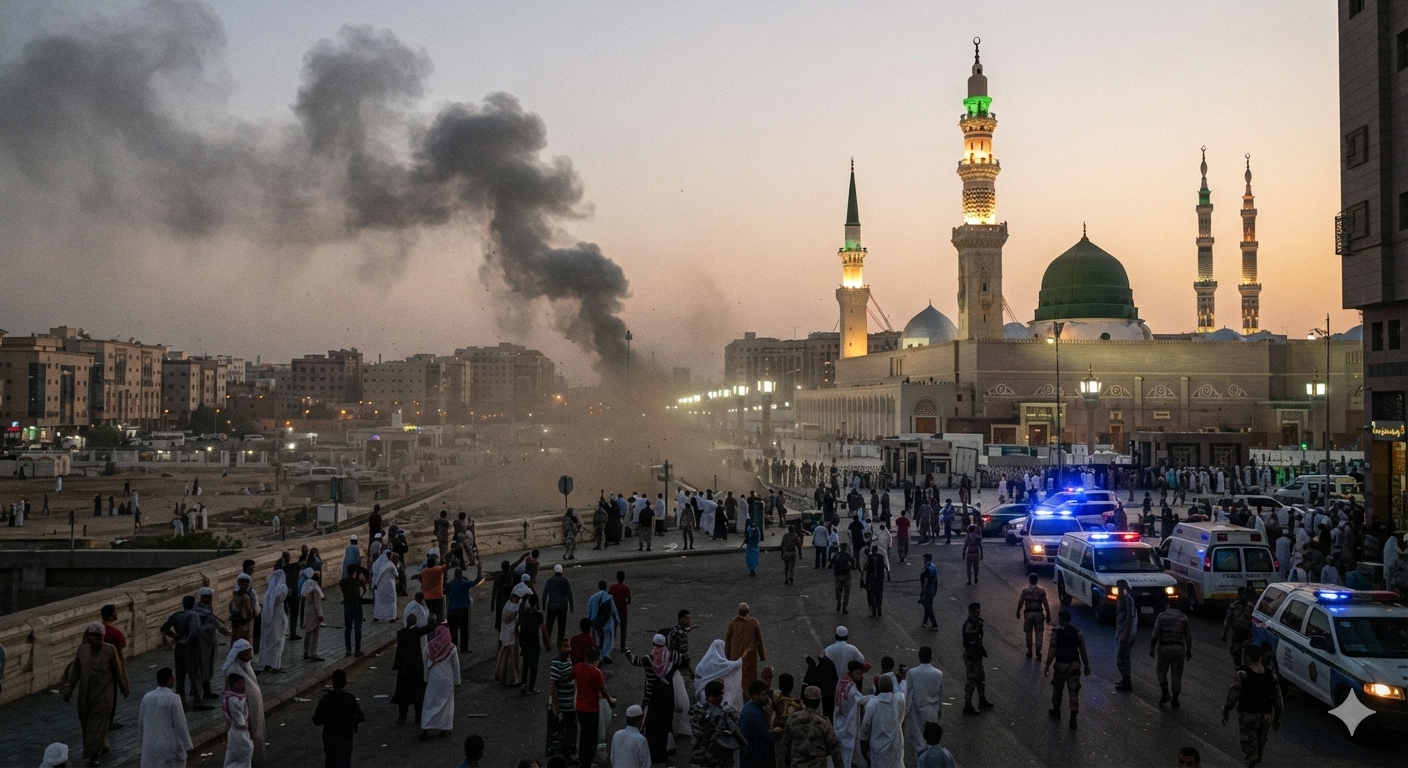
Imagine the worst-case scenario.
A missile is launched from Yemen.
Saudi air defences attempt to intercept it.
The interceptor misses.
The missile reaches Medina.
It strikes somewhere inside or immediately adjacent to the Prophet’s Mosque.
There are casualties.
Images spread around the world within minutes.
At that moment, the nature of the war changes.
The first question would be military:
Who launched it?
The second would be political:
Was the mosque deliberately targeted?
The third would be geopolitical:
Who enabled the attack?
And the fourth would be religious:
How should the Muslim world respond?
The answers to those questions could determine whether the crisis remains a Saudi-Houthi confrontation or becomes something vastly larger.
Saudi Arabia would face enormous pressure to retaliate
Riyadh would be under extraordinary pressure to demonstrate that the holy sites can be protected.
The Saudi government could intensify military operations against Houthi-controlled areas of Yemen.
Missile launch sites, drone facilities, command centres and logistics networks could become immediate targets.
Saudi Arabia could also seek much greater foreign assistance.
And this is where the international dimension becomes important.
Saudi Arabia is already under pressure to strengthen its defensive capabilities. Recent reporting indicates that Riyadh has been seeking assistance from several countries as the Houthi threat expands.
A strike on Medina could transform those requests from an urgent security matter into an international emergency.
The Iran question would immediately become central
The Houthis are an Iran-aligned movement, although that does not mean every Houthi operation is necessarily ordered directly by Tehran.
That distinction would become extremely important.
If a missile struck Medina, Saudi Arabia and its allies would likely investigate the missile’s origin, technology, logistics and command chain.
If evidence suggested Iranian assistance, the crisis could rapidly move beyond the Houthi movement itself.
The question would become:
How much responsibility does Iran bear for what happened?
Tehran would have a strong incentive to reject responsibility for any deliberate attack on the Prophet’s Mosque.
But Saudi Arabia could still argue that Iranian support enabled the Houthis to possess the capability that produced the attack.
That disagreement could become the foundation for a much broader confrontation.
And then comes Israel
This is the part that makes the hypothetical particularly consequential.
Israel and Iran are already locked in a much wider strategic confrontation.
At the same time, Saudi Arabia and Israel have increasingly overlapping concerns about Iranian military networks and the Houthi threat.
Recent reporting says Saudi Arabia has sought Israeli intelligence assistance through U.S. Central Command as the Houthi threat grows. The reports do not establish that Israel has agreed to direct military intervention or that Israel has secretly armed Saudi Arabia.
That distinction matters.
But intelligence cooperation alone could become strategically significant.
Israel has substantial intelligence capabilities focused on Iran and Iranian-aligned organisations.
Saudi Arabia has the immediate need.
A catastrophic attack on Medina could therefore create a powerful convergence of interests.
Saudi Arabia would need intelligence.
Israel would have an interest in weakening an Iranian-aligned military network.
The United States already provides a military coordination framework connecting Israel and Arab states.
The resulting cooperation could become much deeper.
Would Israel secretly arm Saudi Arabia?
That remains a question rather than an established fact.
There is a difference between:
intelligence sharing,
defensive assistance,
weapons transfers,
and
direct Israeli military participation.
The first is already being reported as a possibility.
The others would carry much greater political consequences.
Saudi Arabia and Israel do not have formal diplomatic relations.
A visibly Israeli military role in defending Saudi territory could therefore create political problems for Riyadh.
The Houthis could also exploit such a development in their propaganda, presenting the conflict as an Israeli-Saudi war against Yemen.
For Israel, however, the strategic attraction would be obvious if the crisis became an opportunity to obtain better intelligence on Iranian networks or weaken Iran’s regional military infrastructure.
None of that proves Israel would take such action.
It simply demonstrates why a Medina crisis could create a strategic opening that did not previously exist.
America would be pulled deeper into the crisis
The United States would face an extraordinary dilemma.
Washington already has extensive military involvement in the Middle East.
CENTCOM has also become an important channel connecting American, Israeli and Arab military establishments.
Recent reporting has described meetings involving U.S., Israeli and Arab military officials discussing the wider regional security situation.
If the Prophet’s Mosque were struck, Saudi Arabia would almost certainly seek additional American assistance.
That could include:
- missile defence;
- intelligence;
- surveillance;
- air-defence deployments;
- protection of Saudi critical infrastructure;
- maritime security;
- diplomatic pressure on Iran.
But Washington would simultaneously have an interest in preventing the crisis from becoming an uncontrolled American-Iranian war.
That would be an exceptionally difficult balancing act.
The Muslim world’s response could be enormous
This may ultimately be the most unpredictable part of the scenario.
An attack on an oil facility would produce an economic response.
An attack on an airbase would produce a military response.
An attack on Medina could produce a mass emotional response across national borders.
Governments from Asia to Africa could face intense public pressure.
The Organisation of Islamic Cooperation could face demands for collective action.
Saudi Arabia could receive expressions of solidarity from countries that normally disagree with its foreign policy.
Even governments attempting to remain neutral between Saudi Arabia and Iran could find themselves under pressure to take a position.
The reaction would probably not be confined to the Middle East.
Pakistan, Türkiye, Egypt, Indonesia, Malaysia and Muslim communities across Africa could all become important political factors.
The sectarian danger would be enormous
There would also be a serious danger of the conflict acquiring a sectarian character.
The Houthi movement’s relationship with Iran already exists within a complicated Sunni-Shia regional environment.
An attack on the Prophet’s Mosque could be exploited by extremists seeking to portray the conflict as a religious war.
That would be extraordinarily dangerous.
A conflict that began as a struggle involving Yemen, Saudi Arabia and regional security could suddenly be presented as a confrontation between religious communities.
Once that happens, governments can lose control over public emotion.
The resulting violence could spread to places that have nothing to do with the original battlefield.
The economic consequences would not stop at Medina
The crisis would also threaten the global economy.
The Houthi movement’s strategic position around Yemen’s Red Sea coast has implications for shipping through Bab el-Mandeb.
At the same time, Saudi Arabia is one of the world’s most important oil producers.
The latest escalation has already raised concerns about Saudi energy infrastructure and global oil supplies. Reuters reported that the widening fighting was creating new threats to energy supplies and shipping routes.
A strike on Medina could therefore trigger immediate financial-market anxiety.
Oil traders would ask whether Saudi Arabia would retaliate against Houthi infrastructure.
Shipping companies would reassess Red Sea risks.
Insurance costs could rise.
Airspace restrictions could affect aviation.
And investors would immediately begin asking whether Iran, Israel or the United States might become directly involved.
A religious crisis could therefore become an energy crisis, shipping crisis and financial crisis simultaneously.
China would have a role too
China should not be overlooked.
Beijing has significant economic interests in Gulf energy and global shipping.
Recent reporting indicates that China has pressed Iran to help rein in the Houthis following Saudi appeals for assistance.
That is important because China has relationships with actors on both sides of the regional divide.
If Medina were attacked, Beijing could become one of the powers urging Tehran to prevent the crisis from expanding.
China could potentially use its relationship with Iran to push for restraint while simultaneously protecting its economic interests.
There is another possible outcome: emergency diplomacy
A Medina attack would not necessarily guarantee an unstoppable regional war.
The opposite could happen.
The shock could be so enormous that the United States, China, Saudi Arabia, Iran, Oman and other regional actors would have an overwhelming incentive to prevent further escalation.
The international community could demand an immediate investigation.
Saudi Arabia could seek guarantees against further attacks.
Iran could attempt to distance itself from the incident.
Regional governments could pressure the Houthis to stop.
Major powers could establish emergency diplomatic channels.
In that sense, the same event that could produce enormous pressure for retaliation could also produce enormous pressure for restraint.
Everything would depend on the evidence surrounding the attack and the decisions made in the first hours and days afterward.
The most dangerous chain of events
The nightmare scenario would look something like this:
Houthi missile launched from Yemen
↓
Saudi air defences fail to intercept it
↓
The Prophet’s Mosque or its immediate surroundings are struck
↓
Major casualties occur
↓
Saudi Arabia launches a massive retaliation
↓
Evidence or accusations point toward Iranian assistance
↓
Iran rejects responsibility
↓
Israel expands intelligence and defensive cooperation with Saudi Arabia
↓
The Houthis intensify their attacks
↓
Iran becomes more directly involved
↓
Israel responds
↓
The United States expands its military role
↓
Red Sea shipping becomes increasingly dangerous
↓
Oil infrastructure becomes a target
↓
Other Iranian-aligned groups enter the conflict
↓
The regional war becomes something much larger
That is the scenario that should concern policymakers.
Not because it is inevitable.
But because each step could create pressure for the next one.
The historical warning is clear
There is an important lesson in looking back at Jerusalem, Palmyra and other sacred places that have been caught in wars.
The lesson is not that sacred sites are inevitably destroyed.
The lesson is that wars do not always respect the boundaries that societies consider sacred.
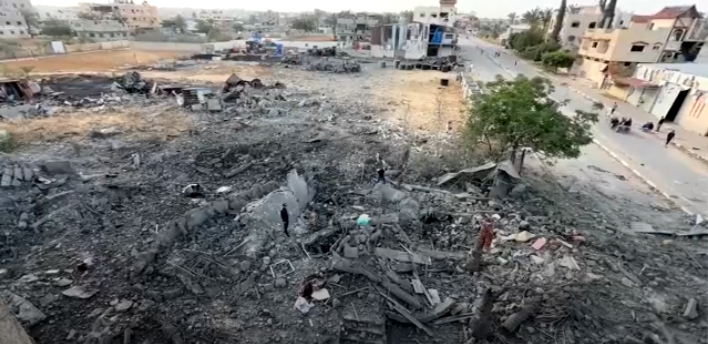
The ancient temples of Jerusalem were destroyed during periods of conquest and rebellion. Palmyra’s Temple of Bel was deliberately destroyed in modern times. The Prophet’s Mosque itself survived devastating fires centuries ago. And in 2016, a suicide bomber attacked outside the Prophet’s Mosque in Medina, killing four Saudi security personnel.
The 2016 bombing is especially relevant because it demonstrates that even Medina’s sacred precinct has not been completely beyond the reach of modern political violence.
But a missile strike during a state-linked regional war would be something different.
It could be interpreted not merely as terrorism, but as an attack connected to an international military confrontation.
That distinction could dramatically alter the response.
The real question is not whether Medina is sacred
Everyone already knows that.
The real question is whether the political and military actors involved in today’s Middle East conflict can keep their weapons away from the places where the consequences of a mistake would be almost impossible to contain.
The recent interception south of Mecca shows how quickly the geography of the conflict can move toward extraordinarily sensitive territory.
The Houthi movement denies targeting Islamic holy sites.
Saudi Arabia says the security of the holy places is a red line.
Between those two positions lies one of the most dangerous possibilities in the current Middle East crisis:
a weapon that was intended for one target but reaches somewhere whose significance is vastly greater than the original battlefield.
A hypothetical worth watching
No missile has struck the Prophet’s Mosque.
There is no evidence presented publicly that the Houthis are planning such an attack.
The scenario remains hypothetical.
But it is no longer a completely detached thought experiment.
Saudi Arabia has already experienced attacks reaching toward its western cities.
A Houthi drone has already been intercepted south of Mecca.
Saudi infrastructure is under pressure.
Riyadh is seeking additional security assistance.
And reports indicate that Israeli and Saudi security contacts are taking place through U.S. channels.
Those facts do not prove that Medina will be attacked.
They demonstrate something else:
The margin for catastrophic miscalculation is becoming increasingly important.
If the unthinkable ever happened, the world would not simply be watching another chapter of the Yemen war.
It could be watching the moment a regional conflict crossed one of the most consequential religious red lines on Earth.
And once that line was crossed, the question would no longer be how the Saudi-Houthi war ends.
It would be how much of the Middle East—and potentially the wider world—gets pulled into what comes next.
This article is a Newsly geopolitical analysis. The Medina strike described above is a hypothetical scenario, not a report of an actual attack
Never Miss a Story: Join Our Newsletter