



Mars, AI, and the Endless Frontier: How Far Can Human Knowledge Take Us?
There is something almost comical about the idea of leaving Earth—a planet that gives humanity breathable air, liquid water, food, gravity, protection from dangerous radiation, and an astonishingly...

There is something almost comical about the idea of leaving Earth—a planet that gives humanity breathable air, liquid water, food, gravity, protection from dangerous radiation, and an astonishingly diverse ecosystem—to establish a home on Mars. Yet the idea is no longer confined to science fiction. Entrepreneurs such as Elon Musk have openly discussed establishing a permanent human presence on Mars, potentially developing a self-sustaining civilization there.
Table Of Content
- Mars: The Ultimate Hostile Environment
- But What If Robots Go First?
- Could Superintelligent AI Solve the Mars Problem?
- But Intelligence Cannot Break Physics
- We Should Not Confuse “Impossible Today” With “Impossible Forever”
- What About Travelling Between the Stars?
- The 2 Percent Brain Myth
- Perhaps AI Will Not Replace Human Curiosity
- Earth Still Matters
- The Infinite Question
- The Future Belongs to the Questions We Have Not Yet Asked
The ambition raises a fascinating question: why would humanity spend enormous resources trying to make a hostile planet habitable when Earth, despite all its problems, already provides the conditions necessary for human life? Perhaps the answer lies not in choosing Mars over Earth, but in understanding what human beings have always done when confronted with seemingly impossible frontiers. We learn. We experiment. We invent. And then we try again.
Mars: The Ultimate Hostile Environment
Imagine leaving your comfortable home and moving deep into a vast forest filled with mosquitoes, venomous snakes, scorpions, and other dangers. To survive, you would need to remain permanently protected by specialized clothing. Your sleeping quarters would have to be enclosed, and food and clean water carefully supplied. A single serious breach in your protection could become life-threatening. Now imagine that the forest has no breathable atmosphere. That is closer to the Martian challenge.
Mars does not provide human beings with the natural conditions that Earth provides. Any permanent settlement would require artificial habitats, reliable energy, water extraction, oxygen production, food systems, radiation protection, medical facilities, and sophisticated industrial infrastructure. Humans would not simply be moving to another country; they would effectively be moving into an enormous life-support machine.
That raises an obvious question: wouldn’t it be easier to improve conditions on Earth? For the foreseeable future, the answer appears to be yes. Earth is already a functioning human habitat. Mars would have to become one.
Read Also: Elon Musk’s Mission to Mars: Starship, Speed, and the Dream of Colonization
But What If Robots Go First?
This is where the discussion becomes considerably more interesting. Perhaps humans do not have to solve the Martian problem themselves—at least not initially.
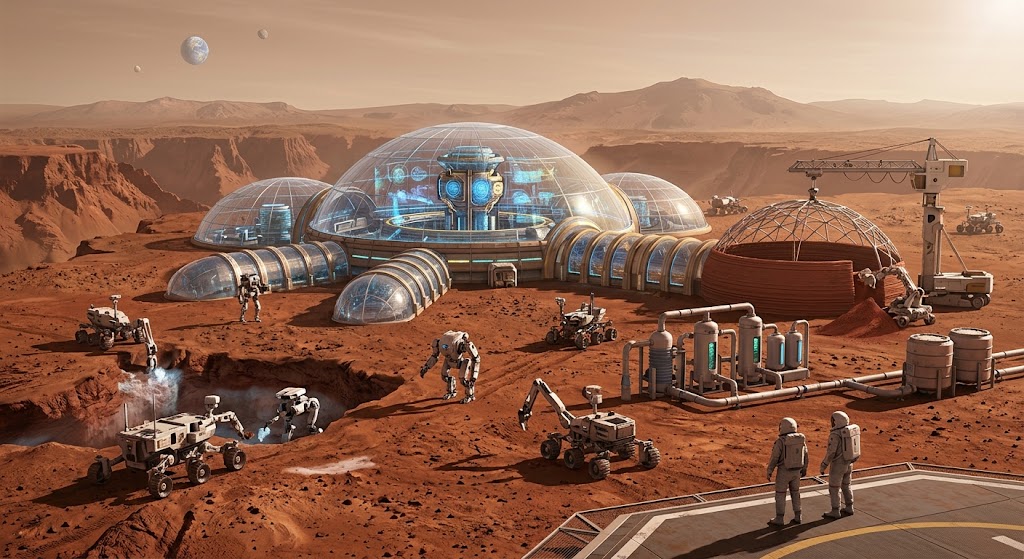
Imagine increasingly sophisticated artificial intelligence managing highly capable robotic fleets. Instead of sending human crews into a lethal void to build their own shelter, humanity could send autonomous machines capable of operating for years or decades beforehand.
This is the logic of In-Situ Resource Utilization (ISRU)—the principle of living off the Martian land before anyone arrives.
Before a single human steps foot on the dust, autonomous rovers could identify subsurface ice deposits in regions like Arcadia Planitia, deploying automated heating probes to extract pure water. Swarms of heavy autonomous diggers and laser-sintering rovers could harvest the iron- and silicon-rich Martian regolith, melting the soil into dense structural bricks or 3D-printing radiation-shielded domes and landing pads that protect against high-velocity exhaust particles.
       [Solar Array & Micro-Fission Power]
                       │
                       ▼
[Atmospheric ISRU] ───► [Chemical Plant] ◄─── [Glacial Ice Extraction]
(CO2 Harvest)             (Sabatier Process)     (Rodwell Water Subsystem)
                       │
                       ▼
          [Methane Fuel & Oxygen Depots]
At the same time, automated chemical processing plants—powered by roll-out solar arrays or compact micro-fission nuclear reactors—could begin processing the atmosphere. Mars’s air is 95% carbon dioxide. Through automated Sabatier reactors and water electrolysis, machines could combine atmospheric carbon with extracted water ice to manufacture liquid methane and liquid oxygen.
By the time humans depart Earth, their return fuel, breathable air, clean water, and shielded shelters would already be waiting for them on the Martian surface. In that scenario, the strategy changes completely. Instead of humans arriving to build everything while fighting for immediate survival, the sequence becomes:
Robots arrive → harvest atmospheric & subsurface resources → print habitats & landing pads → manufacture return propellant → verify life support systems → humans arrive.
The true Martian pioneers will not be biological explorers in pressure suits. They will be machines, autonomous algorithms, and industrial automated systems quietly building a home for a species that hasn’t yet left Earth.
Could Superintelligent AI Solve the Mars Problem?
This takes us into speculation, but it is a fascinating form of speculation. Human civilization has achieved extraordinary scientific advances using biological brains that evolved primarily for survival on Earth. Albert Einstein transformed our understanding of space, time, gravity, and the universe; Newton developed foundational laws of motion and gravity; and thousands of other scientists, engineers, and thinkers have collectively transformed human civilization.
Now imagine an artificial intelligence capable of processing enormous quantities of scientific information, running vast numbers of simulations, designing experiments, identifying patterns, and coordinating thousands of machines simultaneously. The important question would not necessarily be whether an AI has “100 times Einstein’s IQ,” as IQ is not a meaningful universal scale for comparing humans with hypothetical artificial intelligence. The more interesting possibility is massively parallel scientific reasoning.
An advanced AI could potentially investigate physics, chemistry, materials science, robotics, biology, energy systems, and planetary science simultaneously. It could propose solutions, which robots would then test. The results would return to the AI, allowing it to learn from the experiments and design the next generation. That creates a remarkably powerful cycle: AI thinks → robots build → experiments produce data → AI learns → robots improve → the process continues.
But Intelligence Cannot Break Physics
There is an important limitation to this cycle: even a vastly more capable intelligence would not automatically be able to overcome the laws of physics.
An AI might discover an extraordinary material capable of providing better radiation protection, but it would still need to obtain the raw materials and manufacture it. It might design a highly efficient energy system, but it would still have to build it. It might discover a revolutionary method of producing oxygen, but the machinery would still require energy and maintenance.
In other words, intelligence can potentially reveal solutions that humans have not discovered, but a solution still has to exist within physical reality. That distinction matters. AI could potentially help humanity discover possibilities that appear impossible today, but it cannot simply command nature to abandon its fundamental laws.
We Should Not Confuse “Impossible Today” With “Impossible Forever”
Human history provides a reason for humility. For thousands of years, human beings could not fly; today, millions of people routinely travel through the atmosphere in machines weighing hundreds of tonnes. For most of history, humans could not leave Earth; today, spacecraft routinely do so. Humans have walked on the Moon, sent robotic spacecraft across the Solar System, detected gravitational waves, and obtained observations of objects and events billions of light-years away.
None of this means that everything humans imagine will eventually become possible. But it does demonstrate something important: our present technological limitations are not necessarily permanent boundaries. A problem that looks impossible to one generation can become an engineering problem for another.
What About Travelling Between the Stars?
The distances involved are almost beyond ordinary human comprehension. The nearest star system to our Sun is more than four light-years away, and other stars are vastly farther. Galaxies are separated by distances measured in millions of light-years. With today’s technology, interstellar travel is extraordinarily difficult. Faster-than-light travel remains speculative, and current physics provides no demonstrated method for transporting matter faster than light.
But if humanity survives for hundreds of thousands, millions, or even billions of years, it is difficult to predict what forms of transportation, artificial intelligence, materials science, or energy technology might emerge. Perhaps some apparent barriers will remain absolute. Perhaps others will eventually yield to discoveries we cannot presently imagine. The honest position is that we do not know. And that may be one of the most exciting facts about science.
There is another mystery behind all this. Scientists do not yet know whether the entire universe is infinite. We know that the observable universe is finite, because light has had a limited amount of time to reach us, but beyond what we can observe, the universe could be vastly larger. There are also scientific theories that permit the possibility of a multiverse, although there is currently no confirmed observational evidence establishing that other universes exist. The lesson is simple: human knowledge has boundaries. Reality does not necessarily end where our knowledge ends. That distinction is easy to forget.
Read Also: SpaceX Starship Rocket Explodes Setback to Mars mission – What Kenya Should Know
The 2 Percent Brain Myth
One popular claim often enters conversations about human potential: that people use only a tiny percentage of their brains. That is not supported by neuroscience. Humans do not have a hidden 98 percent of their brains waiting to be switched on.
Yet the truth may be even more remarkable. The human brain is a biological organ that has enabled our species to discover mathematics, compose music, develop medicine, build computers, launch spacecraft, and investigate the origins of the universe. We don’t need a mythical unused 98 percent to appreciate the extraordinary capacity of human intelligence. We have already accomplished astonishing things with what we possess, and now we are building artificial intelligence that may eventually extend our ability to reason, calculate, simulate, and discover.
Perhaps AI Will Not Replace Human Curiosity
The future does not necessarily have to be a battle between humans and artificial intelligence. It could instead become a partnership. Human beings provide curiosity, imagination, values, and purpose. AI could provide extraordinary computational and analytical capability. Robots could provide physical capability in environments where humans cannot safely operate. Together, those three could potentially accomplish things that none could achieve alone.
That possibility is particularly relevant to Mars. Perhaps the ultimate achievement will not be humans somehow becoming naturally suited to Mars, but humans becoming extraordinarily good at building environments in which they can survive almost anywhere. We don’t need gills to explore the ocean; we built submarines. We don’t need wings to fly; we built aircraft. We don’t need to survive the vacuum of space naturally; we built spacecraft. The same principle could eventually apply to Mars.
Earth Still Matters
None of this should lead humanity to conclude that Earth is expendable. Quite the opposite. If anything, the challenge of Mars reveals how extraordinarily valuable Earth is. Every breath we take is made possible by a planetary environment that took billions of years to develop. Every glass of water comes from a natural planetary system. Every meal depends on ecosystems, soil, water, sunlight, and biological processes.
Earth provides an enormous amount of infrastructure without sending us a bill. A Mars civilization would have to manufacture much of it. That is why Mars exploration and protecting Earth should not necessarily be treated as competing objectives. Humanity can explore while also preserving the planet that currently sustains us. The objective should not be to escape a damaged Earth. It should be to build a civilization capable of thriving on Earth while developing the knowledge required to explore beyond it.
The Infinite Question
There is a beautiful philosophical dimension to humanity’s search for knowledge. Every discovery seems to reveal another mystery. We learned about atoms and discovered subatomic particles. We studied stars and discovered galaxies. We investigated gravity and encountered the mysteries of spacetime. We developed quantum mechanics and were confronted with deeper questions about reality itself. It can sometimes feel as though every answer opens another door, and perhaps that process will continue for as long as humanity exists.
From a Christian perspective, this also raises a profound question. The Bible says in Daniel 12:4 that “knowledge shall increase” in the latter days. The passage does not tell us the ultimate scale of that increase. How far can human knowledge go? What will humanity understand about creation a thousand years from now? What might we know a million years from now? Could future civilizations understand aspects of spacetime that are completely mysterious to us today? Could they develop technologies that make today’s interplanetary travel look primitive? Could artificial intelligence become an extraordinary instrument for discovering things that biological human minds struggle to comprehend?
We do not know. And perhaps that is the point.
Read Also: Meet Panther: The Chinese Robot Designed to Cook, Clean and Make Beds
The Future Belongs to the Questions We Have Not Yet Asked
It is tempting to look at today’s technology and imagine that we have already reached the boundaries of possibility. History repeatedly warns us against such certainty. The Mars problem may eventually prove far more difficult than today’s enthusiasts imagine. Alternatively, future discoveries could make some of its greatest obstacles surprisingly manageable. Both possibilities remain open.
Perhaps robots will eventually establish sophisticated industrial systems on Mars. Perhaps humans will follow. Perhaps wealthy tourists will one day travel there simply for the experience—turning the red planet into the ultimate luxury destination. Imagine telling someone: “Darling, forget Paris. I’ll take you to Mars.” And perhaps, many generations from now, someone will actually say it.
But beneath the humour is a serious truth. Human beings have always looked at the unknown and asked: “Can we go there?” Then they asked: “Can we understand it?” And eventually: “Can we live there?”
Those questions have carried civilization from the first fires to the Moon, and now toward Mars. We do not know how far knowledge can ultimately take us. We do not know whether interstellar travel will ever become practical, whether superintelligent AI will emerge in the way some researchers anticipate, or whether humanity will ever establish a second independent civilization. But perhaps we should retain one quality above all: humility about what we do not yet know.
The universe is extraordinarily old, and human civilization is remarkably young. There is still an enormous amount left to discover. Whether the next great revelation comes through a human scientist, an AI system, a robotic explorer, a telescope pointing into the depths of space—or through some discovery that today’s science cannot even imagine—the journey of learning is far from finished.
Perhaps the greatest frontier is not Mars. Perhaps it is knowledge itself. And if humanity continues learning, questioning, and exploring, tomorrow’s impossible may simply become another chapter in the story of what we eventually learned was possible.
Never Miss a Story: Join Our Newsletter