Could a Marine Le Pen Presidency Drive Muslims Out of France? Survey Examines Fears
Nearly half of Muslims living in France would consider leaving the country if far-right politician Marine Le Pen becomes president, according to a survey that highlights growing concerns over...

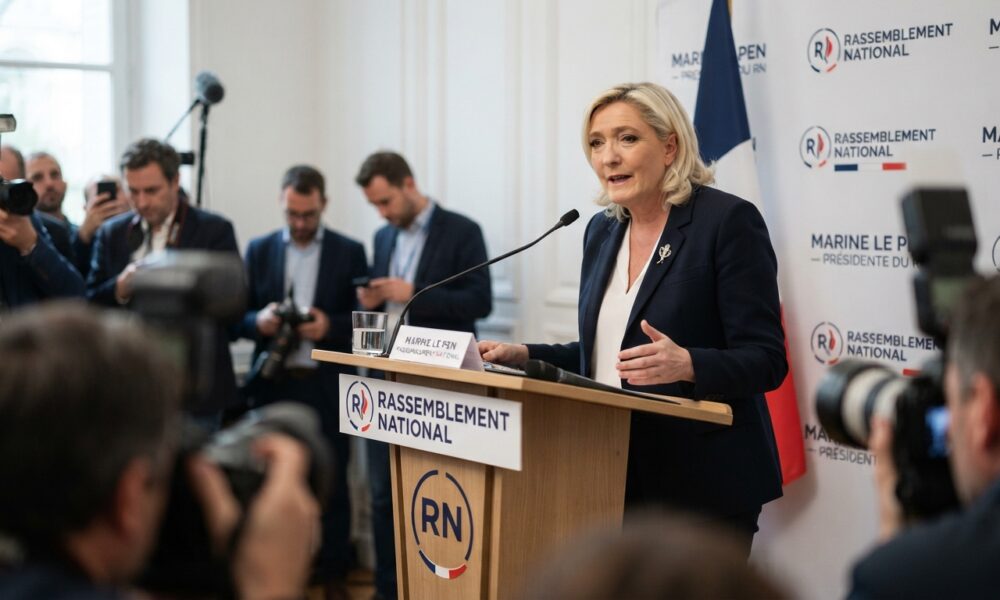
Nearly half of Muslims living in France would consider leaving the country if far-right politician Marine Le Pen becomes president, according to a survey that highlights growing concerns over religious freedom, discrimination and the future of the country’s Muslim minority.
Table Of Content
The poll, conducted by French research institute Ifop, found that 46 per cent of Muslim respondents would contemplate emigrating under a Le Pen presidency. Of those surveyed, 20 per cent said they would definitely leave France if she took office.
The findings come amid debate over immigration, national identity and the place of religion in French public life ahead of the country’s 2027 presidential election.
Le Pen, a leading figure in France’s National Rally party, has repeatedly called for tougher restrictions on Islamic religious practices, including proposals to prohibit Muslim women from wearing headscarves in public spaces.
Survey Reveals Fears of Increased Discrimination
The Ifop survey found that 81 per cent of Muslim respondents feared a Le Pen victory would lead to increased aggression and discrimination against Muslims.
Additionally, 27 per cent said they would consider concealing their religious identity, according to a report by French publication Marianne.
The results point to concerns among some members of France’s Muslim community about how a change in political leadership could affect their daily lives, religious expression and sense of belonging.
François Kraus, director of Ifop’s Politics and Current Affairs unit, said a Le Pen victory could create significant tensions and heighten feelings of fear and insecurity.
However, the findings reflect respondents’ stated concerns and intentions rather than evidence that those who expressed a willingness to leave would necessarily emigrate if Le Pen became president.
Le Pen Renews Push to Restrict Islamic Headscarves
Le Pen has long advocated restrictions on Muslim women’s headscarves in public, making the issue a recurring feature of her political campaigns.
She has argued that France needs stronger measures against what she describes as Islamist ideologies.
In a statement posted on X, the National Rally leader said she intended to submit legislation to a referendum, including a proposal to ban what she calls the Islamist headscarf in public places.
Her position has drawn criticism from opponents who argue that such restrictions would infringe on religious freedom and disproportionately affect Muslim women.
Le Pen previously campaigned on banning headscarves in public during her earlier presidential bids but stepped back from the proposal in 2022 as she sought to broaden her political appeal.
The renewed debate has placed questions about secularism, individual rights and religious expression at the centre of France’s political conversation.
France’s Secularism Rules Remain Controversial
France has some of Europe’s strictest rules governing the display of religious symbols in certain public settings.
In 2011, the country became the first in Europe to introduce a nationwide ban on full-face coverings in public spaces. The legislation covers garments such as the burqa and niqab when they conceal the face, rather than ordinary headscarves that leave the face visible.
Supporters of the law have cited security, identification and social interaction as reasons for the restriction. Critics, however, have argued that the measure disproportionately affects Muslim women.
In 2023, France also prohibited the wearing of abayas, long, loose-fitting garments worn by some Muslim women, in state secondary schools. Authorities defended the measure on the grounds that it upheld the country’s principle of secularism, while critics questioned whether it unfairly targeted Muslim students.
The latest survey also found substantial support among respondents for restrictions on religious clothing and symbols. According to the reported findings, 53 per cent opposed women wearing hijabs in the street, 75 per cent supported the abaya ban in state secondary schools, and 72 per cent favoured prohibiting conspicuous religious symbols at sporting events.
These findings illustrate the continuing divisions in French society over how secularism should be applied and where the boundaries between religious freedom and state neutrality should lie.
Political Stakes Ahead of the 2027 Election
Le Pen’s National Rally has built significant electoral support by campaigning on immigration controls, national identity, security and opposition to aspects of European Union policy.
She has frequently performed strongly in first-round presidential polling, although the final outcome of the 2027 election will depend on the eventual candidates, campaigning and voting patterns.
Her political agenda extends beyond domestic questions of religion and immigration. Le Pen has also criticised European Union policy towards Russia and questioned continued financial assistance to Ukraine.
She has argued that France and other European countries should reconsider the economic consequences of their policies towards Moscow, particularly in relation to energy.
Her positions have generated criticism from political opponents who believe that reducing support for Ukraine could weaken Europe’s response to Russia’s invasion.
For France’s Muslim community, however, the reported survey results suggest that the debate over religious expression and equal treatment could be particularly consequential in the next presidential contest.
A Debate Over Identity and Religious Freedom
France is home to a substantial Muslim population, making the treatment of religious minorities an important issue in national politics.
The survey suggests that a significant proportion of Muslim respondents fear that a change in government could make their lives more difficult. Some would consider moving abroad, while others might respond by concealing aspects of their religious identity.
Nevertheless, the poll does not establish how many people would ultimately leave France, and its findings should be understood as an indication of respondents’ concerns rather than a prediction of future migration.
As the 2027 presidential election approaches, the competing demands of national secularism, religious freedom and social cohesion are likely to remain prominent in France’s political debate.
The central question will be whether the next government can address concerns about national identity and security while protecting the rights and freedoms of all citizens, regardless of their religious beliefs.
Never Miss a Story: Join Our Newsletter