




Social Media Addiction Lawsuits: Why Meta, YouTube, TikTok and Snapchat Are Facing a Growing Legal Battle
A growing legal battle in the United States is challenging some of the world’s largest technology companies over an increasingly familiar question: Can social-media platforms be held legally...

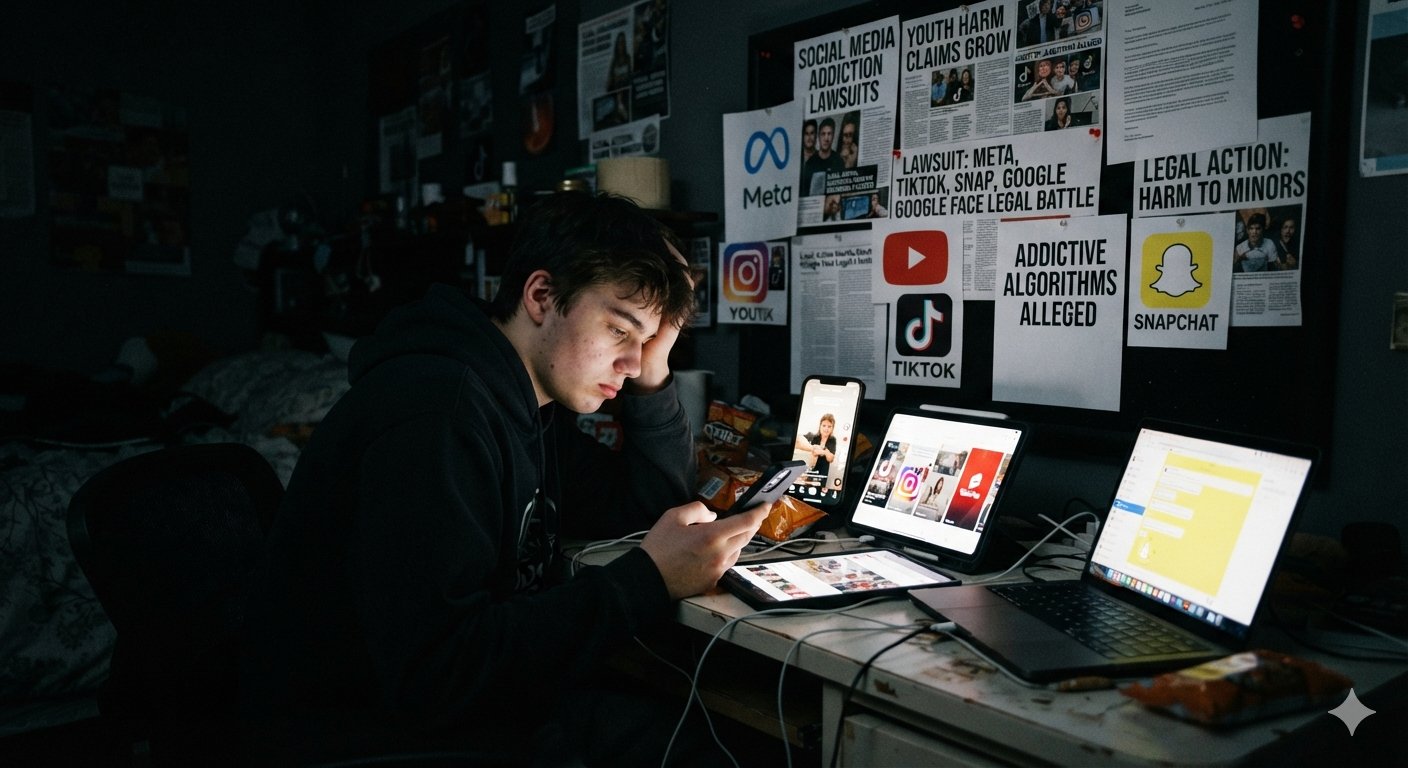
A growing legal battle in the United States is challenging some of the world’s largest technology companies over an increasingly familiar question: Can social-media platforms be held legally responsible when their design allegedly contributes to compulsive use and serious harm among young people?
Table Of Content
- A legal battle involving some of the world’s biggest technology companies
- The enormous US litigation known as MDL 3047
- The case that changed the conversation
- Why the $6 million verdict matters
- What exactly are parents and young users alleging?
- The crucial question: correlation or causation?
- Why teenagers are at the centre of the controversy
- The litigation is not limited to individual families
- The companies’ position is an important part of the story
- A major question: Are social-media platforms products?
- TikTok, Snapchat and other platforms are also exposed
- What about the Goldwater advertisement?
- Could a Kenyan user sue?
- The debate has now reached governments
- The technology industry’s next challenge
- But a lawsuit is not proof that social media causes mental illness
- What happens next?
- Why this matters beyond America
What began as concerns from parents, educators, researchers and child-safety advocates has developed into a major wave of litigation involving Meta, Google, TikTok and Snapchat.
Law firms are now actively advertising for potential clients who believe their use of social media contributed to serious mental-health problems.
One such advertisement from the Goldwater Law Firm asks:
“Have You Suffered From Mental Health Issues Due To Social Media Addiction?”
The advertisement is a paid solicitation for legal services rather than a government warning or medical finding. Goldwater says it and its co-counsel represent potential plaintiffs in social-media addiction litigation across the United States.
But behind advertisements such as this is a much larger legal story.
Read Also: Tea App: The Controversial, Women‑Only Platform Dividing the Internet
A legal battle involving some of the world’s biggest technology companies
The litigation focuses primarily on allegations that social-media companies deliberately designed their platforms to maximize user engagement while failing to adequately protect young users from harmful consequences.
The companies involved include:
- Meta, which owns Facebook and Instagram
- Google/Alphabet, which owns YouTube
- ByteDance, which owns TikTok
- Snap Inc., which operates Snapchat
Plaintiffs have accused the companies of using design features that encourage people, particularly children and teenagers, to remain on their platforms for extended periods.
Among the features discussed in litigation are recommendation algorithms, infinite scrolling, notifications, autoplay and other mechanisms intended to keep users engaged.
The legal argument is important because it is not simply that a child encountered harmful content.
Instead, plaintiffs are attempting to establish that the products themselves were designed in ways that encouraged excessive or compulsive use and that the companies should therefore bear responsibility for resulting injuries.
Goldwater’s description of the litigation says plaintiffs allege that social-media companies intentionally employed techniques designed to encourage users to repeatedly check, interact with and remain on their platforms.
The companies have disputed such allegations.
The enormous US litigation known as MDL 3047
One of the central pieces of the litigation is MDL No. 3047, In re: Social Media Adolescent Addiction/Personal Injury Products Liability Litigation.
MDL stands for multidistrict litigation.
It is a US federal-court mechanism used to coordinate large numbers of lawsuits involving common factual or legal issues.
Rather than having thousands of similar cases independently repeat the same discovery and pretrial proceedings, related cases can be consolidated for certain purposes.
The US Judicial Panel on Multidistrict Litigation continues to list MDL 3047 among the country’s active multidistrict proceedings.
The case is being overseen in the Northern District of California by Judge Yvonne Gonzalez Rogers.
Goldwater describes the litigation as a mass tort involving allegations that major social-media platforms contributed to serious mental-health problems among young users.
Importantly, however, an MDL is not itself a judgment against the companies.
The existence of thousands of claims does not mean every plaintiff will win.
Each case can still involve questions about evidence, causation, damages, applicable law and the specific circumstances of the individual plaintiff.
The case that changed the conversation
The litigation received an enormous boost in public attention on March 25, 2026.
A Los Angeles County jury found Meta and Google liable for negligence in a case involving a young woman identified publicly as Kaley.
She alleged that she began using Instagram and YouTube while young and that her use became compulsive, contributing to serious mental-health problems.
The jury awarded her $3 million in compensatory damages.
It subsequently awarded another $3 million in punitive damages, bringing the total to $6 million.
Meta was assigned $4.2 million of the total and Google/YouTube $1.8 million.
The verdict was particularly significant because the case focused on the alleged design of the platforms rather than simply holding the companies responsible for individual pieces of user-generated content.
That distinction could prove important for future litigation.
Read Also: Parenting in the Age of Social Media: How Digital Platforms Are Shaping Kenyan Families
Why the $6 million verdict matters
A $6 million judgment is relatively small compared with the financial resources of Meta and Alphabet.
The significance of the case therefore goes beyond the amount of money awarded to one plaintiff.
It was viewed as a bellwether case.
A bellwether case is selected as a test case because the issues involved may provide information about how other similar lawsuits could be handled.
Reuters reported that the California case was intended to serve as a bellwether for thousands of similar lawsuits in California state courts.
That does not mean every other plaintiff will automatically receive compensation.
Instead, the case gives lawyers on both sides an opportunity to test evidence, legal theories, expert testimony and arguments about causation.
The companies also said they disagreed with the verdict and were evaluating their legal options.
What exactly are parents and young users alleging?
The allegations vary from case to case.
However, some recurring claims involve:
Compulsive use: Users allegedly find themselves spending substantially more time on platforms than they intended.
Infinite scrolling: Users can continue consuming content without reaching a natural stopping point.
Recommendation algorithms: Platforms recommend additional material based on previous user behaviour, potentially keeping users engaged.
Notifications: Alerts can encourage users to return repeatedly.
Social comparison: Young people may constantly compare their appearance, lifestyle or social standing with others.
Body image concerns: Plaintiffs have alleged that exposure to appearance-focused content contributed to eating disorders and body-image problems.
Cyberbullying and harassment: Some cases also involve allegations that platform design facilitated harmful interactions between young users.
Mental-health problems: Lawsuits have included allegations involving depression, anxiety, eating disorders, body dysmorphia and suicidal thoughts.
These are allegations made in litigation. They should not be interpreted as a finding that social media inevitably causes these conditions.
Read Also:Rethinking Space with Modern House Plans for Kenyan Families
The crucial question: correlation or causation?
This may ultimately be one of the most difficult issues in the litigation.
Millions of young people use social media.
Millions also experience anxiety, depression, eating disorders, bullying, loneliness and other mental-health challenges.
Therefore, proving that a person experienced a mental-health problem while using Instagram, TikTok or YouTube is not necessarily enough.
A plaintiff may need to establish a much stronger connection between the platform’s alleged conduct and the particular injury.
That is why these cases can involve medical experts, psychologists, technology specialists, internal company documents, user records and other evidence.
The legal question is essentially whether the company’s conduct can be connected sufficiently to the specific injury claimed by the plaintiff.
Goldwater itself acknowledges that proving addiction, mental-health harm and company liability can be challenging.
Why teenagers are at the centre of the controversy
Children and teenagers occupy a special position in the debate because their brains and social development are still evolving.
Social media can provide young people with communication, entertainment, education and communities they may not otherwise have.
At the same time, critics argue that features designed to maximize engagement can be particularly powerful when used by young people.
The lawsuits therefore frequently focus on the period when plaintiffs were minors.
In some cases, plaintiffs say they started using platforms at very young ages and developed problematic patterns of use before they fully understood the consequences.
This is one reason age verification and child-safety protections have become major issues internationally.
The litigation is not limited to individual families
An important development is that schools and school districts have also entered the legal fight.
School districts have argued that problematic social-media use creates costs for education systems, including increased demands for counselling, mental-health services, staff intervention and other student-support resources.
The litigation involving schools has grown into a major parallel legal battle.
In 2026, Meta reached a settlement with a rural Kentucky school district in one of the cases brought by school districts alleging that social-media addiction contributes to problems affecting students.
The financial terms of that settlement were not disclosed.
The case was one of a much larger group of lawsuits involving school districts. The Associated Press reported that approximately 1,200 similar school-district cases were involved in the broader litigation.
TikTok, Snap and YouTube have also faced litigation from school districts.
This development is significant because the argument is no longer limited to:
“My child was harmed by social media.”
It can also become:
“Our education system is incurring costs because of the alleged consequences of social-media use among children.”
The companies’ position is an important part of the story
The technology companies have not simply accepted the allegations.
They have challenged claims that their products are legally responsible for individual mental-health problems.
One of the major legal issues is the distinction between content published by users and the design of the platforms themselves.
Technology companies have historically relied heavily on legal protections concerning third-party content.
Plaintiffs in these newer cases are attempting, in part, to avoid that problem by arguing that the companies can be held responsible for their own product-design decisions.
That distinction could have major implications for the technology industry.
If courts ultimately establish that particular platform-design decisions can create product-liability or negligence claims, the legal exposure could extend beyond any single social-media company.
A major question: Are social-media platforms products?
This is one of the fascinating legal questions developing from the cases.
Traditionally, people tend to think of a product as something physical:
A car.
A medicine.
A household appliance.
A toy.
But modern technology companies increasingly operate products that are almost entirely digital.
An application can have:
- algorithms
- recommendation systems
- interfaces
- notifications
- engagement mechanisms
- automated content delivery
- personalized feeds
The plaintiffs’ lawyers argue that these design features can themselves create risks.
That raises a broader question for courts:
Can the design of a digital platform become the basis for product-liability or negligence claims?
The answer could influence future lawsuits involving not only social media but potentially other technology products.
TikTok, Snapchat and other platforms are also exposed
The California case that produced the $6 million verdict involved Meta and YouTube.
But the wider litigation involves other major platforms.
Goldwater identifies Facebook and Instagram, Snapchat, TikTok and YouTube among the companies targeted by social-media addiction lawsuits.
Snapchat and TikTok were also defendants connected to the Kaley case but settled with the plaintiff before the trial, according to the Los Angeles Times. The settlement amounts were not publicly disclosed.
A settlement, however, should not automatically be interpreted as an admission of liability.
Companies often settle lawsuits to avoid the cost, uncertainty and risk associated with continuing litigation.
What about the Goldwater advertisement?
This brings us back to the advertisement that prompted this story.
Goldwater is not announcing that everyone who has mental-health difficulties because they use social media automatically has a valid lawsuit.
It is seeking potential clients.
The firm’s advertisement says people who experienced problems such as depression, anxiety, eating disorders, body dysmorphia or suicidal thoughts after extensive social-media use may potentially qualify for a legal review.
It also makes clear that the advertisement is for legal services and that cases may be referred to other firms.
Potential clients therefore need to understand that answering an advertisement is not the same thing as winning a lawsuit.
A lawyer would have to examine the person’s individual circumstances.
Could a Kenyan user sue?
For Kenyans who encounter these advertisements online, an important distinction must be made.
The litigation described in the advertisement is primarily US litigation.
Goldwater says its co-counsel represents clients across all 50 US states.
That does not mean that somebody living in Kenya automatically qualifies to participate in the US cases.
Questions of jurisdiction, applicable law, location of the injury, the defendant’s relationship with the claimant, age at the relevant time and evidence would all matter.
A Kenyan parent who believes a child suffered harm from social media would therefore need advice based on Kenyan law and the specific circumstances rather than assuming that a US mass-tort advertisement applies to them.
The debate has now reached governments
The legal battle is developing at the same time as governments are considering stronger restrictions on children’s access to social media.
In September 2026, the European Commission proposed the EU Kids Act, which includes measures aimed at restricting social-media access for children under 13 and requiring stronger parental controls for teenagers.
The proposal also targets design features such as infinite scrolling and personalized recommendation systems, while proposing stronger age-verification requirements.
The proposal is not yet EU law.
It must still go through the European legislative process.
But its emergence demonstrates that the social-media debate has moved far beyond parents simply telling children to spend less time on their phones.
Governments are now considering whether platforms themselves should be required to change the way their products work.
The technology industry’s next challenge
The consequences of this litigation could eventually extend beyond the question of compensation.
If courts, regulators or lawmakers determine that particular digital design features pose unacceptable risks to children, technology companies could face pressure to change those features.
That could mean changes involving:
- age verification
- parental controls
- recommendation algorithms
- notifications
- infinite scrolling
- autoplay
- targeted advertising
- children’s accounts
- reporting mechanisms
- default privacy settings
In other words, the eventual outcome could involve product redesign, not merely financial compensation.
But a lawsuit is not proof that social media causes mental illness
This point deserves emphasis.
The existence of thousands of lawsuits does not establish that social media is the sole or direct cause of depression, anxiety, eating disorders or suicide.
Nor does one jury verdict establish that every person who develops a mental-health problem after using social media has been harmed by a platform.
The California verdict was based on the evidence presented in one particular case.
The defendants have disputed the allegations and have legal avenues available to challenge the result.
The broader litigation will have to address different plaintiffs, different circumstances and different evidence.
What happens next?
The legal battle is likely to continue for years.
More individual cases will be examined.
Additional bellwether trials may take place.
Some cases may settle.
Others may go to trial.
Appeals could alter individual verdicts.
Meanwhile, governments in the US, Europe and elsewhere are considering new rules governing children’s use of social-media platforms.
Technology companies are therefore facing pressure from several directions simultaneously:
courts, governments, parents, schools and child-safety advocates.
The central issue is no longer simply whether children spend too much time online.
It is increasingly becoming a question of who is responsible when the design of a digital product allegedly encourages behaviour that results in serious harm.
Why this matters beyond America
The American lawsuits deserve attention in countries such as Kenya because the platforms involved are global.
Kenyan children and teenagers also use Instagram, TikTok, YouTube, Facebook and Snapchat.
The legal decisions emerging from the United States could therefore influence the international conversation about platform design, children’s online safety and corporate responsibility.
Kenya may eventually face its own debates over how digital platforms should protect minors.
For parents, however, the immediate lesson does not require waiting for a courtroom decision.
Understanding how recommendation systems, notifications, endless feeds and social comparison can affect children’s online behaviour is increasingly becoming part of modern parenting.
For technology companies, the lesson is potentially even larger.
The era in which a social-media platform could be viewed simply as a neutral place where users communicate is being challenged in courts around the world.
The question now is whether the architecture of the platform itself can become a source of legal responsibility.
And that is a question that could reshape the future of social media.
Disclaimer : –
This article is for general information and reports on ongoing litigation and public policy developments. Allegations made in lawsuits are not necessarily established facts, and individual legal cases depend on their specific evidence and circumstances.
Never Miss a Story: Join Our Newsletter