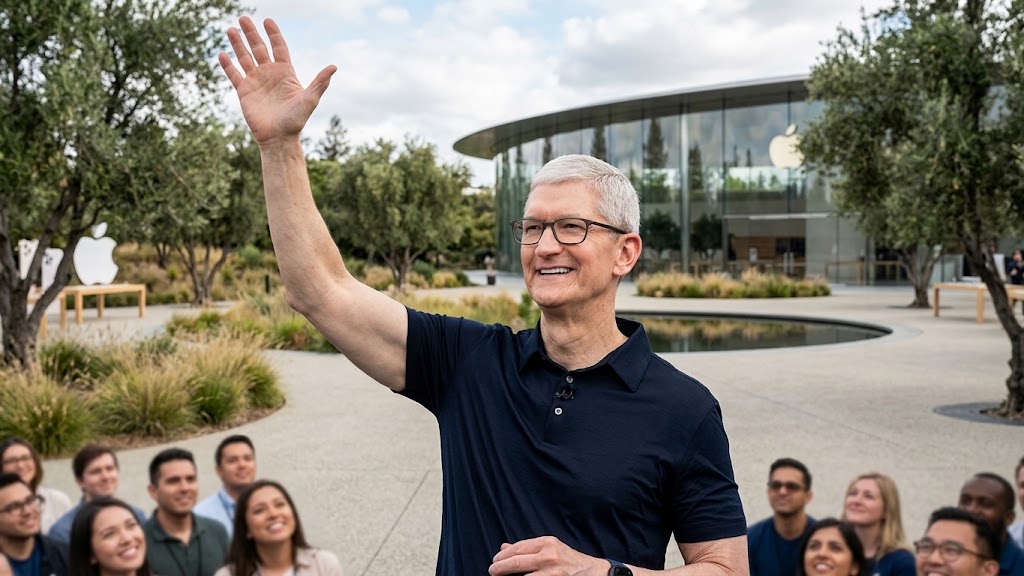
After 15 years at the helm, Tim Cook leaves Apple as one of the most valuable companies in history. But his greatest achievement may not have been creating the next iPhone. It was transforming Apple into a financial and technological machine capable of thriving without Steve Jobs.
When Tim Cook became Apple CEO in August 2011, he inherited perhaps the most difficult job in corporate America.
He was following Steve Jobs.
Jobs was not merely Apple’s co-founder. He was the company’s public face, its product visionary and, in many ways, the embodiment of its culture. His death just weeks after Cook took over made the succession even more daunting.
There were obvious questions.
Could Cook keep Apple innovative?
Could he maintain the magic surrounding the iPhone?
Could a manager known primarily for operations and supply-chain expertise lead a company built around extraordinary products?
Fifteen years later, the answer is difficult to dispute.
Cook did not become another Steve Jobs.
Instead, he built an Apple that was increasingly shaped by his own strengths — operational discipline, enormous scale, services, supply-chain management, financial engineering and the expansion of Apple’s ecosystem.
And on September 1, 2026, as John Ternus takes over as Apple’s chief executive, Cook leaves behind a company almost unrecognizable in financial scale compared with the one he inherited.
From a $350 Billion Company to a $4.6 Trillion Giant
The simplest way to understand Cook’s legacy is to look at the numbers.
When he became CEO in 2011, Apple had a market capitalization of roughly $350 billion.
Today, Apple is valued at around $4.6 trillion, making it one of the world’s most valuable publicly traded companies. Apple itself says its market capitalization grew from approximately $350 billion to about $4 trillion during Cook’s tenure, while annual revenue increased from $108 billion in fiscal 2011 to more than $416 billion in fiscal 2025.
Another measure is even more striking for investors.
Apple’s share price rose by more than 2,200% during Cook’s tenure, while total shareholder return — including dividends and the impact of Apple’s capital-return programme — was even higher. One recent calculation puts the total return at approximately 2,680%.
In practical terms, an investor who put $1,000 into Apple around the beginning of Cook’s CEO tenure would have seen that investment grow to tens of thousands of dollars.
That is an extraordinary record.
But the stock market numbers tell only part of the story.
Cook’s Apple Was About More Than the iPhone
Steve Jobs left behind an extraordinary product.
The iPhone had already become one of the most successful consumer products in history before Cook became CEO.
Cook’s challenge was to make the business around that product bigger, deeper and more resilient.
That meant Apple could not depend indefinitely on consumers buying a new iPhone every few years.
So Apple increasingly built an ecosystem around the device.
iCloud.
Apple Music.
Apple TV.
Apple Pay.
The App Store.
Subscriptions.
Wearables.
AirPods.
Apple Watch.
And eventually the Vision Pro.
Apple says its Services business grew into a company generating more than $100 billion annually, while its installed base expanded to more than 2.5 billion active devices.
This is arguably one of Cook’s most important contributions.
The iPhone gets the attention, but the ecosystem makes Apple unusually difficult for customers to leave.
Someone who owns an iPhone may also have an Apple Watch, AirPods, iCloud storage, Apple Music subscriptions and other services.
Each additional product or service strengthens the relationship between the customer and Apple.
That creates something more valuable than a single product sale: recurring economic activity around an ecosystem.
The Supply Chain Genius Behind the Curtain
Cook’s talents were very different from Jobs’.
Before becoming CEO, Cook had developed a reputation as an exceptional operations executive.
That background became one of Apple’s greatest competitive advantages.
The modern Apple machine is extraordinarily complicated.
Millions of devices must be designed, manufactured, transported and distributed around the world.
Components come from different suppliers and countries. Manufacturing takes place across a global network. Demand must be forecast months in advance. Inventory has to be controlled. New products have to launch simultaneously across multiple markets.
A mistake at this scale can cost billions.
Cook understood this world exceptionally well.
His Apple became famous for squeezing extraordinary efficiency from its global supply chain while maintaining enormous product volumes.
That operational discipline helped Apple turn technological products into one of the most profitable businesses in corporate history.
In other words, Jobs was famous for asking:
“What should we build?”
Cook became famous for answering another question:
“How do we build it at extraordinary scale?”
That distinction matters.
He Did Create New Products — Just Not Another iPhone
It would be unfair to describe Cook as merely the manager who protected Jobs’ legacy.
Apple launched important new product categories under his leadership.
The Apple Watch transformed the company’s position in wearables.
AirPods became a major consumer electronics phenomenon.
Apple expanded services dramatically.
The company introduced Apple Silicon, reducing its dependence on third-party processors and giving Apple much greater control over the performance and power efficiency of its devices.
And there was the much more ambitious Vision Pro, Apple’s attempt to establish a new computing platform around spatial computing.
Apple credits Cook’s leadership with the introduction and expansion of products including Apple Watch, AirPods and Apple Vision Pro, as well as Apple’s transition to its own silicon technology.
Yet there is an important distinction.
None of these products has become another iPhone.
That fact sits at the centre of the debate about Cook’s legacy.
The Criticism: Where Is Apple’s Next Big Revolution?
Cook’s Apple has been enormously successful.
But success creates its own problem.
Apple now needs something new.
The technology industry is entering an era dominated by artificial intelligence, and Apple has not been perceived as a leader in the AI race.
Apple Intelligence arrived after competitors had already made generative AI a central part of their products.
The company’s more ambitious Siri upgrade has faced delays.
Apple has also turned to outside technology partnerships as it works to strengthen its AI capabilities.
This creates an uncomfortable question.
Can a company whose greatest strengths were built around the smartphone ecosystem remain dominant when the primary interface to technology may increasingly become artificial intelligence?
That is the challenge Cook leaves behind.
And it is precisely why the arrival of John Ternus matters.
Meet the Man Taking Over
John Ternus is not a political outsider parachuting into Apple.
He has spent decades inside the company.
He joined Apple in 2001 and eventually became senior vice president of Hardware Engineering. He has played important roles in the development of Apple’s hardware products and now becomes CEO on September 1, 2026.
The appointment is significant.
Cook was the operations expert.
Ternus comes from the hardware and engineering side of Apple.
That could signal a subtle change in emphasis.
Apple is already an enormous machine.
The question is no longer whether it can manufacture hundreds of millions of devices.
The question is what the next generation of those devices should actually do.
Ternus Has an Extraordinary Problem
There is a paradox waiting for Apple’s new CEO.
He inherits one of the most successful businesses ever created.
That sounds like an advantage.
It is.
But it also creates enormous expectations.
If Apple were struggling, Ternus could simply stabilize it.
Instead, he must find ways to grow a company already worth trillions of dollars.
He must defend the iPhone.
He must strengthen Apple’s AI strategy.
He must maintain the services business.
He must navigate geopolitical risks surrounding Apple’s manufacturing network.
And he may have to create entirely new categories capable of producing meaningful growth at Apple’s gigantic scale.
That is a very different challenge from growing a $50 billion company into a $100 billion company.
At Apple’s current size, even a spectacular new product must become enormous to materially move the needle.
Cook’s Greatest Achievement May Have Been Cultural
Perhaps the most important part of Cook’s legacy cannot be measured in Apple’s share price.
He proved that Apple could survive Steve Jobs.
That was never guaranteed.
Jobs had become inseparable from Apple’s identity. Many observers wondered whether the company could continue its extraordinary run after his departure.
Cook demonstrated that Apple could operate successfully without its legendary founder standing on stage.
He built a more institutional Apple.
A company capable of operating at enormous scale without relying entirely on one person’s charisma and vision.
That may be his most important contribution.
Jobs made Apple famous for extraordinary products.
Cook made it extraordinarily scalable.
And Then There Is the Shareholder
Cook’s tenure also changed Apple’s relationship with investors.
Apple has returned enormous amounts of capital to shareholders through dividends and share repurchases.
That financial discipline helped make Apple one of the world’s most important holdings for institutional investors.
The result is a company that simultaneously sells consumer electronics, operates a giant software and services ecosystem, manages one of the world’s most sophisticated supply chains and functions as one of the world’s largest capital-return machines.
That combination is difficult to replicate.
It is one reason Cook’s legacy should not be judged solely by whether he produced an iPhone-sized revolutionary product.
He transformed the economics of Apple.
So, Was Tim Cook Better Than Steve Jobs?
That question is probably impossible — and unnecessary — to answer.
Jobs and Cook solved different problems.
Jobs returned to Apple when the company was struggling and helped create the modern Apple through products such as the iMac, iPod, iPhone and iPad.
Cook inherited that extraordinary foundation and turned it into an increasingly diversified global enterprise.
Jobs was the visionary.
Cook was the builder of the machine.
One was famous for saying no to almost everything that diluted Apple’s focus.
The other proved that Apple’s focus could generate an enormous ecosystem around its core products.
Comparing them directly therefore misses the point.
Apple needed both men.
The Real Test of Cook’s Legacy Starts Now
History will ultimately judge Tim Cook not only by what Apple became while he was CEO, but by what happens after he leaves.
If Apple continues to dominate technology for another decade, Cook’s critics may increasingly look like people who misunderstood his leadership.
If Apple loses ground to AI-native competitors and struggles to create its next major platform, the criticism that Cook prioritized financial performance over breakthrough innovation will become louder.
For now, however, the evidence strongly favours Cook.
He inherited a company worth roughly $350 billion.
He hands over one worth several trillion dollars.
Apple’s annual revenue has multiplied several times.
Its ecosystem has expanded dramatically.
Its services business has become a giant in its own right.
Its active installed base has surpassed 2.5 billion devices.
And the company’s stock has delivered extraordinary returns to long-term shareholders.
That is not the record of someone who merely maintained Steve Jobs’ Apple.
It is the record of someone who created his own version of Apple.
The Cook Era Is Over. The Apple Experiment Continues.
Tim Cook’s departure does not mean he is leaving Apple.
He becomes the company’s executive chairman, while John Ternus takes over as CEO.
That means Cook will remain close to the company he helped reshape.
But the symbolic transition is enormous.
For the first time since Steve Jobs’ return to Apple in the late 1990s, the company is moving into a future that is not directly managed by either Jobs or Cook.
The next chapter belongs to Ternus.
And his central question will be brutally simple:
Can Apple invent its next future before somebody else invents it for them?
That is the test that will determine whether Tim Cook’s extraordinary 15-year run becomes merely one of Apple’s greatest financial chapters — or the foundation of another technological revolution.
Never Miss a Story: Join Our Newsletter