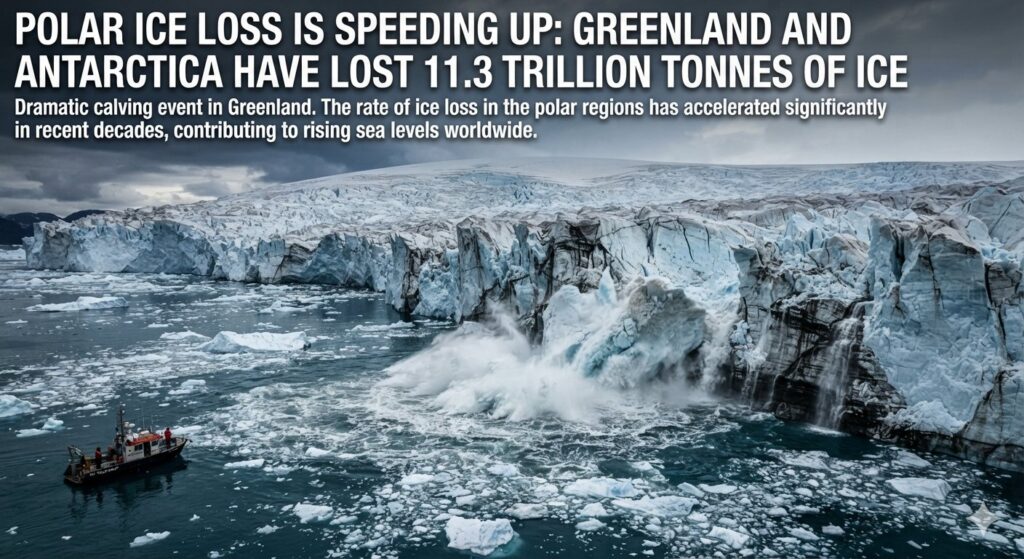
A new satellite study has revealed the staggering scale of ice loss from Greenland and Antarctica, with the world’s two largest ice sheets losing approximately 11.3 trillion tonnes of ice between 1979 and 2023.
The figure is difficult to comprehend.
To put it into perspective, the lost ice represents an enormous volume of frozen water that has entered the world’s oceans and contributed approximately 3.14 centimetres to global sea-level rise.
But scientists say the most important part of the new research is not simply how much ice has disappeared.
It is how the ice is being lost.
A large majority of the loss is being driven by glaciers flowing increasingly rapidly toward the ocean.
This is not simply ice melting in the sun
The new research, published in the journal Scientific Data, combines 42 independent estimates from 27 satellite missions to reconstruct changes in Greenland and Antarctica over several decades.
The researchers found that approximately 84% of the combined ice loss was caused by the acceleration of glaciers, which transported ice from the ice sheets into the ocean.
Only about 16% resulted from changes in surface mass balance, including surface melting and snowfall.
That distinction is extremely important.
It means that the problem cannot be understood simply by asking whether temperatures are warm enough to melt ice at the surface.
The oceans themselves are playing a major role.
According to the European Space Agency, warmer ocean water can reach glaciers and ice shelves, weakening the structures that help hold enormous quantities of inland ice in place. As these glaciers become less stable, they can accelerate toward the sea, carrying huge volumes of ice with them.
In other words, some of the world’s largest reservoirs of frozen water are effectively becoming more efficient at transferring ice into the ocean.
Read Also: The Great Silicon Divide: Inside the Fractured War for Artificial Intelligence
Greenland has lost more than 6 trillion tonnes
Greenland accounted for the larger share of the combined loss.
The study estimates that Greenland lost approximately 6,215 billion tonnes of ice between 1972 and 2023.
Antarctica lost approximately 4,780 billion tonnes between 1979 and 2023.
Together, the two ice sheets lost about 11,309 billion tonnes, or approximately 11.3 trillion tonnes, during the period covered by the analysis.
The rate has also changed dramatically.
Greenland was relatively close to a state of balance during the 1970s. But its losses accelerated over subsequent decades.
The research estimates that Greenland’s average annual ice loss rose from approximately 60 billion tonnes in the 1980s to 264 billion tonnes per year during the 2010s.
Antarctica followed a similar long-term pattern, although its ice-loss story is different because of the enormous influence of ocean-driven changes around the continent.
Antarctica is particularly important
Antarctica contains by far the largest quantity of land-based ice on Earth.
That makes changes there especially important for the future of global sea levels.
The new study found that Antarctica lost approximately 4.78 trillion tonnes of ice between 1979 and 2023, contributing about 13.3 millimetres to global sea-level rise.
The strongest losses have occurred in West Antarctica, where glacier discharge has increased over successive decades.
Scientists are particularly concerned about rapidly changing glaciers in this region, including the Thwaites Glacier and Pine Island Glacier.
These glaciers drain enormous amounts of ice toward the ocean.
Why does three centimetres matter?
Three centimetres of global sea-level rise may not sound frightening.
For someone standing on dry land in Nairobi, London or New York, the difference is almost impossible to notice.
But sea-level rise is not just about the water becoming three centimetres deeper along every beach.
Higher average sea levels mean that storm surges and unusually high tides begin from a higher baseline.
That can make coastal flooding more frequent and more damaging.
The researchers estimate that the 3.14 centimetres of sea-level rise associated with the combined ice loss places an additional 6 million to 9 million people at risk from coastal flooding and erosion.
And Greenland and Antarctica are responsible for only part of the world’s overall sea-level rise.
Other contributors include the thermal expansion of seawater as the oceans warm and melting glaciers outside the two major ice sheets.
The surprising role of the ocean
One of the most important conclusions from the research is that warmer oceans are increasingly important in the polar story.
When ocean water becomes warmer, it can interact with the floating portions of glaciers and ice shelves.
These structures can act like barriers, slowing the movement of inland ice toward the ocean.
When they thin or weaken, the glaciers behind them can accelerate.
The new research found that 84% of the ice loss from Greenland and Antarctica was associated with this kind of glacier dynamical imbalance.
This helps explain why the latest findings are attracting so much attention.
The issue is not simply that more snow is melting during summer.
It is that the enormous ice systems themselves are changing how quickly they transport ice into the ocean.
But there was a temporary slowdown
There is an important qualification to the headline.
The researchers found that overall ice loss slowed between 2020 and 2023.
That does not mean the long-term trend has reversed.
In Antarctica, unusually high snowfall in parts of East Antarctica temporarily added more ice and offset some losses elsewhere.
In Greenland, relatively mild summers reduced surface melting compared with the extreme conditions experienced during parts of the previous decade.
The scientists therefore regard the recent slowdown as a short-term variation rather than evidence that the long-term ice-loss trend has ended.
This is an important distinction.
Climate systems do not move in a perfectly straight line.
Individual years can be colder, snowier or less destructive than the preceding ones while the longer-term trend continues.
What happens if the ice keeps disappearing?
The biggest concern is future sea-level rise.
The 11.3 trillion tonnes already lost are part of a much larger process.
The scientific study notes that Greenland and Antarctica are already responsible for almost one-quarter of global sea-level rise.
If the glaciers continue accelerating, their contribution to rising oceans could become increasingly important during the coming decades.
This has implications far beyond the polar regions.
Low-lying coastal cities, islands, ports, beaches, agricultural areas and infrastructure could face increasing pressure from flooding and erosion.
For countries that have invested heavily in coastal development, rising seas could eventually mean enormous costs for flood protection, drainage, infrastructure relocation and adaptation.
What does this mean for Africa?
Africa may appear far removed from Greenland and Antarctica, but the consequences of rising sea levels are global.
African coastal cities and communities are already exposed to flooding, coastal erosion and increasingly intense weather risks.
Cities such as Mombasa, Dar es Salaam, Lagos and Alexandria have large populations and infrastructure concentrated near the coast.
For Kenya, the issue is particularly relevant because much of the country’s tourism infrastructure, ports, fisheries and coastal settlements are concentrated around the Indian Ocean shoreline.
Sea-level rise does not mean that these cities will suddenly disappear beneath the ocean.
The more realistic concern is a gradual increase in the frequency and severity of coastal flooding and erosion, particularly when rising seas combine with storms, unusually high tides and inadequate drainage.
Read Also: Meet Panther: The Chinese Robot Designed to Cook, Clean and Make Beds
The bigger warning from the satellites
Perhaps the most important achievement of the new study is that scientists can now look at the polar ice sheets over a much longer period with unprecedented consistency.
Researchers combined observations from 27 satellite missions and 42 independent surveys to reconstruct changes extending back to the 1970s.
That long record makes it easier to distinguish a temporary fluctuation from a genuine long-term change.
And the long-term picture is clear.
Greenland and Antarctica are losing enormous quantities of ice.
The pace accelerated substantially after the 1990s.
And much of the loss is being driven not merely by ice melting at the surface but by glaciers becoming faster conduits carrying ice into the sea.
The 11.3 trillion tonnes already lost are therefore more than a shocking statistic.
They are evidence of a changing polar system — one that is already contributing to rising seas around the planet.
The question for the decades ahead is how rapidly that process will continue, and how effectively coastal societies can prepare for the changes that follow.
Never Miss a Story: Join Our Newsletter