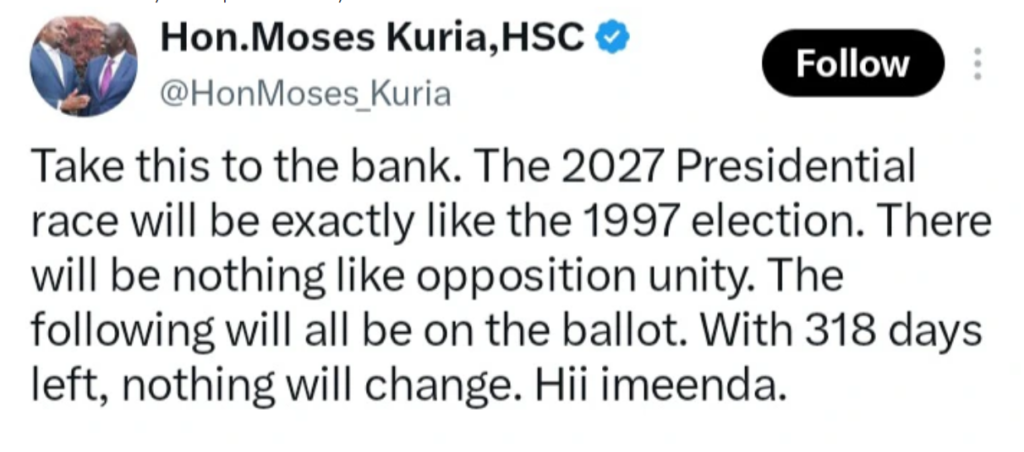
An online poll conducted by former Cabinet Secretary Moses Kuria has triggered fresh discussion about Kenya’s 2027 presidential race after Nairobi Senator Edwin Sifuna emerged with a commanding share of the votes.
The poll, conducted through Kuria’s X account on September 25, attracted 37,353 votes before it closed. Sifuna received 76.3 per cent of the votes, followed by President William Ruto with 14.3 per cent.
Former Interior Cabinet Secretary Fred Matiang’i received 4.8 per cent, while Wiper leader Kalonzo Musyoka polled 4.6 per cent. The figures were reported by several Kenyan media outlets following the closure of the poll.
Sifuna dominates Kuria’s online poll
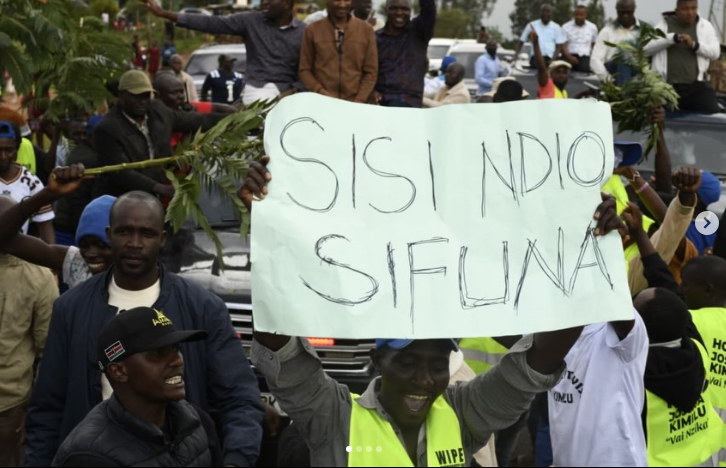
Sifuna’s performance has attracted attention because he has increasingly positioned himself as a possible presidential contender ahead of the August 2027 General Election.
The Nairobi senator has also been involved in opposition mobilisation and discussions around the formation of a political platform capable of challenging President Ruto.
However, the poll should not be interpreted as a scientific measurement of the views of the Kenyan electorate.
Unlike a professionally conducted opinion survey using a defined sample of voters, Kuria’s poll was open to people who chose to participate on his X account. Its results therefore show how participants in that particular online poll voted rather than providing a statistically representative picture of national voter preferences.
The poll nevertheless generated significant interest, with reports indicating that it attracted more than 687,000 views alongside the 37,353 votes.
Kuria links poll to 1997 election
Kuria used the poll to argue that the opposition could once again enter the 2027 election divided.
He drew parallels with the 1997 General Election, when several opposition candidates contested against then-President Daniel arap Moi.
The comparison comes as Kenya’s opposition continues to debate whether to field a single presidential candidate or allow different political formations to pursue their own candidates.
The question of opposition unity has become one of the central issues surrounding the 2027 political contest, with different leaders and parties exploring possible coalitions and political arrangements.
Mizani poll gives a different picture
The results of Kuria’s online poll contrast sharply with another poll released in September 2026 by Mizani Africa.
According to the Mizani survey, President William Ruto recorded 38.7 per cent in the presidential preference question, followed by Kalonzo Musyoka at 27.5 per cent and Sifuna at 13.2 per cent.
Matiang’i received 7.7 per cent, while other candidates attracted smaller shares. Five per cent of respondents were undecided.
The Mizani poll also separately asked respondents about their preferred opposition flagbearer. Kalonzo received 37.2 per cent, followed by Sifuna at 19.7 per cent and Matiang’i at 12.9 per cent.
The contrast illustrates why different polls should be examined in the context of their methodology, sample and question wording rather than treated as interchangeable measurements of public opinion.
2027 race remains fluid
The competing findings come at a time when political alignments ahead of the 2027 General Election remain unsettled.
Sifuna has been increasing his political mobilisation, while Kalonzo continues consultations with other opposition leaders. Ruto, meanwhile, remains the incumbent president and has continued political and government activities across the country.
Recent polling has also tested possible opposition combinations. A Mizani survey reported that a proposed Kalonzo-Sifuna ticket received 40.8 per cent when respondents were asked about preferred opposition pairings.
For now, the two sets of figures tell different stories: Kuria’s online poll shows overwhelming support for Sifuna among its participants, while the September Mizani survey records Ruto leading its presidential-preference question, with Kalonzo and Sifuna following.
With the 2027 election still ahead, party negotiations, coalition arrangements, candidate selection and campaign mobilisation are likely to remain major factors shaping Kenya’s political landscape.
Never Miss a Story: Join Our Newsletter