




In Search of Immortality: Could This Tiny Part of Our DNA Hold the Key to Ageing?
What if one of the most important clues to why we age is hidden at the very ends of our chromosomes? For decades, scientists have been studying tiny structures known as telomeres — protective...

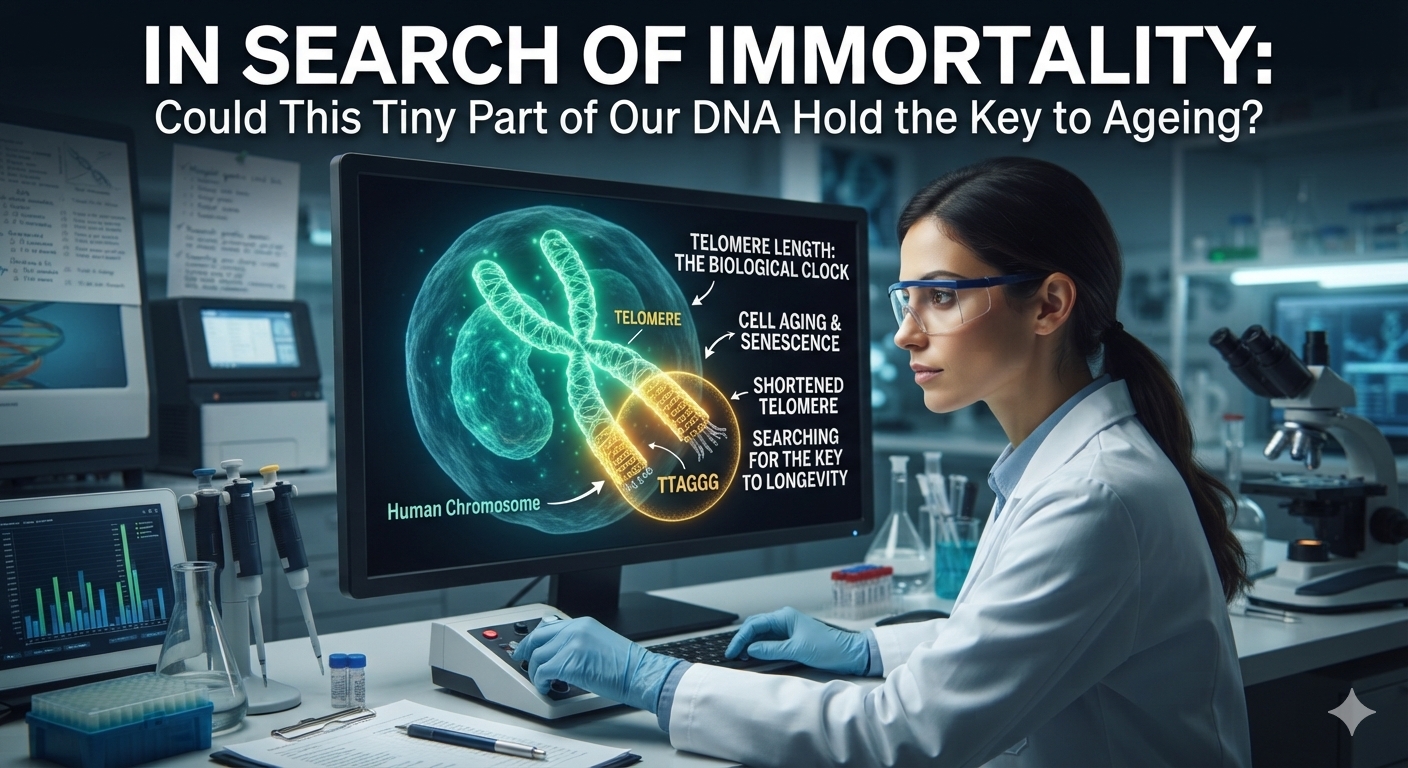
What if one of the most important clues to why we age is hidden at the very ends of our chromosomes?
Table Of Content
- What exactly are telomeres?
- The enzyme that fights back
- Why not simply activate telomerase?
- Ageing may be the price of cancer protection
- Telomeres are important — but they are not the whole story
- Scientists are nevertheless pushing the boundaries
- What about living for hundreds of years?
- The strange paradox of immortality
- Could the future be about slowing ageing rather than defeating it?
- So, can telomeres stop you from ageing?
For decades, scientists have been studying tiny structures known as telomeres — protective sections of DNA that sit at the ends of chromosomes.
They have become one of the most intriguing subjects in the search for longer, healthier lives.
The reason is simple: every time many of our cells divide, their telomeres become progressively shorter. Eventually, critically short or damaged telomeres can contribute to cellular senescence, a state in which cells stop dividing normally.
This has led scientists to ask a remarkable question:
Could preventing telomere deterioration slow some aspects of ageing?
The answer may be partly yes — but the science is considerably more complicated than the idea of an “immortality switch.”
What exactly are telomeres?
Imagine your chromosomes as shoelaces.
At the ends of shoelaces are plastic caps that prevent them from becoming frayed.
Telomeres perform a somewhat similar protective function for chromosomes.
They consist of repetitive DNA sequences and associated proteins that protect chromosome ends from being mistaken by the cell for broken DNA.
Every time a cell divides, however, there is a problem.
The machinery that copies DNA cannot perfectly replicate the very end of a linear chromosome.
As a result, telomeres generally become shorter with successive cell divisions in many human somatic cells.
Eventually, cells with critically short or dysfunctional telomeres can enter senescence or die.
This is one reason telomeres have attracted enormous interest in ageing research.
Read Also: How Spending Time Alone Can Actually Improve Your Well-Being
The enzyme that fights back
Nature has already provided cells with a mechanism for maintaining telomeres.
It is called telomerase.
Telomerase is an enzyme complex capable of adding telomeric DNA sequences back onto chromosome ends.
It is particularly active in cells such as germ cells and certain stem-cell populations, helping those cells maintain their ability to divide.
The catalytic component of telomerase is known as telomerase reverse transcriptase, or TERT.
And TERT is now receiving renewed attention.
A 2026 perspective published in Nature Aging describes TERT as an important upstream regulator connecting telomere maintenance with several biological processes associated with ageing, including mitochondrial health, inflammation, epigenetic regulation and stem-cell function.
That makes TERT particularly interesting to scientists searching for ways to extend healthspan — the period of life spent in relatively good health.
But there is a major problem.
Why not simply activate telomerase?
If telomere shortening contributes to ageing, it might seem logical to activate telomerase throughout the body and keep telomeres long.
There is a catch.
Cancer.
One of the characteristics of many cancer cells is their ability to maintain their telomeres, allowing them to continue dividing far beyond the normal limits of healthy cells.
Telomerase therefore sits at an uncomfortable intersection between regeneration and cancer biology.
A recent review in Nature Reviews Genetics emphasizes that telomere shortening is not simply a biological defect. It can also act as a powerful tumour-suppression mechanism by limiting the ability of potentially dangerous cells to continue proliferating.
In other words, telomere shortening can contribute to ageing while simultaneously helping protect us from cancer.
That creates an extraordinary biological trade-off.
Ageing may be the price of cancer protection
Our bodies have evolved multiple mechanisms to prevent damaged cells from multiplying uncontrollably.
One of them involves telomeres.
When a cell has undergone too many divisions and its telomeres become critically dysfunctional, cellular senescence can prevent it from continuing to proliferate.
That may help prevent damaged cells from becoming cancerous.
But accumulating senescent cells can eventually become a problem of its own.
They can release inflammatory molecules and contribute to changes in surrounding tissues.
This is one reason scientists increasingly view ageing as a complex interaction between several biological processes rather than the consequence of a single molecular clock.
Telomeres are important — but they are not the whole story
This is where the dream of immortality encounters biological reality.
Ageing involves numerous interconnected processes.
Scientists study cellular senescence, chronic inflammation, mitochondrial dysfunction, changes in gene regulation, declining stem-cell function, DNA damage, metabolic changes and other mechanisms.
A major 2026 review of human longevity research concluded that ageing is shaped by a combination of genetic, epigenetic and environmental influences. It also emphasized that much of the evidence for interventions capable of modifying ageing remains preclinical.
Another 2026 study published in Nature examined more than 11,000 transcriptomes from more than 25 tissues across humans and other mammals.
The researchers identified conserved molecular signatures associated with ageing and mortality, involving processes such as inflammation, mitochondrial function, chromatin regulation and cellular senescence.
That finding reinforces an important point:
There probably isn’t one single biological switch that determines whether humans age.
Scientists are nevertheless pushing the boundaries
The research is becoming increasingly ambitious.
Scientists are investigating ways to influence telomere maintenance, remove senescent cells, improve cellular repair and alter biological pathways associated with ageing.
In experimental models, restoring physiological levels of TERT or using telomere-focused interventions has produced improvements in some age-related characteristics.
But researchers emphasize the need for long-term safety testing, particularly because genetic variation involving the TERT region is also associated with cancer risk.
This is why responsible scientists generally talk about extending healthspan rather than promising immortality.
Read Also: The Silent Epidemic: Why Dementia Is Quietly Becoming Kenya’s Next Public Health Crisis
What about living for hundreds of years?
The idea may sound like science fiction, but researchers are beginning to explore theoretical limits to human longevity using mathematical models.
A 2026 study in npj Aging modelled what human lifespan might look like if various mechanisms of ageing were eliminated while leaving the accumulation of somatic mutations untouched.
The researchers estimated median lifespans of roughly 146 to 194 years under their model.
But there is an enormous caveat.
This was a theoretical modelling exercise, not an experiment demonstrating that humans can live to 194 years. The authors themselves note that removing one group of ageing mechanisms would not eliminate the many other biological constraints on lifespan.
So claims that science has discovered a path to 200-year human lives would go far beyond what the research currently demonstrates.
The strange paradox of immortality
There is an even deeper problem.
If scientists eventually learned how to keep cells dividing indefinitely, that would not automatically make a human being immortal.
A human body is an enormously complicated system.
The brain accumulates molecular and cellular changes.
The immune system changes.
Organs experience damage.
DNA accumulates mutations.
Proteins become damaged or misfolded.
Blood vessels and other tissues deteriorate.
And cells interact with one another in extraordinarily complicated ways.
Keeping telomeres healthy would therefore be more like maintaining one important component of a machine than making the entire machine indestructible.
Could the future be about slowing ageing rather than defeating it?
That may ultimately be the more realistic goal.
Instead of searching for one magic molecule that makes people immortal, scientists are increasingly investigating whether several aspects of biological ageing can be modified simultaneously.
The objective would not necessarily be to make a 90-year-old biologically 25.
It could be to delay the accumulation of multiple age-related problems so that people remain healthier for longer.
That distinction is crucial.
Longevity means living longer.
Healthspan means spending more of those years in good health.
Modern ageing research is increasingly interested in the second goal.
So, can telomeres stop you from ageing?
Not according to current evidence.
Telomeres are undoubtedly important to cellular ageing, genome stability and cancer biology.
Telomerase and TERT are promising research targets, and scientists are investigating whether carefully controlled manipulation of these systems could eventually help treat diseases associated with abnormal telomere shortening or improve aspects of healthy ageing.
But there is currently no scientifically established treatment that can make humans biologically immortal by simply lengthening their telomeres.
Indeed, indiscriminately increasing telomerase activity could carry serious risks.
The paradox is fascinating.
The same biological mechanism that limits cellular ageing can also help protect the body against cancer.
Nature appears to have built ageing and cancer protection into the same complicated equation.
And that may explain why the search for immortality is proving far more difficult than simply finding a way to keep our chromosomes young.
The dream of living forever remains just that — a dream.
But the possibility of living longer and healthier is becoming a much more scientifically credible goal.
And somewhere at the ends of our chromosomes, scientists may be holding one important piece o
Never Miss a Story: Join Our Newsletter