




Edwin Sifuna, Kenyans Need to Know What You Are Willing to Fight For
Edwin Sifuna has spent years establishing himself as one of Kenya’s most distinctive political voices. From his role in opposition politics to his time in Parliament, he has demonstrated an...

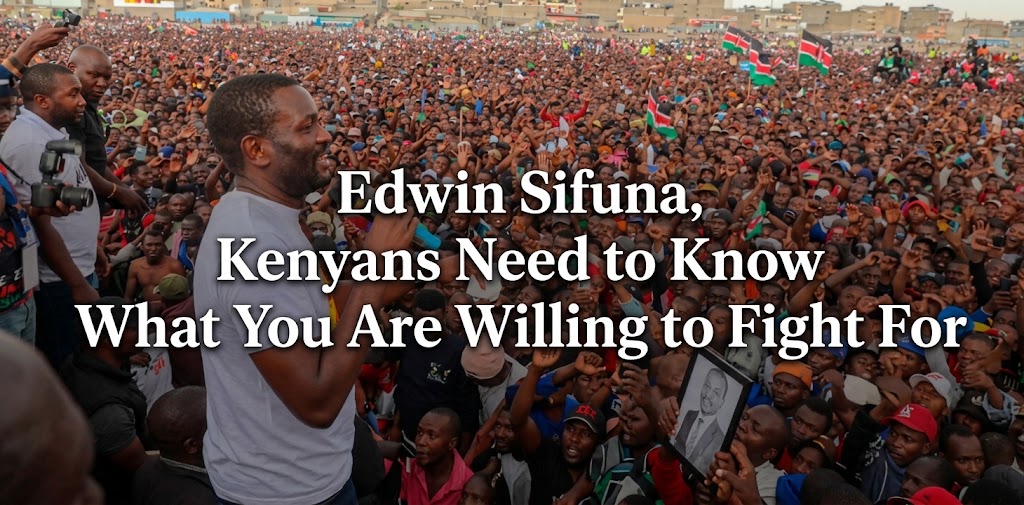
Edwin Sifuna has spent years establishing himself as one of Kenya’s most distinctive political voices. From his role in opposition politics to his time in Parliament, he has demonstrated an ability to articulate political arguments, challenge those in power and command public attention.
Table Of Content
- Look at the Lesson from “Bottom-Up”
- Ndindi Nyoro Illustrates Another Important Point
- How Will You Confront the Monster?
- Will There Be Sacred Cows?
- The Bigger Battle Is Cultural
- Change the Culture, Not Just the Officials
- Build a Team Prepared to Stand With You
- Because Every Other Promise Depends on This
- Edwin, This Is the Message I Want You to Find
Now, as he sets his sights on the presidency, I believe the conversation around him needs to move to a different level.
Read Also: Edwin Sifuna and Barack Obama: Striking Parallels Between Two Charismatic Political Leaders
What exactly does Edwin Sifuna want to change about Kenya?
I ask this not as a critic, but as someone who has followed his political journey closely and genuinely wants to see him give this ambition his very best.
Edwin is my guy.
And precisely because I believe he has something important to offer, I think he needs to hear this:
You need to give Kenyans a defining message.
You have the voice. You have the confidence. You can debate, confront and articulate an argument with remarkable clarity. But whenever I listen to you in the context of your presidential ambition, I find myself asking a simple question:
Read Also: Ndindi Nyoro Biography: Early Life, Education, Business, Investments and Political Career
What is the one thing Edwin Sifuna passionately wants to change about Kenya?
That, I believe, is the missing link between you and many Kenyans who are hungry for change.
Look at the Lesson from “Bottom-Up”
Whether one agrees with William Ruto’s politics or his record in office is a separate conversation. But his 2022 campaign offers an important lesson in political communication.
He took a complicated economic and political argument and gave it a simple identity:
Bottom-Up.
The “Hustler” narrative gave ordinary people a place within that story. Whatever one’s assessment of the subsequent outcomes, the messaging itself was easy to understand and remember.
That is the muscle I believe you need to develop.
And I would not advise you to copy Ruto.
Find your own.
Ndindi Nyoro Illustrates Another Important Point
Give Ndindi Nyoro a platform and he frequently gravitates towards economics. Debt, taxation, public expenditure, jobs, investment and the economy are subjects he speaks about with particular fluency.
Part of that is naturally explained by his training as an economist.
You are a lawyer.
So perhaps your defining political territory should be the issue at the heart of Kenya’s governance crisis:
Corruption.
Not corruption as another item buried somewhere in a manifesto.
I mean making the fight against corruption one of the defining missions of your presidency.
But if you choose that road, don’t simply tell Kenyans, “I will fight corruption.”
They have heard that promise many times.
Tell them exactly how.
How Will You Confront the Monster?
As a lawyer, you have an opportunity to take this conversation somewhere deeper.
Would you strengthen the institutions responsible for investigating, prosecuting and adjudicating corruption?
Would you push for specialised judicial capacity to ensure corruption and economic-crime cases are handled efficiently while respecting the independence of the Judiciary?
How would you strengthen the Office of the Director of Public Prosecutions, which handles criminal prosecutions, alongside EACC’s investigative mandate?
How would you ensure that investigations do not take years, evidence does not disappear and cases do not collapse through procedural failures?
How would you accelerate the recovery of stolen public assets?
And perhaps the most important question:
What happens when corruption fights back?
Because it will.
Read Also: The Matiang’i-Sifuna Calculus: Can a Technocrat-Charisma Ticket Unseat the Current President?
Will There Be Sacred Cows?
This is where I think you can give Kenyans a message they can understand.
What happens when the person accused of stealing public money is your political ally?
What happens when he financed your campaign?
What happens when she is a billionaire?
What happens when the suspect is a powerful politician, a close friend or somebody from your own political establishment?
Will the law apply differently to the powerful?
Or will your administration say:
“We don’t ask who you are before we ask what you did.”
That is the kind of statement Kenyans can remember.
But it has to be backed by action.
Your own ministers, advisers, party officials and political allies must be subjected to the same standards as everybody else.
Otherwise the anti-corruption message becomes another campaign slogan.
The Bigger Battle Is Cultural
There is another dimension that deserves your attention.
Corruption has become so normalised in parts of Kenyan society that genuine public service can sometimes surprise people.
A citizen gets a service without paying a bribe and wonders why.
Someone refuses to “facilitate” an official and is treated as though they are being unreasonable.
We have created an environment where people sometimes believe that knowing somebody, paying somebody or offering something is simply how government works.
That culture has to change.
Change the Culture, Not Just the Officials
So don’t just promise to arrest corrupt officials.
Tell Kenyans how you will protect honest public servants, protect whistle-blowers, digitise government processes, reduce opportunities for discretionary interference and make public spending more transparent.
Teach the next generation that public office is public service, not an opportunity to harvest public resources.
Build a Team Prepared to Stand With You
A mission of this magnitude cannot be fought by one man.
You would need people around you who understand that fighting corruption means fighting powerful interests, including interests that may eventually turn against your own administration.
How will you select them?
How will you vet them?
What happens when one of your closest allies is implicated?
What happens when the person standing accused is politically useful to you?
That is where Kenyans will judge whether the mission is genuine.
Because Every Other Promise Depends on This
You can have the most sophisticated economic blueprint in Africa.
You can have ambitious plans for healthcare, agriculture, manufacturing, education, housing, infrastructure and jobs.
But if money allocated for those programmes is systematically diverted, the blueprint remains a beautiful document.
The money must reach the hospital.
The road must actually be built.
The farmer must receive the intended support.
The student must receive the promised opportunity.
The taxpayer must see value for their money.
That is why the fight against corruption cannot be treated as a footnote in a presidential manifesto.
It can be the foundation upon which everything else is built.
Read Also: Nelson Mandela: The Prisoner Who Became a President
Edwin, This Is the Message I Want You to Find
I am not suggesting that you campaign on corruption alone or abandon the other responsibilities of government.
You will need comprehensive policies for the economy, healthcare, education, agriculture, security, housing, infrastructure and foreign relations.
But you need one powerful idea that ties your presidency together.
So I would challenge you to complete this sentence:
“If Edwin Sifuna becomes President, the defining change Kenyans will remember his government for is __________.”
Fill that blank.
Then build your campaign around it.
Don’t make “Ruto must go” the entire message.
That only tells Kenyans what you want to remove.
Tell them what you want to build.
Don’t simply tell Kenyans that you want regime change.
Tell them what will change when the regime changes.
Don’t just give them a manifesto.
Give them a mission.
And if you decide that the mission is to confront corruption to its logical conclusion, then make Kenyans understand that you are prepared to follow that fight wherever it leads — even when it leads to powerful people, political allies and members of your own administration.
Because that is the kind of presidential message that can rise above ordinary political rhetoric.
Edwin, you already know how to speak.
Now tell Kenyans what you are willing to stand for, what you are willing to fight for, and what you are willing to risk politically to deliver it.
There are many Kenyans who want change.
The missing link may simply be giving that change a clear idea, a face and a mission they can believe in.
During your recent interview with Yvone Okwara of Citizen TV, as I listened and followed the conversation, I could see her nudging, or perhaps goading, you toward making that declaration. But you did not quite pick up the signal.
I believe that was one of those moments when Kenyans could have been given a glimpse into your personal stand.
I use the word “personal” deliberately.
The business community, students, farmers, professionals, workers, young people and virtually every other Kenyan are sitting on the edge of their seats, trying to understand whether the message you are developing speaks to their aspirations. They want to know: What is the one thing that Edwin Sifuna personally feels must change about Kenya?
The Jacaranda rally presented another grand opportunity.
You had a mammoth crowd in front of you, and millions of Kenyans were following the proceedings from their homes. That was another moment when you could have planted a powerful idea in the minds of the country and begun giving your presidential ambition a distinct identity.
But again, I felt the opportunity passed.
Of course, you spoke about affordable housing. And there is nothing wrong with that. But if you have been following the national conversation, you know that affordable housing has already been widely discussed by politicians across the political divide.
What I kept asking myself was this:
What if, instead of speaking about an issue that has already occupied so much political space, you had used that moment to tell Kenyans about the change you personally and passionately want to make?
What if you had stood before that enormous crowd and said, in essence: “This is the Kenya I want to change, and this is the battle I am prepared to fight from the first day I occupy State House”?
That would have been different.
That would have given Kenyans something to think about, discuss and carry home.
A presidential campaign cannot only be about the problems everyone already knows. At some point, the candidate has to reveal the central conviction that drives his or her ambition.
That is the footprint I am talking about.
Edwin, you have already demonstrated that you can command a political stage. What I am asking you to do now is to give Kenyans a reason to remember what you said after the microphone has been switched off.
Tell them your personal stand.
Tell them the battle you are prepared to take on even when it becomes politically uncomfortable.
Tell them what you believe must fundamentally change about Kenya — and then show them how you intend to do it.
You have the microphone, my brother. Give Kenyans something worth carrying home.
Read Also: US Confirms Deployment of Orbital Space Weapons in Historical Shift
Never Miss a Story: Join Our Newsletter