
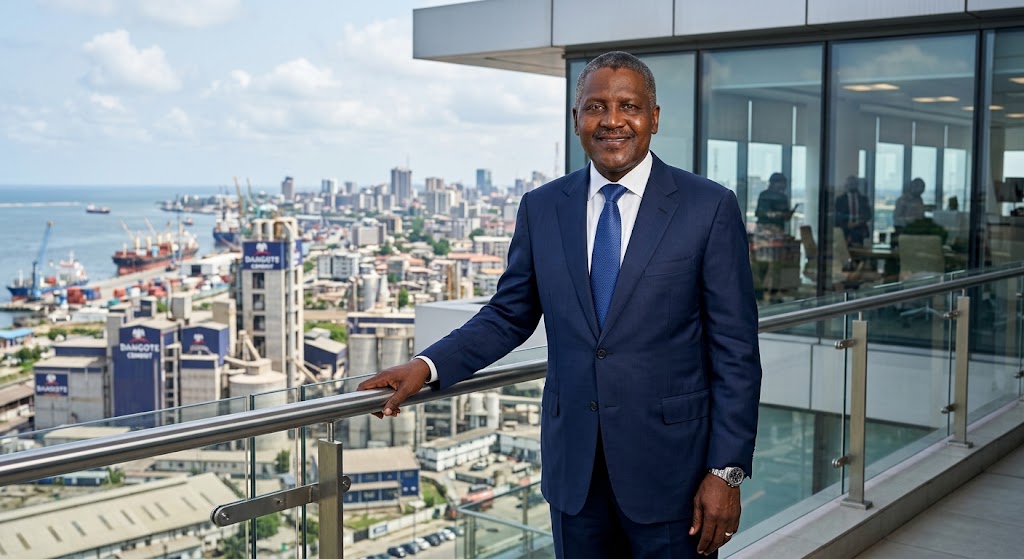
When Aliko Dangote was a child in Kano, Nigeria, there was little indication that he would one day become Africa’s richest person and one of the world’s most prominent industrialists. Yet the foundations of his business career were already being laid in a remarkably simple way. He was fascinated by commerce. According to Forbes, Dangote has recalled that as a young boy he bought sweets, gave them to other children to sell and kept the profits. His grandfather was also a successful trader, and commerce was deeply embedded in the family environment in which he grew up.
Decades later, Dangote would control cement plants, fertilizer production, a giant oil refinery, logistics operations and businesses spread across several African countries. His name would become associated with projects measured not in thousands or millions of dollars, but in billions. Yet the most interesting part of Dangote’s story is not his wealth. It is the evolution of his thinking. He did not begin by building factories. He began by trading. He learned distribution before manufacturing. He learned the customer before attempting to control production. He gradually moved from selling products made by other people to producing those products himself, then to controlling the raw materials, transportation and infrastructure surrounding them.
His career therefore provides an extraordinary study of how a relatively conventional trading business can evolve into an industrial empire. As of September 2026, Forbes estimates Dangote’s personal fortune at about $31.4 billion, making him Africa’s richest person. His principal wealth remains associated with cement, while his business empire has expanded dramatically into fertilizer, petroleum refining and other industrial activities.
1. The Family Behind the Entrepreneur
Dangote was born in Kano in 1957 into a wealthy Muslim commercial family. His maternal grandfather, Alhassan Dantata, was a prominent West African businessman whose activities included commodity trading. Dangote grew up surrounded by people who understood buying, selling, negotiation, credit, distribution and the movement of goods.
That background is important because Dangote’s story is sometimes simplified into a “started from nothing” narrative. He did not start from nothing. He came from a financially established family and had access to business knowledge and connections that most aspiring entrepreneurs do not have. That advantage should not be ignored. At the same time, having a wealthy family background does not automatically produce a multibillion-dollar industrial empire. Dangote had to make a series of decisions that transformed the advantages available to him into businesses of extraordinary scale.
After studying at Al-Azhar University in Cairo, he returned to Nigeria and entered the world of commerce. Forbes records that he initially worked with his maternal uncle in commodities trading before receiving a business loan from his uncle to start his own operation. That loan is frequently cited as the beginning of the modern Dangote story.
2. 1977: The Young Trader Enters Business
In the late 1970s, Dangote started trading commodities in Nigeria. The business dealt in essential products such as rice, sugar and cement.
This may sound modest compared with what came later, but there was already an important principle embedded in his choice of products. He was not trying to sell something fashionable. He was selling things people needed. Rice would be consumed, sugar would be consumed, and cement would be needed to construct buildings. These were products with established markets.
That was important because Dangote did not have to create demand from scratch. His task was to understand how existing demand could be supplied more efficiently and profitably. The early business was fundamentally a trading operation, but trading also gave Dangote something that would later prove more valuable than the initial profits: knowledge.
He could see which commodities moved quickly, observe where shortages occurred, understand customers’ purchasing patterns and learn how transportation and storage affected margins. He could also see how exchange rates, import costs and government policies affected prices. Most importantly, he could see where the biggest opportunities existed.
This would eventually lead him to a fundamental question: Why continue importing products when Nigeria itself could manufacture them?
That question changed the direction of his career.
3. From Trading to Manufacturing
The first stage of Dangote’s career was therefore not about becoming a manufacturer; it was about becoming an increasingly knowledgeable trader. Many aspiring entrepreneurs want to manufacture before they understand the market. Dangote effectively did the reverse. He first understood the market and distribution system, and then moved toward production.
Dangote Industries was established in 1981 as a trading company, with activities involving commodities such as cement, sugar, rice, flour and salt. Over time, the company began moving aggressively into manufacturing.
The shift represented a profound change in business philosophy. As an importer, Dangote depended on someone else to manufacture the product. As a manufacturer, he could control production. As a large-scale manufacturer, he could control costs. As an integrated manufacturer, he could eventually control raw materials, energy, transport and distribution.
That progression became the defining characteristic of the Dangote business model.
4. Why Cement Became the Foundation
Among all the commodities in which Dangote operated, cement became particularly important. Nigeria was a rapidly urbanizing country with enormous infrastructure requirements. People needed houses; governments needed roads, schools and hospitals; businesses needed factories, offices and warehouses; cities were expanding.
All of those activities required cement.
Dangote recognized that Nigeria’s cement market represented more than a commodity opportunity. It represented a structural industrial opportunity. The country had demand, but domestic production was insufficient. That meant Nigeria was importing a product that could potentially be produced domestically at enormous scale.
Dangote began moving deeper into cement manufacturing, and one of the most significant steps was his involvement with the Obajana cement project in Kogi State. The facility eventually became one of the largest cement plants in Africa. Over time, the plant was expanded repeatedly, and the larger Dangote Cement business developed into a pan-African industrial operation.
The significance of Obajana was not simply that it produced cement. It represented a fundamental change in Dangote’s business model. He was no longer merely asking, “How much cement can I sell?” He was asking, “How much cement can I produce, and how much of the production chain can I control?”
5. Vertical Integration: Controlling More of the Value Chain
Consider what is involved in producing cement. There is limestone, quarrying, transportation, crushing, clinker production, grinding, packaging, energy, trucks, warehouses and distribution.
Dangote increasingly sought to control multiple parts of this chain.
This is called vertical integration, and it became one of his most powerful strategies. If an entrepreneur depends on ten outside companies to supply ten essential parts of a product, every disruption can hurt the business. If the entrepreneur can control several of those stages internally, the business can become more resilient.
That does not mean vertical integration is automatically superior. Owning too many parts of a business can create enormous complexity and consume huge amounts of capital. But when the economics make sense, controlling critical stages of the supply chain can create a powerful competitive advantage.
Dangote repeatedly used this principle.
His involvement with Benue Cement and the subsequent expansion of its production capacity demonstrated another part of his strategy: he did not always have to build from zero. Existing industrial assets could be acquired, improved, expanded and integrated into a larger system.
This was not simply entrepreneurship through creation. It was entrepreneurship through acquisition, integration and scale.
6. 2010: Dangote Enters the Capital Markets
A major milestone came in 2010 when Dangote Cement became a publicly listed company following its combination with Benue Cement.
This was enormously important because it changed the financial architecture of the business.
Dangote was no longer relying solely on family money, business profits and conventional private financing. A publicly listed company could access the capital markets. Investors could buy shares, and the company could use its scale and reputation to attract institutional capital.
This is an important stage in the development of almost every large industrial enterprise. The entrepreneur begins with personal or family capital, then moves through trading profits, bank financing, retained earnings and institutional investment. Eventually, the capital markets can become another source of growth.
Dangote had effectively moved from the world of the small trader into the world of large-scale corporate finance.
7. From Nigerian Business to Pan-African Expansion
The next transformation was geographical.
Dangote could have built a huge Nigerian cement business and stopped there. Instead, he looked across Africa.
Countries such as Ghana, Senegal, Ethiopia, Zambia, Tanzania, Cameroon, South Africa and others offered something Nigeria had already demonstrated: growing populations, urbanization and infrastructure demand.
The company began establishing production capacity in multiple African markets.
Today, Dangote Cement reports total production capacity of about 55 million tonnes per year. Its 2025 results showed group revenue of approximately ₦4.307 trillion, EBITDA of about ₦1.981 trillion and profit after tax of approximately ₦1.015 trillion.
These figures show something important.
Dangote Cement is no longer simply a Nigerian company selling cement.
It is an African industrial platform.
8. Why Distribution Was the Hidden Advantage
There is an economic logic behind Dangote’s African expansion. Cement is a heavy product, and transporting huge quantities over long distances can be expensive. Therefore, building manufacturing capacity closer to customers can make economic sense.
Dangote’s expansion strategy effectively positioned production around major markets rather than relying entirely on one enormous Nigerian factory. This also reduced dependence on long international supply chains.
The result was a network of production assets rather than one giant business concentrated in one location.
The strategy was simple in principle: find demand, put production near the demand, build distribution around the production, and then connect the various markets into a larger regional system.
It is easy to look at Dangote’s factories and conclude that factories are what made him rich. That is only partly true. The deeper foundation was distribution.
Dangote learned distribution as a trader. He learned what customers wanted, how commodities moved, how to negotiate with suppliers, how transportation affected margins and where shortages occurred. He then carried that knowledge into manufacturing.
Manufacturing without distribution can be disastrous. You can build the best factory in the world and still fail if you cannot sell what you produce. Dangote’s early years in trading gave him an advantage because he already understood the commercial side of the equation.
He knew that producing something was only half the problem.
The other half was getting it to the customer.
9. Fertilizer: Moving Into Agriculture
Dangote’s ambitions eventually expanded beyond cement and food-related manufacturing.
Fertilizer represented another structural opportunity.
Nigeria is an agricultural country, yet farmers have historically depended heavily on imported fertilizer and other agricultural inputs. Dangote invested approximately $2.5 billion in a large fertilizer complex in Lagos. The plant began operations in 2022 and has annual urea production capacity of approximately three million tonnes.
Again, the pattern was familiar.
Dangote was not chasing a fashionable consumer trend. He was addressing a structural economic need.
Agriculture needs fertilizer. Nigeria has natural gas resources that can serve as feedstock for fertilizer production. Therefore, the opportunity was to convert an abundant natural resource into an industrial product that agriculture needs.
The formula was becoming increasingly clear:
Resource → processing → manufacturing → distribution → market.
10. The Refinery: Dangote’s Biggest Gamble
If cement built Dangote’s fortune, the refinery became the project that demonstrated the full scale of his ambition.
Nigeria is one of Africa’s largest oil producers, yet for many years the country imported large quantities of refined petroleum products because its domestic refining capacity was inadequate or unreliable.
This created a remarkable paradox: Nigeria could produce crude oil but still import fuel.
Dangote saw the gap.
His answer was extraordinarily ambitious.
He would build a massive refinery—not a small refinery, and not a facility designed simply to satisfy a local niche, but a refinery capable of operating at a scale comparable with some of the largest facilities anywhere in the world.
The project took years and became one of the largest privately financed industrial projects in Africa. Construction began in the 2010s, and the facility eventually cost roughly $20 billion. It encountered financing challenges, construction difficulties, regulatory disagreements and issues involving crude supply. The refinery began producing petroleum products as it moved into operation in the 2020s.
This is where the popular version of entrepreneurship often becomes misleading.
Successful entrepreneurs do not necessarily experience smooth progress.
Large projects can take years longer than expected. Costs can increase. Markets can change. Governments can change policies. Financing can become difficult. Suppliers can fail. Customers can change.
Dangote continued pushing the project forward.
11. The Refinery Is More Than a Refinery
The refinery is also more than a fuel project.
Once again, the deeper strategy is integration. The facility is connected to storage, marine infrastructure, pipelines, power and petrochemical production. The objective is not simply to produce petrol. It is to create an integrated industrial ecosystem around petroleum.
A person who owns a petrol station is in the fuel business.
A person who owns a refinery is in the refining business.
A person who owns refining, petrochemicals, storage, logistics and distribution infrastructure begins to participate in a much larger portion of the energy value chain.
That is increasingly where Dangote has positioned himself.
12. 2026: The Refinery Goes Toward the Public Markets
In September 2026, another major stage of the refinery’s story began.
Nigeria’s Securities and Exchange Commission approved an IPO for the Dangote Refinery. The offering is designed to raise approximately $1.6 billion through the sale of shares, with the proceeds intended to support the refinery’s expansion. Reuters reported that the plan is to increase capacity toward approximately 1.4 million barrels per day.
This represents another stage in Dangote’s evolution.
The businessman who began with a family-supported trading operation is now using the public capital markets to finance the expansion of a giant industrial asset.
In other words, Dangote has moved through several forms of capital:
family capital → trading profits → bank financing → corporate earnings → institutional capital → public investment.
That is a remarkable financial evolution.
Dangote has described the refinery IPO as a way of allowing ordinary Africans to participate in the ownership of a major industrial enterprise. Whether the offering ultimately achieves all of its ambitions remains to be seen, but the concept is significant.
Historically, many African citizens have watched enormous companies operate around them without having direct ownership. A successful public offering can potentially change that. Instead of simply buying the fuel produced by a refinery, investors can potentially own shares in the enterprise producing it.
13. September 30, 2026: Dangote Comes to Kenya
The latest chapter in Dangote’s story is particularly relevant to East Africa.
On September 30, 2026, Dangote and Kenyan President William Ruto broke ground in Lamu for a proposed $16 billion refinery.
The project is designed to process approximately 700,000 barrels of crude oil per day and is intended to supply petroleum products to Kenya and other East African markets. It is planned to include a 1,000-megawatt power plant, and Dangote has offered regional governments an opportunity to take a combined stake of approximately 30%.
This is not a small expansion.
It represents the export of the Dangote industrial model from West Africa to East Africa.
Nigeria was the laboratory.
Kenya could become the next major platform.
The project is intended to serve a market extending beyond Kenya, potentially including countries across the wider East African region. It is therefore consistent with the same strategy Dangote used in cement: do not simply sell into a market; build infrastructure within the market.
14. The Risks and Controversies of Industrial Scale
The Lamu project is not without controversy.
Local landowners and environmental campaigners have raised concerns about land rights and environmental impacts, including the project’s proximity to the Lamu cultural and environmental landscape. Reuters has reported legal challenges surrounding the project, while Dangote has maintained his commitment to proceeding.
This illustrates an important reality about industrial entrepreneurship.
The bigger the project, the bigger the consequences.
A small shop can affect a few dozen people. A factory can affect a community. A refinery can affect an entire region.
Industrial development therefore brings not only economic opportunities but also questions about land, environment, employment, energy security, competition and public policy.
There is another issue that deserves serious attention: Dangote’s extraordinary market power.
Supporters argue that his investments have helped Nigeria replace imports with domestic production, create jobs and develop industrial capacity. Critics have questioned whether the dominance of a single private group in strategic sectors such as cement and petroleum can create excessive market concentration.
These debates are particularly important in emerging economies where governments are trying to encourage domestic manufacturing while also protecting competition.
The tension is difficult to avoid. If governments want local industries to become globally competitive, they may need to support domestic production. But the stronger those domestic companies become, the more important competition policy becomes.
Dangote’s story therefore sits at the intersection of entrepreneurship, industrial policy and government.
15. The Real Strategy Behind the Empire
At first glance, Dangote’s success appears to be about money, but money alone does not explain it.
Many wealthy people have access to capital. Very few turn that capital into continent-scale industrial infrastructure.
Dangote repeatedly did something else.
He looked for structural shortages, then asked how to control the supply chain behind those shortages.
He started with trading, moved into manufacturing, expanded capacity, integrated raw materials, built distribution, expanded geographically and eventually accessed capital markets.
The sequence matters.
He did not jump directly from trading to a $20 billion refinery.
There were decades of accumulation between the two.
16. Moving Upstream: From Seller to Producer to Infrastructure Owner
Perhaps the simplest way to understand Dangote’s journey is to follow his movement upstream.
At the beginning, he was near the customer. He bought and sold commodities.
Then he moved toward distribution.
Then he moved into manufacturing.
Then he moved toward raw materials and energy.
Each move gave him more control.
Imagine a simple construction-material business. At the bottom of the chain, you buy a finished product and resell it. At the next level, you buy directly from the manufacturer. Then perhaps you become the distributor. Then you manufacture. Then you control raw materials. Then you provide transportation.
At each stage, the entrepreneur moves closer to the source of value.
That is essentially what Dangote did.
17. Why Dangote Chose “Boring” Businesses
Another reason Dangote’s story deserves attention is that his greatest businesses are not particularly glamorous.
Cement is boring.
Fertilizer is boring.
Sugar is boring.
Logistics is boring.
Refining is complicated rather than glamorous.
But these businesses are tied to necessities.
People need food.
People need homes.
Farmers need fertilizer.
Factories need energy.
Vehicles need fuel.
Buildings need cement.
The entrepreneur who supplies a basic necessity to millions of people may have a much larger opportunity than the entrepreneur selling something fashionable to a small audience.
This is particularly relevant to Africa, where enormous unmet demand remains for basic infrastructure and essential goods.
18. The Dangote Lesson for Smaller Entrepreneurs
The average entrepreneur obviously cannot copy Dangote by building a refinery.
That would miss the point.
The real lesson is to copy the sequence of thinking.
Suppose someone starts selling construction materials. At first, they may simply buy and resell. But after several years, they might discover that customers repeatedly struggle to find certain products.
That creates an opportunity.
The business can start stocking those products, negotiate directly with manufacturers, offer delivery, provide installation and maintenance, and perhaps eventually move into local assembly or manufacturing.
The business has moved from:
seller → distributor → service provider → manufacturer.
That is a miniature version of the Dangote journey.
19. Turn a Product Into an Ecosystem
This way of thinking can be applied to almost any business.
Consider a trampoline company. Selling one trampoline produces one transaction, but a trampoline also requires installation, safety nets, springs, mats, padding, inspections, repairs and replacement parts.
A company that provides all those services is no longer simply selling trampolines. It is controlling the trampoline ecosystem.
The same applies to glass. A company can sell a shower enclosure, but it can also provide measurement, design, installation, hardware, maintenance, office partitions, balustrades, façades and commercial glazing.
The entrepreneur who thinks in ecosystems can generate much more value from the same customer.
That is very close to the way Dangote thinks about industry.
20. Find the Bottleneck
Perhaps Dangote’s greatest asset is not any individual factory but his ability to identify bottlenecks.
A bottleneck is something that prevents an entire market from functioning efficiently.
Nigeria had cement shortages, so he built cement factories.
Nigeria imported refined petroleum products, so he built a refinery.
Nigeria needed fertilizer, so he built fertilizer capacity.
East Africa depends heavily on imported petroleum products, so he is now attempting to build another refinery.
The pattern is remarkably consistent:
Find the bottleneck. Control the bottleneck. Build infrastructure around it. Then scale.
This is one of the most powerful lessons in the entire Dangote story.
21. Patience: The Invisible Ingredient
The refinery is perhaps the clearest example of another defining characteristic: patience.
An entrepreneur accustomed to measuring success every month would probably struggle with a project that takes many years to complete.
Dangote has demonstrated an unusually long investment horizon.
Cement plants take years.
Refineries take years.
Mining and industrial infrastructure take years.
Public-market expansion takes years.
This is one reason his story cannot simply be reduced to entrepreneurial motivation.
It is a story about capital allocation over decades.
He has repeatedly been willing to commit enormous resources today in expectation of economic benefits years later.
22. But Patience Does Not Mean Stubbornness
Dangote has repeatedly changed direction.
He began with commodities, then manufacturing, then cement, then pan-African expansion, then fertilizer, then refining, and now increasingly broader energy infrastructure.
The underlying principle remained stable: find large structural demand.
But the businesses used to pursue that principle changed.
Successful entrepreneurs may remain committed to the destination while changing the vehicle.
That distinction is important.
Persistence means continuing to pursue an objective.
Stubbornness means refusing to change the method.
Dangote’s career demonstrates much more of the former.
23. From Businessman to Institution Builder
Perhaps the most profound part of Dangote’s journey is what happened to the scale of his ambitions.
A young trader thinks about profit.
A growing entrepreneur thinks about market share.
A large businessman thinks about assets.
An industrialist thinks about infrastructure.
An institution builder thinks about systems that continue operating beyond the founder.
Dangote increasingly operates at the final level.
His businesses require thousands of employees, engineers, financiers, managers, logistics professionals, technicians and executives. The organization is too large for one man to personally run.
That means the real achievement is not simply owning businesses.
It is creating institutions capable of operating enormous systems.
24. Where Dangote Stands in 2026
By 2026, Dangote’s empire has reached a point almost unimaginable when he began trading commodities.
Dangote Cement has about 55 million tonnes of annual production capacity and generated more than ₦4.3 trillion in revenue in 2025, with profit after tax exceeding ₦1 trillion.
The fertilizer business has approximately three million tonnes of annual urea production capacity.
The Nigerian refinery is operating and preparing for major expansion.
The refinery is simultaneously being opened to public investors through an IPO.
And on September 30, 2026, Dangote broke ground on the proposed $16 billion Lamu refinery in Kenya.
His personal fortune, according to Forbes’ September 2026 real-time estimate, stands at approximately $31.4 billion.
But the numbers alone do not explain the significance.
What matters is the industrial capacity sitting behind them.
25. The Real Dangote Story
The temptation is to summarize all of this with a single sentence:
“Aliko Dangote started with a small loan and became Africa’s richest man.”
That statement captures the destination but misses the journey.
The deeper story is that a young man entered commodity trading, learned the market, learned distribution, built relationships, accumulated capital, moved into manufacturing, identified cement as a structural opportunity, built enormous production capacity, expanded across Africa, integrated supply chains, entered fertilizer, tackled Nigeria’s refining deficit, built one of Africa’s largest industrial projects, opened the refinery to public investment and is now taking the same industrial philosophy into East Africa.
His journey therefore represents a progression from commerce to control.
He began by selling things other people produced.
Then he produced the things himself.
Then he controlled more of the raw materials and infrastructure required to produce them.
Then he expanded that model across borders.
That is why Dangote’s story is ultimately not a story about becoming rich.
It is a story about understanding where value is created and gradually moving closer to the source of that value.
26. What Entrepreneurs Can Actually Learn From Him
For the ordinary entrepreneur, this may be the most useful part of the entire story.
You do not need a billion-dollar idea.
You need to understand a market deeply enough to see where money is already moving and where the supply chain is failing.
You need to learn distribution.
You need to understand what customers repeatedly need.
You need to identify bottlenecks.
You need to reinvest.
You need to move closer to the source of value when the economics justify it.
You need to turn individual transactions into recurring relationships, and relationships into systems.
Eventually, if the opportunity is large enough, you can use other people’s capital to accelerate what you have already proven.
That is the real Dangote formula.
He did not begin with a refinery.
He began with trading.
The refinery became possible because of everything that came before it.
The cement empire became possible because he understood commodities and distribution.
The pan-African expansion became possible because he had already built manufacturing capacity in Nigeria.
The fertilizer business became possible because he understood the importance of natural resources and industrial processing.
The refinery became possible because decades of capital accumulation, financing relationships, management experience and industrial knowledge had created the platform from which such a project could be attempted.
27. The Next Chapter: From Nigeria to a Continental Industrial Network
And now Kenya represents another test of the model.
A businessman who started by moving commodities is attempting to move entire energy systems.
That is the extraordinary transformation at the heart of Aliko Dangote’s career.
From sweets to commodities.
From commodities to manufacturing.
From manufacturing to cement.
From cement to African industrial expansion.
From industrial expansion to fertilizer and refining.
From Nigeria to a broader African ambition.
And from private ownership toward public capital.
At 69, the journey is still underway. The Nigerian refinery is being expanded, its ownership is being opened to public investors, the cement empire continues to grow, fertilizer remains an important part of the industrial portfolio, and the proposed Lamu refinery has entered its construction phase.
The boy from Kano who learned the economics of buying and selling has spent nearly five decades turning that simple lesson into one of the most ambitious industrial enterprises Africa has ever produced.
The greatest lesson in his story is therefore not “become a billionaire.”
It is something much more practical:
Find where value is already flowing. Learn why it flows that way. Identify what limits it. Control that bottleneck. Reinvest the gains. Move upstream. Build systems. And give yourself enough time for the system to become larger than the person who started it.
That is how a commodity trader became an industrialist.
And that is how Aliko Dangote’s journey—from a young businessman in Kano to the builder of an African industrial empire—continues into its next chapter.
Never Miss a Story: Join Our Newsletter