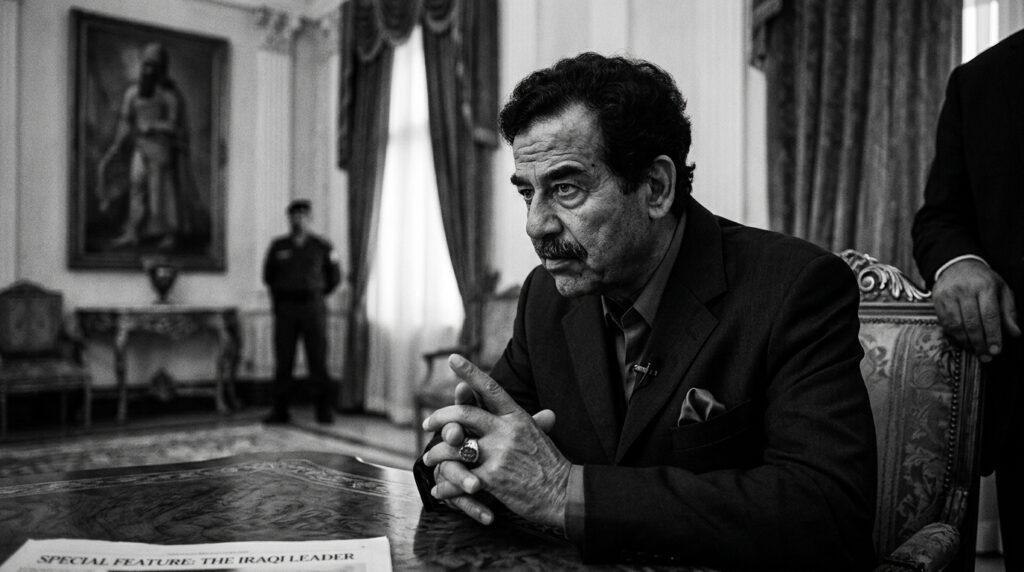
On July 22, 1979, six days after assuming the presidency of Iraq, Saddam Hussein convened a meeting of the Ba’ath Party leadership in Baghdad. What began as a routine gathering quickly transformed into a chilling spectacle of political purge that would define his rule for the next quarter-century . Before the assembled party officials, a man named Muhyi Abdul-Hussein Mashhadi mounted the podium and began reading a list of names. One by one, those named were removed from the room. Sixty-eight people were identified and arrested; twenty-two were sentenced to death, with twenty-one ultimately executed. The most horrifying aspect of the day came afterward: surviving members of the leadership were reportedly ordered to participate in the executions of their former colleagues .
The message was unmistakable. Saddam Hussein was no longer merely a senior Ba’athist or a figurehead president. He was now the undisputed ruler of Iraq, and his reign would be built upon a foundation of fear, loyalty, and absolute obedience. The footage of that day’s purge became one of the most notorious records of his consolidation of power, serving as a macabre warning to anyone who might contemplate opposition .
For those born after his fall, understanding Saddam Hussein is essential to comprehending not just Iraqi history but the broader geopolitics of the Middle East, the contradictions of Western foreign policy, and the devastating consequences of authoritarian rule in the modern era. Born on April 28, 1937, to a poor farming family in the village of al-Awja near Tikrit, Saddam’s early life was marked by poverty and political awakening. His rise from these humble beginnings to become one of the most feared dictators of the twentieth century is a story of ruthless ambition, strategic cunning, and the manipulation of both internal and external forces .
His political career began in earnest in 1956 when he joined an uprising against the pro-British monarchy. By October 1959, at the age of twenty-two, he participated in an attempt to assassinate Prime Minister Abdel-Karim Kassem, an act that forced him to flee to Syria and then Egypt . In Cairo, he studied law at Cairo University from 1962 to 1963 while maintaining his Ba’ath Party connections . These early years shaped his worldview, teaching him the importance of revolutionary commitment, the fragility of political institutions, and the necessity of absolute loyalty to one’s cause.
The Ba’ath Party first seized power in a 1963 military coup, but was toppled nine months later. Saddam was arrested and imprisoned, yet even from his cell, he was elected deputy secretary-general of the party . This period of incarceration only deepened his resolve and honed his political instincts. When the Ba’ath Party returned to power in the 1968 revolution, Saddam had positioned himself as a key player, becoming vice chairman of the Revolutionary Command Council in November 1969 . Over the next decade, he skillfully managed the levers of power, building a vast security apparatus and eliminating rivals while President Ahmed Hassan al-Bakr nominally held the top position.
By 1979, the sixty-two-year-old al-Bakr was in poor health, and Saddam had consolidated enough power to assume the presidency . The purge that followed his ascension was not merely an act of cruelty—it was a calculated political strategy designed to eliminate any potential threat to his absolute authority. This was the moment when Saddam Hussein transformed from a political operative into the architectural master of a regime of terror.
Consolidation of Power and the Machinery of Repression
Saddam’s seizure of power on July 16, 1979, marked the beginning of one of the most brutal authoritarian regimes of the late twentieth century . The purge at the party meeting was just the opening act in a systematic campaign to eliminate all opposition, real or perceived, from within the Ba’ath Party and across Iraqi society . In the months following his ascension, he had hundreds of party members and army officers executed . This was not a regime that imprisoned its opponents; it liquidated them.
Central to Saddam’s control was the construction of an elaborate security apparatus. Multiple overlapping intelligence agencies—the Mukhabarat (intelligence service), the Amn al-Amm (General Security), and the Istikhbarat (military intelligence)—created a climate of total surveillance . Spies were everywhere, informants were incentivized, and citizens were actively encouraged to report on their neighbors, colleagues, and even family members. The regime operated through an intricate web of fear in which no Iraqi could be certain who was watching or who might denounce them.
The scope of Saddam’s repression was staggering. Amnesty International documented in 2001 that Iraqi torture victims were subjected to multiple forms of punishment, including eye-gouging, brutal beatings, and electric shock. Some victims died under torture, while many more carried permanent physical and psychological scars . Political opponents, suspected dissidents, and even ordinary citizens caught in the wrong place at the wrong time could disappear into the regime’s prisons, never to be seen again.
The regime was willing to go to any lengths to suppress dissent. In 1983, the government ordered the execution of 148 Shi’ite men and boys in the town of Dujail following an assassination attempt against Saddam—the very incident that would eventually lead to his conviction and execution . This was not an isolated atrocity but part of a systematic pattern of violence against communities the regime perceived as a threat.
The true scale of Saddam’s brutality became clear after his fall, when mass graves were discovered across Iraq. These sites, containing the remains of thousands of victims, testified to the regime’s willingness to murder its own citizens on a massive scale. Human rights organizations estimate that Saddam’s regime was responsible for hundreds of thousands of deaths . This included the murders of approximately forty of his own relatives .
What made Saddam’s rule particularly chilling was the normalization of this violence. The regime did not hide its brutality; it was a deliberate tool of governance. Public executions served as macabre reminders to the populace of the consequences of disobedience. Bodies were sometimes returned to families with clear signs of torture, serving as messages to the wider community. The regime understood that fear, once sufficiently instilled, became a self-perpetuating mechanism of control.
Saddam’s consolidation of power also involved systematic efforts to eliminate Iraq’s political opposition. Communist Party members, Shi’ite activists, Kurdish nationalists, and even former Ba’athists who had fallen out of favor were targeted. The purges were not always predictable, and loyalty to Saddam personally mattered more than ideological commitment. This unpredictability was itself a tool of control: no one, no matter how loyal, could be entirely certain that they would not be the next to face the regime’s wrath.
The regime also systematically destroyed Iraqi civil society. Trade unions, professional associations, women’s organizations, and religious institutions were brought under state control or suppressed entirely. Political parties other than the Ba’ath Party were banned. The regime created a cult of personality around Saddam, with his image appearing everywhere—on posters, in schools, in government buildings, and even on currency. He was portrayed as a father figure to the nation, a wise leader who alone could guide Iraq through its challenges. This cult was not optional; it was enforced, and failure to display sufficient enthusiasm for the dictator could be interpreted as treason.
Economically, Saddam nationalized key industries and built a state-controlled economy that was heavily dependent on oil revenues. This created a system of patronage in which access to employment, housing, and services depended on loyalty to the regime. Those who were loyal could prosper; those who were not could be reduced to poverty or worse. The regime used economic leverage to coerce compliance and reward supporters, creating a class of beneficiaries who had a vested interest in the continuation of Saddam’s rule.
The Kurdish Genocide and Chemical Weapons
Among the darkest chapters of Saddam’s regime was the systematic persecution and genocide of the Kurdish population in northern Iraq. The Kurds, an ethnic minority concentrated in the mountainous northern region of Iraq, had long sought autonomy. Saddam’s response to Kurdish aspirations was not to negotiate but to annihilate.
Between 1987 and 1988, Saddam launched Operation Anfal, a brutal military campaign against Kurdish communities . The campaign, directed by Saddam’s cousin Ali Hassan al-Majid (infamously known as “Chemical Ali”), followed a systematic pattern. Villages were bombed, houses demolished, and inhabitants rounded up and executed. An estimated 2,000 Kurdish villages were destroyed during this campaign . The scale of the destruction was so extensive that it amounted to genocide, an attempt to eliminate the Kurdish population as a political and cultural force.
The campaign’s precise death toll remains a matter of dispute, but estimates are staggering. Human Rights Watch estimates that between 50,000 and 100,000 Kurds were killed during the Anfal campaign . Other estimates suggest that up to 180,000 Kurds died during the 1987-88 crackdown . Entire communities were erased, and survivors were forcibly displaced, with approximately 90,000 Iraqis becoming internally displaced due to the regime’s policies .
The most notorious single atrocity of the Anfal campaign occurred on March 16, 1988, when Iraqi forces launched a chemical attack on the Kurdish town of Halabja . The attack killed approximately 5,000 people, primarily civilians—women, children, and the elderly . Those who survived were left with permanent physical damage, including respiratory disorders, cancers, and birth defects. The Halabja attack remains one of the largest chemical weapons attacks ever directed at a civilian population.
Documentary evidence later emerged showing that Saddam personally authorized the use of chemical weapons against Kurdish populations. In his trial, prosecutors presented documents from Iraqi military intelligence seeking permission from the president’s office to use mustard gas and the nerve agent sarin against Kurds. A responding document confirmed that Saddam had ordered military intelligence to study the possibility of a “sudden strike” using such weapons against Iranian and Kurdish forces . An internal memo from military intelligence confirmed it had received approval from the president’s office for strikes using “special ammunition” and emphasized that no strike would be launched without first informing the president . The chain of command was clear: Saddam was personally responsible.
When questioned about the Halabja attack during his trial, Saddam defended his actions. He claimed that the Anfal campaign was a legitimate military operation against Kurdish militias who had sided with Iran during the Iran-Iraq War . However, this defense was contradicted by overwhelming evidence that the attacks targeted civilians, not just combatants. The regime made no effort to distinguish between Kurdish fighters and civilians, deliberately spreading the terror across the entire Kurdish population.
The regime also targeted other ethnic and religious minorities. Shi’ite Muslims, who constitute a majority of Iraq’s population, faced systematic discrimination and repression. Their religious practices were severely restricted, including bans on Friday prayers and limitations on funeral rites . After the 1991 uprising in southern Iraq, the regime intensified its persecution of Shi’ites, with reports indicating that up to 250,000 people may have died in the subsequent repression . Marsh Arabs in southern Iraq were targeted through a campaign of draining wetlands, destroying their traditional way of life and forcing displacement .
Saddam’s regime also implemented Arabization policies targeting Kurdish areas. The government systematically expelled Kurds, Assyrians, and Turkmen from the oil-rich region of Kirkuk and its surroundings, replacing them with Arab settlers . Between 80,000 and 100,000 Kurds and other minorities were forced from their homes in this campaign. The regime sought not merely to control Kirkuk’s oil resources but to fundamentally alter the demographic composition of the region, eliminating Kurdish identity and presence.
The Iran-Iraq War: Catalyst for Catastrophe
On September 22, 1980, Saddam launched a full-scale invasion of Iran, triggering an eight-year war that would devastate both countries and reshape the Middle East . The invasion was a catastrophic miscalculation that would cost approximately one million lives across both nations and cause total economic losses estimated at $900 billion . The war not only failed to achieve Saddam’s territorial and strategic goals but also fundamentally transformed the nature of his regime, making it even more brutal and repressive.
Saddam’s motivation for the invasion was complex and multifaceted. Iran was in chaos following the 1979 Islamic Revolution, which had overthrown the Shah and established a militant Shi’ite theocracy. Saddam saw an opportunity to assert Iraqi dominance in the Persian Gulf, regain control over the strategically vital Shatt al-Arab waterway, and potentially annex Iran’s oil-rich Khuzestan province . He also feared that Iran’s revolutionary government would inspire Iraq’s Shi’ite majority to rise up against his Sunni-dominated secular regime. The war was in part an attempt to preempt that threat by unifying the population behind a nationalist cause.
Initially, Iraq made significant territorial gains, capturing large swaths of Iranian territory. However, Iran’s military response was more effective than Saddam had anticipated, and by 1982, the war had stalemated, with Iranian forces pushing into Iraqi territory . The protracted conflict became a grinding war of attrition, with enormous casualties on both sides. Iraq’s military strategy evolved to include chemical weapons, terror tactics, and indiscriminate attacks on Iranian cities.
The Iran-Iraq War marked the first time that Saddam systematically employed chemical weapons against an enemy. Evidence presented during his trial showed that Saddam personally approved the use of chemical weapons against Iranian forces. A document from July 29, 1982, showed that Iraqi commanders had expressed concern about an Iranian offensive and had sought Saddam’s approval for a chemical attack. He approved the request . In his trial, Saddam acknowledged this responsibility, stating, “In relation to Iran, if any military or civil official claims that Saddam gave orders to use either conventional or special ammunition, which as explained is chemical, I will take responsibility with honor” .
The death toll from chemical weapons during the war was substantial. Human rights groups documented evidence of at least 30,000 Iraqis and Iranians killed by chemical attacks between 1983 and 1988 . Thousands more suffered lifelong injuries and disabilities. The regime’s willingness to use chemical weapons against Iranian forces, even when the Geneva Protocol had prohibited such weapons since 1925, demonstrated Saddam’s complete disregard for international law and basic human morality.
In 1988, after Iran’s mounting losses, military exhaustion, and international isolation, Tehran accepted UN Resolution 598, leading to a ceasefire that was officially implemented on August 20, 1988 . The war ended with no territorial changes, leaving both countries devastated. Iraq was burdened with massive war debts, a shattered economy, and a military establishment that had become increasingly powerful but also increasingly brutal.
The war had transformed Iraq. The regime’s military had expanded enormously, becoming a state within a state. The necessity of the war effort had been used to justify increasing repression at home, and the rhetoric of sacrifice was used to silence dissent. The regime had also become deeply embedded in a network of international arms suppliers, with the Soviet Union, France, China, and other countries providing weapons to Iraq throughout the conflict.
As the war progressed, the Iraqi military became increasingly reliant on a top-down command structure that discouraged initiative and punished failure. While the regime claimed victories, its troops suffered enormous losses against Iranian defenses. The Republican Guard was expanded and equipped with modern Soviet-made T-72 tanks, BMP-1 armored personnel carriers, and MiG-25 fighter jets, but the overall war effort remained one of attrition rather than decisive victory.
The psychological impact of the war on Iraq was equally profound. Saddam’s claim to be leading the Arab world against Persian Shia expansionism resonated with many Iraqis, but the costs were enormous. The war killed a generation of young men and crippled Iraq’s infrastructure, creating the conditions for widespread poverty that would persist for years after the conflict ended.
The Invasion of Kuwait and the Gulf War
On August 2, 1990, Saddam ordered the invasion of Kuwait, sending shockwaves through the international community . Iraq’s 100,000-man army quickly overwhelmed Kuwait’s defenses, occupying the tiny oil-rich emirate in less than a day . Saddam proclaimed Kuwait Iraq’s nineteenth province, an annexation that was universally condemned by the international community .
The invasion was driven by multiple factors. Iraq was economically crippled by the Iran-Iraq War, burdened with massive debts, and dependent on oil revenues for its survival. Saddam claimed that Kuwait was stealing Iraqi oil by slant-drilling across the border and that Kuwait had exceeded OPEC production quotas, driving down oil prices and depriving Iraq of desperately needed revenue . He also maintained that Kuwait was historically part of Iraq, a claim that had been made by Iraqi nationalists for decades .
The invasion of Kuwait led to the most severe international sanctions ever imposed on a nation. UN Security Council Resolution 661 imposed comprehensive economic sanctions on Iraq, prohibiting all trade with the country . The sanctions regime would remain in place for over a decade, causing widespread suffering among the Iraqi people but failing to dislodge Saddam from power .
The United States, under President George H.W. Bush, responded aggressively to the invasion. Operation Desert Shield was launched to prevent Iraq from invading Saudi Arabia, while an international coalition was assembled to force Iraq’s withdrawal from Kuwait . On November 29, 1990, the UN Security Council authorized the use of force against Iraq if it did not withdraw from Kuwait by January 15, 1991. Saddam refused to comply .
On January 17, 1991, coalition forces launched Operation Desert Storm, beginning a massive air campaign against Iraqi targets . The air war lasted thirty-eight days, with coalition aircraft flying over 100,000 sorties and dropping tens of thousands of tons of bombs . Iraq’s air defenses were systematically destroyed, its command and control systems collapsed, and its military infrastructure was devastated. Iraq attempted to retaliate by launching Scud missiles at Saudi Arabia and Israel, but these attacks caused limited casualties .
On February 24, 1991, coalition forces launched the ground phase of the campaign, Operation Desert Sabre. Within 100 hours of ground operations, the Iraqi Republican Guard was crushed, and Iraqi forces in Kuwait were routed . On February 26, Iraqi forces formally accepted all twelve UN resolutions, and by February 28, all coalition offensive operations had ceased. Kuwait had been liberated, but Saddam remained in power .
The aftermath of the Gulf War created conditions for mass suffering in Iraq. In March 1991, both Kurdish forces in the north and Shi’ite populations in the south rose up against the regime. The United States, which had encouraged these uprisings, did not intervene to support them. Saddam’s security forces responded with overwhelming force, killing tens of thousands of Shi’ite and Kurdish rebels . The regime’s repression of these rebellions was brutal, employing helicopter gunships, artillery, and chemical weapons to crush dissent.
Following the Gulf War, the UN sanctions regime remained in place for twelve years, contributing to widespread suffering among the Iraqi people. The sanctions made it nearly impossible for Iraq to import needed food, medical supplies, and replacement parts for critical infrastructure . The oil-for-food program, established in 1995, allowed Iraq to sell limited oil to purchase humanitarian goods, but this program was effectively controlled by the regime, which manipulated it for its own purposes . The regime maintained military stores filled with food while ordinary Iraqis went hungry.
The impact of sanctions on the Iraqi population was devastating. In 2003, British Prime Minister Tony Blair estimated that 400,000 children under the age of five had died in the previous five years because of malnutrition and preventable diseases, a death toll he attributed to the nature of the regime’s rule . The regime’s control over oil-for-food funds prevented food from reaching those who needed it most and ensured that the regime’s loyalists received preferential access to scarce resources.
The Post-Gulf War Years and Repression
Saddam’s survival of the Gulf War strengthened his conviction that he could weather any international challenge. Despite the comprehensive military defeat and crippling sanctions, he maintained absolute control over Iraq through his security apparatus, repressive instruments, and willingness to do whatever it took to preserve his regime. The 1990s were characterized by continued human rights abuses, devastating economic misery, and the deliberate starving of Iraqi civilians.
The regime systematically targeted political opponents, journalists, intellectuals, and anyone perceived as a threat to Saddam’s survival. The regime continued to use rape as a tool of political repression, employing sexual violence to break those who opposed the state and to terrorize communities suspected of harboring dissent . This brutality was not merely incidental to the regime but was central to its operation. Fear was the currency of Saddam’s rule.
In 1995, Saddam ordered the killing of his two sons-in-law, who had defected to Jordan but later returned to Iraq after receiving guarantees of safety . This act epitomized Saddam’s approach to governance: promises were meaningless, and no one, including family members, was safe from his paranoia. The regime was willing to murder even its closest allies to send a message to the rest of the political class and the wider populace.
The regime also engaged in the systematic destruction of political opposition abroad. Iraqi expatriates, including journalists, politicians, and activists, were not safe from Saddam’s reach. Iraqi intelligence operatives assassinated opponents in Europe, the United States, and the Middle East, demonstrating the regime’s determination to silence dissent regardless of location.
Saddam’s rule also saw a cult of personality unprecedented in the Arab world. His image was everywhere—on currency, on buildings, and in the homes of Iraqi citizens. The regime required all Iraqis to profess loyalty to Saddam and to participate in rituals of obedience, such as yearly referendums in which he won 99.96 percent and eventually 100 percent of the votes cast . These numbers were not inaccurate; they were entirely fabricated, but the regime required a public display of loyalty to maintain its legitimacy.
During the 1990s, Saddam also methodically undermined religious authority, limiting Friday prayers, restricting pilgrimages to Shia holy sites, and controlling religious organizations. The regime required all mosques to display Saddam’s portrait and to read political statements during sermons, ensuring that even spiritual authority served the interests of the state .
The United States and the West: From Cooperation to Conflict
One of the most troubling aspects of Saddam’s rule is the complex and contradictory role played by Western governments, particularly the United States. Despite the brutal character of his regime, which was evident from his rise to power, Western countries engaged with Saddam when it served their geopolitical interests .
The 1979 Iranian Revolution transformed the geopolitics of the Middle East. The Islamic Republic of Iran was fiercely anti-American and actively sought to export its revolution to other countries. To counter Iran, the United States began to view Iraq as a potential partner, despite clear evidence of Saddam’s brutality . This calculation became even more pronounced after September 1980, when Saddam invaded Iran .
The Reagan administration, which took office in 1981, systematically moved toward closer relations with Iraq. In November 1983, the United States removed Iraq from its list of state sponsors of terrorism, opening the door for diplomatic and economic engagement . This decision was made despite the regime’s documented support for terrorist groups and its ongoing repression of Iraqi citizens.
In December 1983, Reagan sent a special envoy to Baghdad with a personal letter for Saddam. That envoy was Donald Rumsfeld, who would later serve as Secretary of Defense during the 2003 invasion of Iraq. Declassified documents show that Rumsfeld met with Saddam and conveyed that the United States was willing to do more to help Iraq . At the same time, Baghdad was subject to American agricultural credits, economic assistance, and intelligence support .
The United States also provided intelligence to Iraq during the Iran-Iraq War. The U.S. used airborne warning and control systems to provide detailed information to the Iraqi military, which it used to coordinate attacks and identify incoming threats . A retired Iraqi brigadier general later confirmed that without U.S. intelligence, the Iraqi air force could not have effectively countered Iranian fighters.
During the war, Western governments were aware that Iraq was employing chemical weapons against Iranian forces and Kurdish civilians. The Reagan administration never seriously attempted to prevent Iraq from using chemical weapons . An Iraqi general admitted that Washington knew Iraq would use chemical weapons if Iranian forces entered Iraqi territory and that the United States continued to support Iraq despite this knowledge . This decision to ignore the regime’s use of chemical weapons—which continued for years—allowed Saddam to believe that he could act with impunity regarding WMDs.
Western support for Iraq did not cease with the end of the Iran-Iraq War. The United States and other countries continued to provide credits, dual-use technology, and strategic support until Saddam’s invasion of Kuwait in August 1990 . Even after Iraq invaded Kuwait, the United States did not immediately confront Saddam but first sought a diplomatic solution while continuing to supply military aid .
This cooperation was not a passing phase. The United States and Iraq were in a “principal-agent relationship” during much of the 1980s, with the U.S. providing support in exchange for Iraq’s cooperation in containing Iranian power and maintaining stability in the Gulf region . Saddam used this relationship to his advantage, buying advanced weapons, expanding his geopolitical reach, and establishing economic ties with Western countries .
The contradiction between the U.S. approach and its stated values was apparent. The United States was simultaneously condemning human rights abuses in other countries while cooperating with Saddam’s regime and turning a blind eye to the repression of Iraqi citizens . This contradiction did not mean the United States immediately decided to support Saddam after the 1979 coup—the relationship developed only after the regime proved useful in the Iran-Iraq War—but the inconsistency remains striking.
The Fall of a Dictator
The regime that had crushed its own citizens, used chemical weapons against its neighbors, and defied the international community came crashing down in March-April 2003. On March 20, the United States, Britain, and a coalition of other countries launched a military invasion of Iraq . The stated rationale was to eliminate Saddam’s weapons of mass destruction—which were later found not to exist—and to free the Iraqi people from a brutal dictator.
The invasion was swift and decisive. U.S. forces swept into Baghdad on April 9, 2003, and the regime collapsed . Saddam’s military forces were quickly routed, his security forces dissolved, and the once-dreaded dictator was forced to flee. On July 22, his sons Uday and Qusay were killed in a gun battle with U.S. forces in Mosul . On December 14, 2003, American troops found Saddam hiding in a “spider hole” near his hometown of Tikrit. He was captured without resistance, marking the end of his reign .
The regime’s fall led to the discovery of the full extent of its crimes. Mass graves containing thousands of bodies were found across Iraq. Documents detailing the regime’s atrocities emerged, including evidence of chemical attacks, systematic torture, and murder on a massive scale. The scope and systematic nature of the regime’s brutality became even clearer, confirming what human rights organizations had been saying for years.
Saddam’s trial began on October 19, 2005, before the Iraqi High Tribunal . The proceedings were controversial from the outset, but they provided a forum for victims and survivors to testify. The first case, Dujail, charged Saddam with crimes against humanity for the killing of 148 Shi’ite men and boys after a failed assassination attempt in 1982. During the trial, Iraq presented documentary evidence, and the process proceeded despite challenges and withdrawals by defense lawyers .
On November 5, 2006, the court found Saddam guilty and sentenced him to death by hanging . The verdict was appealed, but on December 26, 2006, the appeals court confirmed the sentence . Saddam was executed on December 30, 2006, just before the start of the new year . He was sixty-nine years old.
Saddam’s death did not bring closure to the Iraqi people, nor did it end the sectarian violence that had bloodied the country since the invasion. But his hanging symbolized a break with an era of rule by terror, a reminder of the regime’s crimes, and a sign that even the most powerful dictators are ultimately accountable.
Before his execution, Saddam wrote a farewell letter to the Iraqi people, positioning himself as a martyr who gave his life for his country . It was a final act of manipulation, but it was also revealing: Saddam saw himself not as a brutal dictator but as a heroic defender of Iraq against the unjust powers that had come to destroy him. In his farewell, he urged Iraqis to put aside sectarian hatred, a message that was at once a cynical plea and a glimpse of an Iraq that might have been .
Conclusion: The Enduring Significance of Saddam Hussein
Saddam Hussein’s rule was one of the most brutal, destructive, and oppressive regimes of the twentieth century. Under his leadership, Iraq became a byword for repression, terror, and militarism. The human cost was staggering: hundreds of thousands dead, millions displaced, and a nation’s potential squandered.
From the blood-soaked halls of the 1979 Ba’ath Party conference to the chemical attacks on Halabja, from the invasion of Kuwait to the wars that devastated the country, Saddam’s legacy was one of violence. His was a regime that built institutions of terror, that industrialized murder, and that poisoned its own people in the name of survival.
Yet Saddam’s legacy is also one of complexity and contradiction. The United States, which ultimately led the invasion to topple him, had supported him during the Iran-Iraq War. The Western governments that condemned his use of chemical weapons had been aware of it for years and had not intervened. The regime that ruthlessly suppressed dissent had been sustained, in part, by foreign nations that placed geopolitical interests above moral considerations.
Saddam’s regime was also a product of its time, reflecting the Cold War and post-Cold War geopolitics, the struggles of the Arab world with modernization, the tensions between Sunnis and Shi’ites, and the ongoing conflict between Kurds and Arabs. His regime was shaped by the same forces that have shaped the wider Middle East.
The history of Saddam Hussein illustrates the dangers of unchecked power, the consequences of authoritarian rule, and the moral compromises that states sometimes make in the pursuit of strategic goals. It also highlights the continuing relevance of human rights, international law, and accountability for crimes against humanity. The regime was not merely a historical aberration; it was the result of choices—choices made by Saddam, by the Iraqi political class, and by the international community.
For those born in the decades after Saddam, understanding his regime is essential to understanding the region. Iraq today is in many ways a product of Saddam’s rule, his actions, and the consequences of his fall. The sectarian divides that have plagued Iraq since 2003 were exacerbated by his policies, and the trauma inflicted by his regime persists. The Kurdish claim to autonomy, the Shi’ite demand for justice, the Sunni Arab loss of status—all are legacies of Saddam’s Iraq.
Ultimately, the story of Saddam Hussein is a cautionary tale. It demonstrates the ease with which a ruler can descend into genocide; the vulnerabilities of institutions to control; the readiness of the international community to ignore human rights violations; and the difficulty of rebuilding after catastrophe. It also shows that even the most seemingly impregnable regimes are fragile, and that even the most brutal dictators are accountable, if only in the end.
The day he turned a party meeting into a purge, Saddam Hussein announced that he was the undisputed ruler of Iraq. He was right—but only for a time. The day of July 22, 1979, was the beginning of a reign of terror that would last more than twenty years; but it was also the beginning of the end of Iraq as a functioning, stable society. And history, with all its contradictions, continues to judge Saddam Hussein’s regime by its acts and omissions, its repression and its geopolitics, its failures and its occasional successes in the brutal art of survival.
Iraq After Saddam: From Ruins to Fragile Sovereignty
In 2003, the United States invaded Iraq on the grounds that Saddam Hussein possessed weapons of mass destruction. After the regime fell, investigators confirmed that intelligence was entirely false—but by then, the war had already torn apart a nation with millennia of civilization. More than two decades later, Iraq has traveled a tortuous road: from sectarian civil war to terrorist rampages, from foreign occupation to painful reconstruction. Today’s Iraq is neither a fully stable country nor a completely failed one—it exists in a contradictory transitional phase, and the path to genuine sovereignty remains long and arduous.
Political Transformation: A Fragile Democratic Experiment
After Saddam’s fall, the United States imposed a political system in Iraq organized along sectarian and ethnic lines, creating a power structure with three major centers of influence: Shia, Sunni, and Kurdish forces. In October 2005, Iraq adopted a permanent constitution through a national referendum, establishing a parliamentary democracy. On paper, the framework was democratic; in practice, the transplanted system has always struggled to take root.
As of 2025, Iraq has held six parliamentary elections. In the most recent election, Prime Minister Mohammed Shia’ Al-Sudani’s “Coalition for Reconstruction and Development” won 46 seats, while former Prime Minister Nouri al-Maliki’s “State of Law Coalition” secured 29 seats. Both factions belong to the broader “Coordination Framework” alliance, which maintained its position as the largest parliamentary bloc. On the surface, the electoral system functions; in reality, political power remains deeply attached to sectarian and ethnic identities.
The deeper predicament of Iraqi politics lies in the coexistence of power vacuums and external interference. On one hand, the centralized state apparatus was dramatically weakened, political factions proliferated, and governmental capacity was severely constrained. On the other hand, the United States—through the “Iraq Development Fund” mechanism established in 2003—deposited Iraq’s oil revenues in the New York Federal Reserve, giving Washington a significant lever of pressure over Baghdad. Approximately 90 percent of government revenue comes from crude oil exports, and all of that revenue must pass through the New York Fed before reaching Iraq’s central bank. This is tantamount to an implanted “fiscal virus”—the United States can cut off Iraq’s economic lifeline at any moment.
In early 2026, the United States openly interfered in Iraq’s prime ministerial selection. Donald Trump publicly threatened that if former Prime Minister Nouri al-Maliki were re-elected, the U.S. would cease aid to Iraq. This blatant diplomatic coercion laid bare the limits of Iraq’s so-called “sovereignty.” Al-Maliki was viewed by Washington as “pro-Iran,” and under America’s longstanding ideological hostility toward Iran, even Iraq’s normal diplomatic relations with its neighbor became a “problem.”
Security Situation: From ISIS to Militia Forces
After Saddam’s fall, Iraq was immediately plunged into a complex web of sectarian, ethnic, and tribal rivalries. Terrorist organizations such as Al-Qaeda and the Islamic State exploited the chaos. In 2014, ISIS seized large swaths of Iraqi territory, prompting the United States—at Iraq’s request—to return and lead an international coalition in counter-terrorism operations.
In recent years, Iraq’s security situation has improved considerably. ISIS’s territorial control has been largely dismantled. In August 2026, U.S. and Iraqi officials confirmed that September 30, 2026, would mark the final deadline for the U.S.-led coalition to conclude its military mission in Iraq. U.S. Central Command assessed that Iraqi security forces are now capable of independently confronting the ISIS threat within the country.
However, another security challenge has emerged: the problem of non-state armed actors. The Popular Mobilization Forces—a coalition of Shia militias—are formally subordinate to the Iraqi government but in practice maintain a relatively independent military system. After the U.S.-Israel military strikes on Iran in 2026, some Iran-aligned militia factions within Iraq effectively joined Iran’s camp, launching attacks on U.S. military targets inside Iraq and conducting drone strikes against Gulf states such as the UAE and Kuwait from Iraqi territory.
This exposes a fundamental weakness in Iraq’s ability to safeguard national sovereignty and security: the state cannot fully control armed forces within its borders. The Sudani government set September 30, 2026, as a deadline for these armed factions to surrender their weapons to the state. But factions such as the Nujaba Movement and Kata’ib Hezbollah have strongly resisted. Whether Iraq can truly “hold its own guns” remains an open question.
Economic Reconstruction: Oil Dependence and External Constraints
Iraq’s economy has long relied on crude oil exports, which account for approximately 75 percent of GDP and 90 percent of government revenue. In 2024, Iraq ranked fifth among Arab countries in GDP, and some progress was made in economic and social development. However, structural problems remain severe.
After the U.S.-Israel military strikes on Iran in 2026, the Strait of Hormuz became effectively blockaded. Iraq could no longer export crude oil through this route, and fiscal revenues plummeted. Oil production in the southern oil fields collapsed by 80 percent, falling from a pre-war average of 4.3 million barrels per day to approximately 900,000 barrels. This exposed Iraq’s fundamental economic vulnerability: excessive reliance on a single export route, with insufficient alternative oil transport corridors.
In May 2026, Moody’s downgraded Iraq’s outlook from stable to negative, maintaining a “Caa1” rating, indicating high credit risk. Although Iraqi officials have stated that crude exports could return to pre-war levels within one week if shipping lanes were cleared, the reality of frequent drone attacks on oil facilities casts serious doubt on such optimistic projections.
External Balancing: Survival Between the U.S. and Iran
The most intractable challenge Iraq has faced since independence is maintaining balance between two powerful neighbors—the United States and Iran. After 2003, Iraq’s Shia political forces rose to prominence. Iran, leveraging traditional religious and cultural influence as well as geographic proximity, steadily expanded its political and military influence in Iraq. The United States, meanwhile, maintained involvement through military presence, economic control, and diplomatic pressure.
This dual pressure has left Iraq with extremely limited diplomatic space. In July 2026, Prime Minister Sudani visited the United States, and both sides announced that U.S.-Iraq relations would shift from military cooperation toward trade, investment, and energy sectors. This signaled Iraq’s attempt to recalibrate its foreign policy framework, maintaining balanced diplomacy amid complex circumstances to reduce the domestic impact of regional turmoil.
But the United States can pressure Iraq at any moment over the Iran factor—suspending dollar cash shipments, halting military cooperation projects, or threatening to cut off oil revenues. Meanwhile, a commander of Iran’s Islamic Revolutionary Guard Corps’ Quds Force publicly declared that Iraq’s internal affairs should not be interfered with by “crimes against humanity perpetrators.” Caught between two regional powers, Iraq’s path to genuine “strategic autonomy” remains long and uncertain.
The Long Road of Reconstruction: The UN’s Farewell
On December 31, 2025, the United Nations Assistance Mission for Iraq (UNAMI) officially concluded its mandate. This political mission, which had remained in Iraq for 22 years, witnessed the entire journey from post-war ruins to painful reconstruction. It helped draft the constitution, supported national elections, assisted refugee resettlement, and promoted women’s rights and minority protection. In his farewell address, UN Secretary-General António Guterres noted that although UNAMI’s mission had ended, many UN specialized agencies would continue to support Iraq.
UNAMI’s departure marked a transitional endpoint for Iraq’s post-war period. But just as the mission itself had been a victim of the war’s shadow—22 UN staff members were killed in the August 2003 Canal Hotel bombing—Iraq’s reconstruction is far from complete. The children who grew up amid turmoil, the lives taken by war and terrorism, and the deep social trauma will not automatically heal because a mission has departed.
In 2026, ballot boxes in Iraq hold votes rather than fear and chaos—that may be the most valuable progress achieved in more than two decades. But the power vacuum left by Saddam’s fall, continued external interference, the inherent contradictions of sectarian politics, and the fundamental vulnerabilities of the economic structure all serve as reminders: peace is not a destination, but the starting point of ongoing reconstruction.
Never Miss a Story: Join Our Newsletter