



Vasco da Gama: The Navigator Who Forged the First Global Empire
In the pantheon of history’s great explorers, few names carry the weight of Vasco da Gama. He was the man who, in a single audacious voyage, shattered the Islamic monopoly on the spice trade...

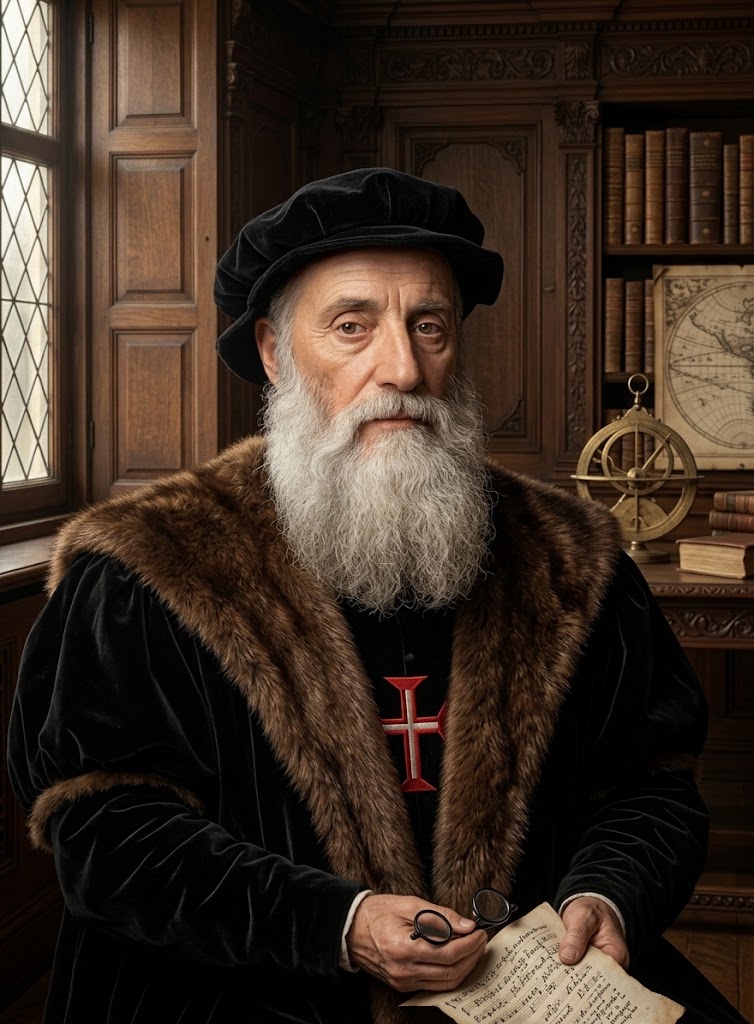
In the pantheon of history’s great explorers, few names carry the weight of Vasco da Gama. He was the man who, in a single audacious voyage, shattered the Islamic monopoly on the spice trade and connected Europe to Asia by sea for the first time. His journey around the Cape of Good Hope to India in 1497-1499 was one of the great acts of European seamanship. It laid the foundation for the Portuguese Empire, a maritime dominion that would last for centuries, and initiated a process that we now call globalization. Yet, the man who “opened the doors to the world” remains a figure of profound contradiction—celebrated in Lisbon as a national hero, but seen in the post-colonial world as a symbol of exploitation and religious persecution.
Table Of Content
- The Making of an Admiral: Early Life and the Call to the East
- The First Voyage: A Leap into the Unknown (1497-1499)
- The Fleet and the Departure
- The Great Detour: Sailing Around Africa
- The East African Coast: Hostility and Hospitality
- The Arrival in Calicut: A Mixed Welcome
- The Harrowing Return
- The Rewards
- The Second Voyage: The Admiral of the Indies (1502-1503)
- The Third Voyage and Death (1524)
- The Complicated Legacy
This is the story of Vasco da Gama, a deep dive into the man, his epic voyages, and the complicated legacy he left behind.
The Making of an Admiral: Early Life and the Call to the East
Vasco da Gama was born around 1460 in Sines, a small port town on the coast of Portugal’s Alentejo province. He was the third son of Estêvão da Gama, a minor provincial nobleman who served as the commander of the fortress at Sines. Little is known of his early life, but he was raised in a noble household with strong ties to the military and the Order of Santiago, one of the most powerful religious-military orders in Portugal.
His first recorded entry into public service came in 1492. King John II of Portugal, eager to assert Portuguese naval power, sent the young da Gama to the port of Setúbal and the Algarve region with a simple but risky mission: to seize French ships in retaliation for French attacks on Portuguese shipping. Da Gama performed this task rapidly and effectively, demonstrating the seamanship, audacity, and ruthlessness that would define his later career.
The timing of this mission was crucial. Portugal was obsessed with finding a sea route to Asia. For decades, Portuguese mariners had been painstakingly inching their way down the coast of Africa. The goal was to reach India, the source of highly lucrative spices—pepper, cinnamon, cloves—that were essential to European life as preservatives and status symbols. The overland routes through the Middle East were controlled by Muslim powers, giving them a monopoly on trade. Finding a direct sea route was not just a commercial ambition for Portugal; it was a strategic and religious crusade to outflank Islam and forge direct trade links with the legendary Christian ruler, Prester John.
When King Manuel I ascended to the throne in 1495, this project was revived. For reasons that remain unknown, Vasco da Gama, a man with little relevant experience for such a complex expedition, was appointed to lead it. Perhaps it was his family’s favour with the new king, or perhaps it was the unwavering determination and competence he had shown in his prior missions.
The First Voyage: A Leap into the Unknown (1497-1499)
The Fleet and the Departure
On July 8, 1497, da Gama set sail from Lisbon with a fleet of four vessels:
- São Gabriel: A three-masted ship of about 120 tons, which served as da Gama’s flagship.
- São Rafael: A sister ship of similar size, commanded by his brother, Paulo da Gama.
- Berrio: A smaller 50-ton caravel, a nimble vessel ideal for exploration.
- A storeship: A 200-ton ship carrying supplies and provisions, intended to be broken up and its materials used for shelter in Africa.
With him went a crew of approximately 170 men, many of whom would not return. The expedition was well-equipped with the tools of discovery: padrões (stone pillars) to be erected as marks of discovery, interpreters who could speak Arabic and several Bantu dialects, and priests to tend to the sailors’ souls.
The Great Detour: Sailing Around Africa
Da Gama’s navigational genius was immediately apparent. Instead of hugging the dangerous and unpredictable coast of West Africa, he executed a massive “volta do mar” (turn of the sea), a long detour out into the South Atlantic. He sailed so far west that he was nearly off the coast of Brazil, a route that would later become standard for sailing vessels traveling to the Cape of Good Hope.
Passing the Canary Islands and the Cape Verde islands, the fleet then veered far out into the open ocean. This strategy used the prevailing winds and currents to carry them around the southern tip of Africa. The fleet didn’t sight land for almost three months, a terrifying ordeal for the sailors.
On November 7, 1497, they finally made landfall at Santa Helena Bay on the coast of modern-day South Africa. Unfavorable winds and adverse currents delayed the rounding of the Cape of Good Hope until November 22. On November 25, they anchored in Mossel Bay, where they erected a padrão on an island and, in a strategic move, ordered the storeship to be broken up, distributing its provisions among the remaining three ships.
The East African Coast: Hostility and Hospitality
As da Gama pushed up the east coast of Africa, he encountered a world shaped by the Indian Ocean’s bustling Islamic trade network. The Portuguese were outsiders, and their reception varied wildly.
Sailing on December 8, they reached the coast of Natal (so named because it was sighted on Christmas Day). By January, many of the crew were suffering from scurvy, a disease caused by Vitamin C deficiency that would become the scourge of long sea voyages. The expedition rested for a month near the Quelimane River, which they called the “Rio dos Bons Sinais” (River of Good Omens), while the ships were repaired and the sick recovered.
On March 2, they arrived at the Island of Mozambique, a key trading port under the control of a Muslim sultan. The inhabitants initially welcomed the Portuguese, believing them to be fellow Muslims. Da Gama learned that the city traded with Arab merchants and that four Arab vessels laden with gold, jewels, and spices were in port. The sultan even supplied da Gama with two pilots. However, this goodwill quickly evaporated when the pilots realized the Portuguese were Christians; one of them deserted.
Da Gama pressed on, reaching the hostile port of Mombasa on April 7. The situation was tense, so he continued north to the friendlier port of Malindi, which they reached on April 14.
In Malindi, the Portuguese fortunes changed. The friendly sultan of Malindi, eager to gain an ally against his rival Mombasa, provided da Gama with a Gujarati pilot who knew the route to Calicut across the Indian Ocean. This pilot’s knowledge of the monsoon winds allowed the expedition to make the final leap.
The Arrival in Calicut: A Mixed Welcome
After a 23-day dash across the Indian Ocean, the Portuguese sighted the mountains of India on May 18, 1498. On May 20, they dropped anchor off the coast of Calicut (now Kozhikode), the most important trading port in southern India.
The arrival was a moment of immense symbolic and historic significance. Da Gama, in his role as an ambassador, presented himself to the Hindu ruler, the Zamorin. However, the welcome was not as warm as he had hoped. Da Gama’s gifts were woefully inadequate—they were cheap clothing and foodstuffs, a far cry from the lavish tributes that were custom in this part of the world. The Zamorin was unimpressed, and he was also skeptical of these new, strange visitors.
The Portuguese were also cultural outsiders. They visited Hindu temples, but they mistook the local religion for some “odd branch of Eastern Christianity”. The existing trade relations in Calicut were dominated by well-established Arab merchants, who were deeply hostile to the Portuguese interlopers and viewed them as direct commercial threats.
Fearing for the safety of his ships, da Gama was forced to negotiate. His diplomacy was clumsy, and he eventually took several hostages—a common practice for him—to ensure his safe passage. While the Europeans saw this as a necessary security measure, the locals viewed it as an act of brazen aggression.
The Harrowing Return
Eager to leave what he saw as a hostile and uncooperative region, da Gama set sail for home on August 29, 1498. In a fatal miscalculation, he ignored the local knowledge of the monsoon wind patterns, which were still blowing onshore. This would be his greatest mistake.
The return journey was a nightmare. The São Rafael, under Paulo da Gama, was scuttled (likely due to a shortage of crew), and its men were redistributed to the other vessels. Disease swept through the fleet, and of the 170 men who had set out, only about 55 returned. Among the dead was his brother Paulo. Da Gama’s other brother, Pedro, was also lost.
After more than two years at sea, da Gama finally arrived back in Portugal in September 1499. The mission had been a success, but the cost in human life had been staggering.
The Rewards
Despite the losses and the diplomatic troubles, the voyage was an unprecedented success. Da Gama was greeted as a hero. He was given a royal grant of land and various tax incomes, right of membership to the Royal Council, the title of “Admiral of the Seas of India, Persia, Arabia, and the entire Orient” (a magnificent title bestowed in 1502), and the right to bear the title Dom before his name. He had established the all-water route to Asia, breaking the Islamic monopoly and placing Portugal at the heart of a new global economy.
The Second Voyage: The Admiral of the Indies (1502-1503)
Da Gama’s second voyage to India, which departed in 1502, had a very different character from the first. This time, he was not merely an explorer; he was a powerful admiral on a mission to secure Portuguese commercial interests in the Indian Ocean by any means necessary.
On this voyage, da Gama’s brutality was on full display. He attacked Arab Muslim ships he encountered on the way, a campaign of intimidation designed to break the Arab monopoly and establish Portuguese naval dominance. In Calicut, he forced the Zamorin to make peace, but only after a show of force that included the bombardment of the city and the bombing of its ports.
He was more successful in forming alliances with local Indian rulers who were rivals of the Zamorin, such as the rulers of Cochin and Cannanore. These alliances gave Portugal a secure foothold on the Malabar Coast, a decisive position in the Indian Ocean, and a valuable base for future trade operations.
The Third Voyage and Death (1524)
After his second voyage, da Gama lived a quiet and wealthy life in Portugal for over 20 years, serving as an advisor on Indian matters to the king. However, the situation in Portugal’s Indian territories had become chaotic, with corruption and mismanagement rampant among the Portuguese authorities.
In 1524, King John III appointed the now-aged da Gama as Portuguese Viceroy in India, sending him back to restore order.
Da Gama arrived in India in September 1524. He immediately set about his task with his characteristic firmness, but he was already ailing. He fell ill shortly after arriving in Cochin, then the capital of the Portuguese establishments in India, and died on December 24, 1524. He was initially buried in St. Francis Church in Fort Kochi. In 1539, his remains were repatriated to Portugal and entombed in a magnificent monastery in the Jerónimos Monastery in Lisbon, where they rest today.
The Complicated Legacy
Today, Vasco da Gama’s legacy is deeply contested.
In Portugal, he is hailed as a national hero, a pioneer of globalization who “opened the doors to the world” and offered “a sign of innovation”. His name graces the longest bridge in Europe (the Vasco da Gama Bridge), and the 500th anniversary of his death was marked by state ceremonies in Lisbon.
In India, and in post-colonial scholarship, the picture is much darker. His arrival is seen not as a moment of “discovery” but as the beginning of a long and painful era of domination and subjugation. He is increasingly depicted as a “glorified pirate, a pillager who treated the Malabar coast’s natives brutally, and as an unabashed tool of imperialism and religious persecution”. Historian Fr. Pius Malekandathil noted that communities in Kerala have faced “great suffering due to the Portuguese” and that a commemoration of his arrival would be an insensitive celebration of “domination”.
The contemporary view of da Gama is a reflection of a changing historical consciousness. The old narrative of heroic European exploration has been challenged and enriched by perspectives that emphasize the brutality, exploitation, and cultural destruction that often accompanied these voyages. Da Gama’s accomplishments were not just navigational; they were deeply political, economic, and violent. He was, as his own contemporary records show, a figure of immense ambition and ruthlessness, who saw the peoples of Asia not as partners but as obstacles to be overcome.
Ultimately, Vasco da Gama is a man of history who can only be understood through the lens of his own time and the subsequent centuries of interpretation. He was a brilliant navigator, a determined commander, and a man who, for better or worse, irrevocably connected the world. His voyages launched a new era of global trade, cultural exchange, and conflict. He is a pivotal figure in the history of the world, a complex symbol of both exploration and colonialism, and a testament to the enduring and often contradictory nature of human ambition.
Never Miss a Story: Join Our Newsletter