




Master of the Frozen Realm: The Life, Science, and Extreme Exploits of Wim Hof
For decades, modern medical textbooks taught a strict biological rule: human beings cannot consciously control their autonomic nervous system, internal thermostat, or innate immune response. Heart...

For decades, modern medical textbooks taught a strict biological rule: human beings cannot consciously control their autonomic nervous system, internal thermostat, or innate immune response. Heart rate, vascular constriction, and immune defenses were thought to run strictly on biological autopilot.
Table Of Content
- Born of Tragedy: How Grief Built “The Iceman”
- Legendary Exploits & World Records
- 1. The Standing Ice Tank Submersion (1 Hour, 52 Minutes+)
- 2. High-Altitude Mountaineering in Shorts
- 3. The Arctic Barefoot Half-Marathon (2009)
- 4. The Terrifying Under-Ice Swim (2000)
- 5. Defying Heat and Gravity
- Summary of Feats & Exploits
- The Science That Shocked Medicine
- 1. Radboud University Endotoxin Study (2011 & 2014)
- 2. Brain Scans at Wayne State University (2018)
- The Three Pillars of the Wim Hof Method (WHM)
- Safety, Risks, and Critical Context
Then came Wim Hof.
Known globally as “The Iceman,” the Dutch extreme athlete and speaker has spent over four decades turning human physiology on its head. By standing submerged in ice tanks for nearly two hours, scaling frozen mountain peaks in nothing but running shorts, and voluntarily suppressing bacterial inflammation in laboratory settings, Hof transformed from an obscure European street performer into one of the most studied figures in sports science and biohacking.
Born of Tragedy: How Grief Built “The Iceman”
Born on April 20, 1959, in Sittard, Netherlands, Wim Hof was one of nine children. From a young age, he exhibited an unusual affinity for nature, often running barefoot through snow as a teenager. However, his deep obsession with freezing water was forged in profound personal grief.
In 1995, Hof’s world shattered when his wife, Olaya, who suffered from severe depression, tragically died by suicide, leaving him alone to raise four young children. Overwhelmed by emotional agony, Hof found little solace in traditional philosophies. Seeking an escape from his mental pain, he plunged himself into the freezing waters of Amsterdam’s Beatrixpark canal.
Hof discovered that the immediate shock of icy water forced his mind into absolute stillness. In sub-zero water, there was no room for anxiety, grief, or internal noise—there was only survival, breath, and deep presence. The cold became his sanctuary, his teacher, and his path to emotional recovery.
Legendary Exploits & World Records
To prove to a skeptical scientific community that his cold endurance was not a genetic fluke, Hof embarked on a series of extreme physical feats that earned him 26 world records and 18 Guinness World Record titles.
1. The Standing Ice Tank Submersion (1 Hour, 52 Minutes+)
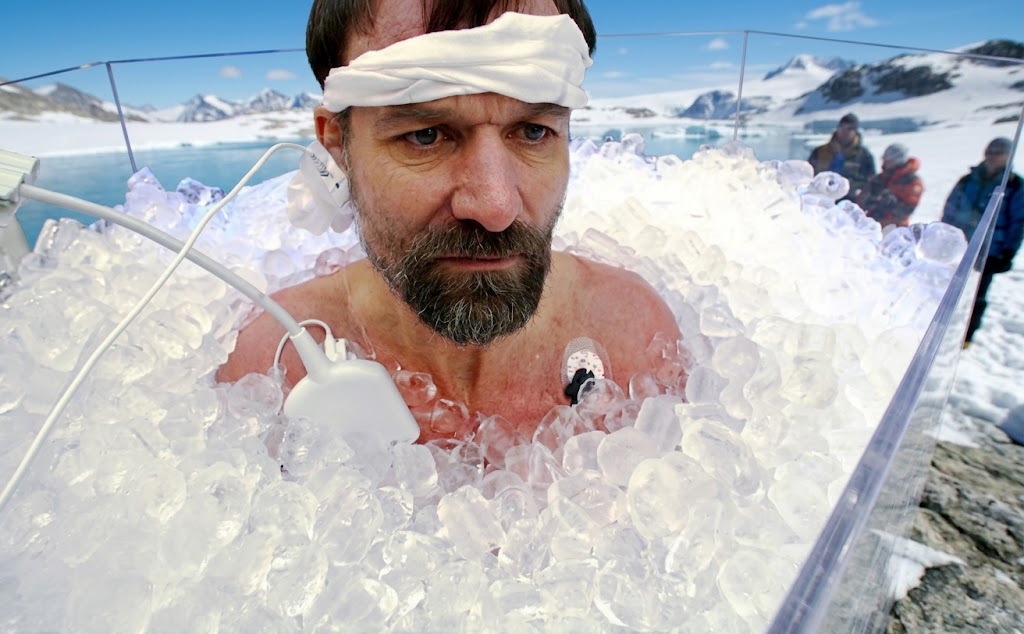
Hof’s most famous signature feat involved standing inside a transparent acrylic cylinder filled entirely with ice cubes up to his neck.
- The Challenge: While an ordinary human submerged in ice water develops severe hypothermia within minutes and risks cardiac arrest, Hof remained standing in direct contact with crushed ice for 1 hour, 52 minutes, and 42 seconds.
- Physiological Mystery: Medical staff monitoring his vitals noted that while his skin temperature plummeted near freezing, his core body temperature remained steadily around 37°C (98.6°F) without shivering. He broke his own Guinness World Record for full-body ice immersion 16 times.
2. High-Altitude Mountaineering in Shorts
Hof challenged conventional high-altitude mountaineering gear by scaling world-famous peaks clad only in running shorts, boots, and gloves.
- Mount Everest (2007): Hof climbed to an altitude of 22,000 feet (approx. 6,700 meters) on the slopes of Mount Everest wearing nothing but shorts and shoes in temperatures hovering around -30°C (-22°F). He navigated sub-zero blizzards and extreme hypoxia before an earlier foot injury forced him to halt his ascent short of the summit.
- Mount Kilimanjaro (2014 & 2015): Hof climbed Africa’s highest peak (19,340 ft / 5,895 m) in shorts in just 48 hours—an ascent that usually requires 7 to 9 days for acclimatization. To prove his method was teachable, he later led a group of 26 non-athletes (including individuals with asthma, multiple sclerosis, and rheumatoid arthritis) up Kilimanjaro in shorts, with the majority reaching Uhuru Peak safely in record time.
3. The Arctic Barefoot Half-Marathon (2009)
In 2009, Hof traveled above the Arctic Circle to Oulu, Finland, to complete a full 21 km (13.1 mile) half-marathon.
- The Conditions: The air temperature was -20°C (-4°F).
- The Feat: He ran the entire distance through deep snow and solid sheets of ice completely barefoot, wearing nothing but shorts, completing the run in 2 hours, 16 minutes.
4. The Terrifying Under-Ice Swim (2000)
Hof attempted a dangerous underwater record by diving into a frozen lake in Finland to swim 66 meters (217 feet) beneath a solid sheet of ice, wearing only swimming trunks without a wetsuit, goggles, or flippers.
- The Crisis: Mid-swim, the water freezing his corneas caused temporary blindness underwater. Unable to see, he swam past the second hole and traveled over 110 meters under the ice before a safety diver guided him out.
- The Lesson: Despite near-asphyxiation, Hof maintained absolute mental composure, citing the event as a core proof of overcoming blind panic through breath control.
5. Defying Heat and Gravity
Hof’s physiological control extends beyond freezing cold to extreme heat and physical strain:
- The Namib Desert Marathon (2011): To prove his breathing technique could manage extreme heat as well as cold, Hof ran a full 42.2 km (26.2 mile) marathon across the scorching Namib Desert in 40°C (104°F) temperatures without drinking a single drop of water.
- One-Finger High-Altitude Hanging: Suspended his entire body weight hanging from a single finger attached to a cliff hook at an altitude of 2,000 meters (6,500 feet).
Summary of Feats & Exploits
| Feat / Record | Location / Year | Environment | Key Physical Achievement |
| Full Ice Submersion | Global / Multi-year | Submerged up to neck in ice cubes | Maintained 37°C core temp for 1 hour 52 mins. |
| Mount Everest Climb | Nepal / 2007 | Altitude >22,000 ft, -30°C windchill | Reached death-zone altitudes clad only in shorts. |
| Kilimanjaro Speed Climb | Tanzania / 2014 | 19,340 ft summit, -20°C | Reached summit in 48 hours in shorts with non-athletes. |
| Barefoot Arctic Run | Finland / 2009 | -20°C (-4°F) ice & snow | Ran 21 km barefoot in shorts. |
| Under-Ice Swim | Finland / 2000 | Sub-zero lake water under solid ice | Swam 66m under ice; survived frozen corneas. |
| Namib Desert Marathon | Namibia / 2011 | 40°C (104°F) desert heat | Ran 42.2 km without consuming water. |
The Science That Shocked Medicine
For years, doctors dismissed Hof as a biological anomaly. That perspective changed when university laboratories began running controlled clinical trials on his body.
1. Radboud University Endotoxin Study (2011 & 2014)
In 2011, researchers at Radboud UMC in the Netherlands injected Hof with an endotoxin—a bacterial agent that triggers severe fever, uncontrollable shivering, and violent sickness. By applying his breathing routine, Hof intentionally spiked his adrenaline levels higher than a first-time skydiver, suppressing pro-inflammatory proteins (cytokines) by nearly 50% and preventing flu symptoms.
In 2014, scientists tested 12 ordinary volunteers trained in the Wim Hof Method for just 10 days. When injected with the same bacterial endotoxin, all 12 volunteers successfully replicated Hof’s results, demonstrating that the human immune response can be voluntarily conditioned through specific breathwork.
2. Brain Scans at Wayne State University (2018)
Using neuroimaging (fMRI and PET scans), researchers monitored Hof’s brain while flooding his suit with freezing water. The scans revealed that his practice activated the periaqueductal gray region—the brain’s primary control center for pain suppression and internal opioid/cannabinoid release. Hof had effectively learned to turn on his brain’s internal pain relief system on command.
The Three Pillars of the Wim Hof Method (WHM)
Hof organized his daily practices into three core pillars:
- Controlled Breathwork: Involves 30–40 deep, rhythmic cycles of breathing (deep inhalation, passive exhalation), followed by a prolonged breath hold (retention) on empty lungs, and a 15-second recovery breath. This temporarily shifts blood chemistry, increases alkalinity, alters carbon dioxide levels, and floods the system with adrenaline.
- Gradual Cold Therapy: From cold showers to ice baths, cold exposure acts as “vascular gymnastics.” It strengthens the smooth muscles surrounding blood vessels, lowers resting heart rates, and stimulates brown adipose tissue (brown fat) that generates body heat.
- Mindset & Commitment: Facing ice water triggers an automatic fight-or-flight shock. The mental pillar teaches practitioners to remain calm, conscious, and relaxed amidst intense physical stress, conditioning the brain to manage real-world mental stress.
Safety, Risks, and Critical Context
While millions of people practice the Wim Hof Method, safety instructions are vital:
- Shallow Water Blackout Risk: Hyperventilation dramatically lowers blood carbon dioxide levels, muting the brain’s urge to breathe. Wim Hof breathing should never be practiced in or near water, in a bathtub, or while driving. Drownings have occurred when individuals practiced hyperventilation breathwork immediately before diving or swimming.
- Gradual Adaptation: Exposure to extreme cold must be built up incrementally. Direct, prolonged immersion in freezing water without prior training can cause sudden cardiovascular shock or hypothermia.
Wim Hof’s core philosophy remains grounded in human potential: “What I am capable of, everybody can learn. I am not a superhero; I am just a human who reconnected with nature.”
Never Miss a Story: Join Our Newsletter