




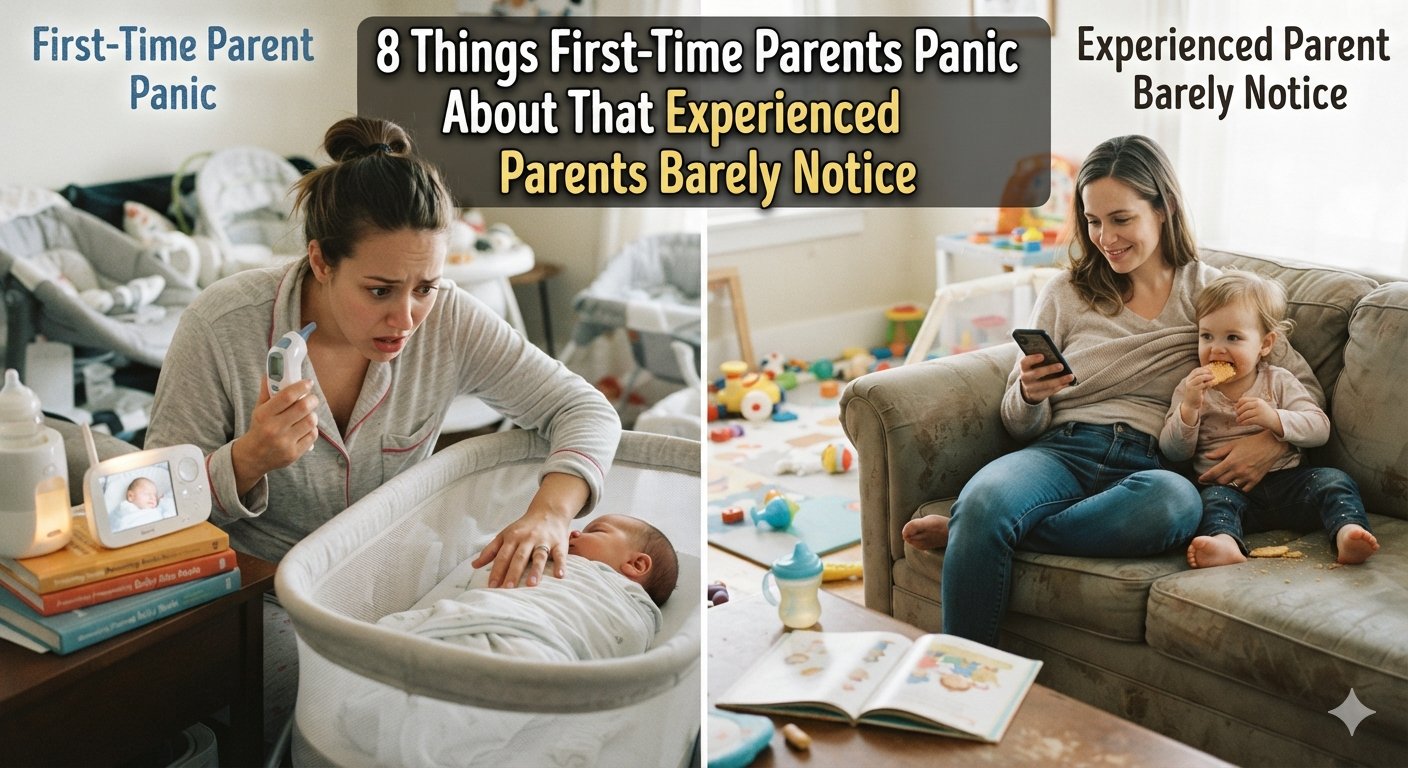
8 Things First-Time Parents Panic About That Experienced Parents Barely Notice
There is something uniquely terrifying about becoming a parent for the first time. You can read books, attend antenatal classes, listen to advice from experienced parents and even convince yourself...

There is something uniquely terrifying about becoming a parent for the first time.
Table Of Content
- 1. Every Small Symptom Looks Like an Emergency
- 2. Visiting the Doctor to Treat Your Own Anxiety
- 3. Comparing Your Baby With Everybody Else’s Baby
- 4. Thinking You Must Understand Every Cry
- 5. Becoming So Protective That You Start Lecturing Your Spouse
- 6. Being Terrified of Making One Wrong Parenting Decision
- 7. Buying Everything Advertised as a “Baby Essential”
- 8. Taking Everybody’s Advice Seriously
- And Then You Have More Children
- The Real Lesson of First-Time Parenting
You can read books, attend antenatal classes, listen to advice from experienced parents and even convince yourself that you are fully prepared. Then the baby arrives, makes a strange sound at 2 a.m., develops a tiny rash on the skin and suddenly you are wondering whether you need to rush to hospital.
I know this because I experienced it myself.
As a first-time father, I could easily panic over small changes in my baby’s health. A simple skin rash could send my mind into overdrive. I would start wondering what had caused it, whether it was an allergy, whether the baby was seriously ill and whether we needed to see a doctor immediately.
But there is one particular incident I remember that still makes me laugh.
One day, I noticed that an isolated section of my son’s scalp appeared not to have hair. Immediately, my mind went into medical-detective mode. I became convinced that the boy might have what Kenyans commonly call “mashilingi” — ringworm of the scalp.
So what did I do?
I rushed downstairs to the chemist in my building and asked a lady called Joyce to examine my son’s scalp and tell me whether he had a scalp infection.
Joyce looked at the boy’s head, listened to my explanation and then burst out laughing.
She reminded me of something that should have been obvious: the boy’s hair coverage was still developing. That apparently bald-looking patch wasn’t necessarily an infection. It was simply a baby’s scalp with hair that hadn’t yet grown evenly.
There I was, a grown man, already preparing myself mentally for a scalp infection when the child was simply growing.
The funny thing is that this wasn’t the first time I had bothered Joyce with one of my false alarms. She had probably begun to recognise me as the father who arrived at the chemist with a new emergency every few days.
It was during one of those conversations that she jokingly advised me to get more children quickly.
Her reasoning was simple: perhaps having more children would eventually teach me to stop panicking over every little thing.
Looking back, she may actually have had a point.
Read Also: In Search of Immortality: Could This Tiny Part of Our DNA Hold the Key to Ageing?
1. Every Small Symptom Looks Like an Emergency
This is probably one of the biggest first-time parenting weaknesses.
A baby develops a rash and the first-time parent starts searching for explanations. The baby’s stool looks different and suddenly everyone is worried. The child sleeps longer than usual and the parent checks repeatedly to make sure the baby is breathing.
Some of these concerns are completely understandable. Babies cannot explain what hurts, so parents have to interpret signs from someone who cannot tell them what is happening.
The problem comes when every unusual observation is interpreted as evidence of serious illness.
Experienced parents often have something first-time parents don’t yet possess: a mental catalogue of previous experiences.
They have seen heat rash before. They have seen mild stomach upsets. They have seen teething. They have seen a child recover from an ordinary cold. They have watched temporary symptoms disappear.
That experience doesn’t mean they ignore genuine warning signs. It simply gives them a better sense of perspective.
2. Visiting the Doctor to Treat Your Own Anxiety
Sometimes a first-time parent takes a baby to the doctor because the baby is genuinely unwell.
But sometimes the baby is probably fine and the parent desperately needs somebody qualified to say, “Your child is okay.”
There is nothing particularly strange about this.
When you don’t know whether something is normal, professional reassurance has enormous value. You aren’t necessarily paying for medicine. Sometimes you are paying for certainty.
I remember how easily I could become concerned about relatively minor changes in my first child. Looking back, some of those visits probably weren’t necessary.
But hindsight is easy.
When you are holding your first baby and wondering whether something is wrong, “wait and see” can feel like an unacceptable medical strategy.
Of course, parents should never ignore genuine warning signs or avoid professional medical attention when a child is seriously unwell. The important lesson is learning, with experience, how to separate normal childhood variations from symptoms that require prompt attention.
Read Also: How Spending Time Alone Can Actually Improve Your Well-Being
3. Comparing Your Baby With Everybody Else’s Baby
Then comes the comparison game.
“Her baby is already crawling.”
“His baby has started talking.”
“That child already has several teeth.”
“Why isn’t ours doing that yet?”
First-time parents can easily turn normal childhood development into a competition without even realising it.
Social media makes the problem worse. You see photographs of babies reaching milestones, smiling, walking and doing impressive things, while nobody posts a photograph saying, “Today my baby spent 40 minutes staring at the ceiling.”
Children develop at different rates.
One child may walk early and talk later. Another may talk early and take longer to walk. Another may appear to develop slowly and then suddenly make enormous progress.
The first-time parent often needs to learn that a baby isn’t necessarily behind simply because another baby is ahead.
4. Thinking You Must Understand Every Cry
The first few months can turn parents into detectives.
Why is the baby crying?
Is he hungry?
Is she cold?
Is he too hot?
Is it gas?
Is it the diaper?
Is the baby tired?
Is the baby sick?
Is the baby teething?
First-time parents can feel like failures when they cannot immediately stop the crying.
But babies sometimes cry.
That sounds obvious, yet it can be surprisingly difficult for a new parent to accept.
You can feed the baby, change the diaper, hold the baby, check the temperature and make sure there are no obvious signs of illness — and the baby may still cry.
Experienced parents often become more comfortable with this reality.
They still investigate when something seems wrong, but they don’t necessarily interpret every cry as evidence that they have failed.
5. Becoming So Protective That You Start Lecturing Your Spouse
Here is another interesting first-time-parent weakness that doesn’t get discussed enough.
Overprotectiveness doesn’t always stop with the baby.
Sometimes it starts affecting the relationship between the parents.
In many couples, one parent may naturally be more anxious or insecure about the baby’s safety than the other. When that parent becomes convinced that something has been mishandled, the concern can quickly turn into a lecture.
“How could you, in your right mind, forget to change the baby’s diaper?”
“Don’t you know that leaving the baby like that can cause an infection?”
“Why did you leave the baby there? What if he fell?”
“Didn’t you notice that the baby was too hot?”
The underlying motivation may actually be love and fear. But the delivery can make the other parent feel incompetent, careless or constantly judged.
And that is where something that began as concern for the baby can quietly become a source of tension between husband and wife.
A new parent needs to learn an important distinction: correcting a genuine danger is different from constantly policing your spouse.
If the baby is in immediate danger, of course the parent should intervene. But if the issue is simply a different way of doing something, turning every disagreement into a parenting lecture can create unnecessary resentment.
The more anxious parent may also forget that the other parent loves the child just as much.
Nobody becomes a perfect parent simply because they have produced a child.
Both parents are learning.
And sometimes the parent who forgot the diaper change doesn’t need a twenty-minute lecture. A simple, “Hey, I think we should change the baby’s diaper now,” may accomplish exactly the same thing without creating a domestic argument.
If this pattern continues unchecked, the couple can gradually stop feeling like partners and start feeling like two people supervising each other’s parenting.
That is not good for the relationship, and ultimately it isn’t good for the family either.
Read Also:The Silent Epidemic: Why Dementia Is Quietly Becoming Kenya’s Next Public Health Crisis
6. Being Terrified of Making One Wrong Parenting Decision
First-time parents sometimes approach parenting as though they are sitting an examination in which every wrong answer will permanently damage the child.
“Am I feeding the baby enough?”
“Should I wake the baby?”
“Should I let the baby sleep?”
“Is the room too cold?”
“Is it too warm?”
“Am I holding the baby correctly?”
“Did I buy the right bottle?”
The anxiety can become exhausting.
The truth is that parenting involves thousands of small decisions, and children are remarkably adaptable. Parents don’t need to execute every decision perfectly.
What matters is providing consistent care, responding to genuine needs, learning as the child grows and correcting mistakes along the way.
Experience gradually replaces the fear of making every decision perfectly with something much more useful: judgement.
7. Buying Everything Advertised as a “Baby Essential”
First-time parents can be remarkably easy targets for baby marketing.
Suddenly everything seems necessary.
Special blankets.
Special clothes.
Special feeding equipment.
Special toys.
Special gadgets.
Special furniture.
And then the baby arrives and may be more interested in an ordinary household object than the expensive toy you carefully selected.
Experienced parents often become more practical.
They learn that children don’t necessarily need enormous quantities of possessions. They need safety, nutrition, affection, attention, appropriate healthcare and plenty of interaction with the people around them.
The first child can therefore be an expensive education in discovering the difference between a genuine necessity and something described by a marketing department as a necessity.
8. Taking Everybody’s Advice Seriously
This may be the most confusing part of first-time parenting.
Your mother has advice.
Your mother-in-law has advice.
Your neighbour has advice.
Your friend has advice.
The nurse has advice.
Another parent has advice.
Then somebody on Facebook has a completely different theory.
Before long, the new parent has heard twenty different explanations for the same problem.
Experience teaches another important lesson: not every piece of advice deserves equal weight.
Some advice comes from medical evidence. Some comes from experience. Some comes from cultural traditions. Some worked for one particular child. Some is simply an old belief repeated so many times that people assume it must be true.
Parents eventually have to learn how to listen respectfully while still deciding which information is reliable and appropriate for their own child.
And Then You Have More Children
This brings me back to Joyce’s rather humorous advice.
She suggested that I should get more children quickly so that I could overcome my hypersensitivity.
Obviously, having more children isn’t a treatment for anxiety, and every child is different. But there is something interesting about the experience of raising children more than once.
The second child can arrive with many of the same challenges as the first, but the parent is no longer meeting all of them for the first time.
The first child’s cough may send you into immediate panic.
With the second, you may think, “We have seen this before. Let’s check what is happening.”
The first child’s strange-looking patch on the scalp may have you rushing to the chemist.
The next time, you may look carefully first and remember that babies don’t necessarily grow hair evenly.
The difference isn’t necessarily that the parent loves the second child less.
It is that experience has been added to the love.
Read Also: Navigating the Modern Crisis: Stress, Isolation, and the Path Forward
The Real Lesson of First-Time Parenting
Perhaps the greatest weakness of first-time parents isn’t ignorance.
It is the combination of enormous love and very little experience.
You suddenly have responsibility for somebody who cannot speak, explain what they are feeling or tell you whether something is normal. Naturally, you become hypersensitive.
And parents who waited many years for their first child may feel this even more intensely. After years of anticipation, the child can become so precious that every cough, rash or change in behaviour feels disproportionately significant.
But parenting gradually teaches something no book can completely teach.
You cannot eliminate every childhood illness.
You cannot prevent every fall.
You cannot understand every cry.
You cannot make every decision perfectly.
And you cannot control everything that happens to your child.
What you can do is learn.
You learn your child’s patterns. You learn what is normal for them. You learn which symptoms deserve attention. You learn when to call a doctor and when to observe calmly. You learn that children can be surprisingly resilient.
And perhaps just as importantly, you learn to trust your spouse.
You learn that the parent who handles something differently from you isn’t necessarily careless. You learn that correcting everything can become more damaging to your relationship than the small parenting mistake you were trying to correct.
Most importantly, you learn that good parenting isn’t about never being afraid.
Sometimes it is about being afraid, taking a breath, looking carefully at the situation and asking yourself:
“Is my child actually in danger, or am I simply experiencing this for the first time?”
That question alone may save a first-time parent a considerable amount of money — and perhaps a few sleepless nights.
Never Miss a Story: Join Our Newsletter