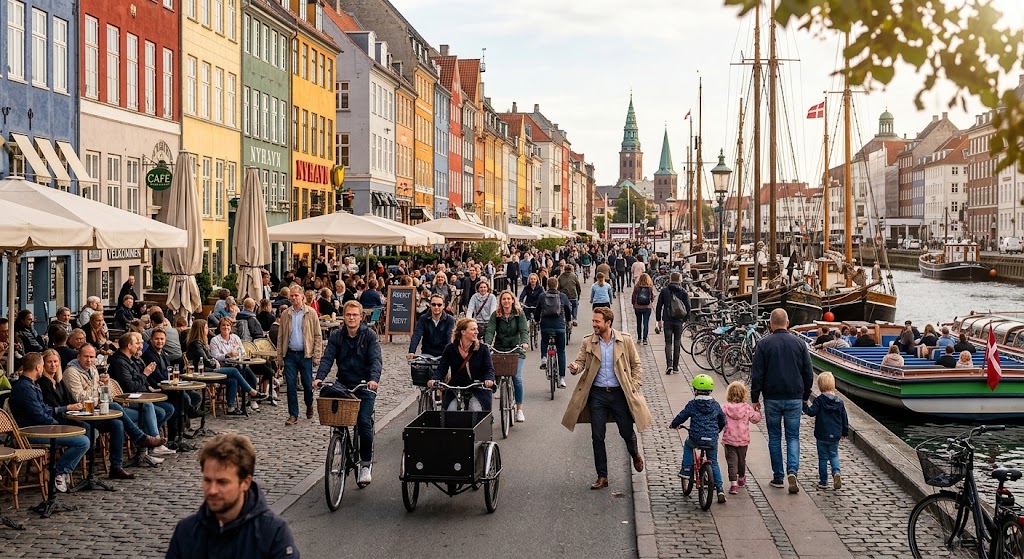
Denmark has topped the world’s corruption rankings for eight consecutive years. It did not achieve this through one powerful anti-corruption agency or a single tough leader. Its secret is something much deeper: a society and state built around transparency, trust, accountability and institutions that generally work.
When people discuss the world’s least corrupt countries, Singapore is often the first name that comes to mind.
And understandably so.
Singapore transformed itself from a relatively poor, corruption-prone colony into one of the world’s cleanest and most efficiently governed states. Its approach was famously uncompromising: investigate corruption, pursue powerful people, strengthen institutions and make corruption financially and professionally disastrous.
But Singapore is not No. 1.
Denmark is.
According to Transparency International’s 2025 Corruption Perceptions Index, Denmark scored 89 out of 100, ranking first among 182 countries and territories. Finland followed with 88, while Singapore scored 84 and ranked third. Kenya, by comparison, scored 30 and ranked 130th.
Denmark has now held the top position for eight consecutive years.
So what exactly is Denmark doing differently?
The answer is more complicated than “Denmark has good politicians.”
In fact, Denmark’s greatest anti-corruption weapon may not be its politicians at all.
It may be the system surrounding them.
Denmark does not have a Singapore-style anti-corruption machine
This is the first surprising discovery.
One might assume that the world’s least corrupt country has an enormous anti-corruption bureaucracy dedicated exclusively to hunting corrupt officials.
It doesn’t.
The OECD notes that Denmark does not have a standalone national anti-corruption strategy or a central anti-corruption body. Responsibilities for integrity are distributed across government institutions, including the Ministry of Justice, the Prime Minister’s Office and the Employee and Competence Agency.
That sounds strange.
How can a country rank first for cleanliness when it does not even have a giant anti-corruption agency?
The answer is that Denmark has attempted to make corruption difficult before it becomes a criminal case.
Instead of relying primarily on catching corrupt officials after money has changed hands, Denmark has built a broader environment where transparency, administrative procedures, public scrutiny and professional norms make corruption considerably harder to normalize.
This is an important distinction.
Singapore’s message is roughly:
“If you take the bribe, we will catch you.”
Denmark’s system is closer to:
“There are so many eyes, rules, records, expectations and institutional safeguards around public administration that taking the bribe is difficult to hide in the first place.”
Both approaches can work.
But they operate differently.
1. Denmark makes government information unusually accessible
One of Denmark’s greatest strengths is transparency.
Its Act on Openness in Administration gives people broad rights to access government information. Requests generally do not require the requester to explain why they want the information, statutory deadlines apply, and refusals can be challenged.
Think about the implications.
If government is spending public money, citizens have greater ability to ask:
Where did the money go?
If a public contract is awarded:
Who won it?
If a piece of land changes ownership:
Who owns it?
If an election takes place:
What happened?
If the state publishes its budget:
What exactly are taxpayers funding?
Transparency doesn’t automatically eliminate corruption.
But it makes corruption harder to hide.
And that matters enormously.
The OECD notes that Denmark makes a wide range of integrity-related information publicly available, including the state budget, election results, public tenders and their outcomes, business and land registries, and salaries of top-level civil servants.
This is one of the biggest lessons for Kenya.
You cannot effectively fight corruption if citizens, journalists, auditors and civil society cannot see what government is doing.
2. Transparency creates thousands of unofficial watchdogs
This is perhaps the most underappreciated part of Denmark’s model.
Imagine a government department has only one anti-corruption investigator.
That investigator has limited resources.
But if government information is accessible to:
- journalists,
- opposition politicians,
- civil society,
- academics,
- auditors,
- businesses,
- citizens,
- lawyers,
then thousands of people can potentially identify something suspicious.
The anti-corruption system becomes much larger than the government agency officially responsible for fighting corruption.
The OECD has found a strong relationship between access to government information and public trust. Across OECD countries, people who say administrative information is easily available are much more likely to trust their government than those who say information is difficult to obtain.
Transparency therefore serves two purposes.
It can expose wrongdoing.
And it can increase confidence that government is operating honestly.
3. Denmark has something Kenya desperately needs: institutional trust
According to the OECD’s 2024 survey, 44% of Danes reported high or moderately high trust in their national government, compared with an OECD average of 39%.
But the more remarkable figures concern other institutions.
Around 75% of Danes expressed trust in the courts and judicial system, while the same proportion trusted other people. Trust in the police stood at 69%.
That matters because corruption flourishes when citizens believe institutions are incapable of protecting them.
If a Kenyan citizen believes:
“Reporting this will achieve nothing.”
the corruption survives.
If a Danish citizen believes:
“The institution will probably do its job.”
the incentives are different.
Trust does not appear from nowhere.
It is built through repeated experiences.
If a citizen applies for a government service and receives it without paying a bribe, that experience reinforces trust.
If a business wins a tender because it submitted the best proposal rather than because it knows a politician, trust increases.
If a police officer refuses a bribe, trust increases.
If a minister is forced to answer legitimate questions from the public, trust increases.
Over decades, these small experiences accumulate.
4. Danish public servants are expected to be impartial
Another important ingredient is the professional culture of Denmark’s public administration.
The Danish Public Administration Act contains conflict-of-interest rules and is reinforced by the broader legal principle of impartiality.
That sounds technical.
But it addresses one of the fundamental problems of corruption:
What happens when an official’s personal interests collide with their public responsibilities?
Suppose a government official is involved in deciding whether a company should receive a lucrative contract.
Then suppose the official’s spouse owns that company.
A healthy administrative system must have rules preventing that official from simply saying:
“I will make the decision anyway.”
The principle is simple:
Public office is not personal property.
5. The system reduces opportunities for petty bribery
There is another fascinating finding from the OECD.
In Denmark, 52% of people surveyed believed it was likely that a public employee would refuse a bribe intended to speed up access to a service.
The OECD average was only 36%.
That tells us something important.
Denmark’s low corruption is not merely about ministers.
It reaches the everyday interaction between citizens and government.
The passport office.
The licensing desk.
The police station.
The local authority.
The public hospital.
The government department.
The more citizens can obtain services without paying someone under the table, the less corruption becomes part of everyday life.
And once people stop expecting to pay bribes, officials have less opportunity to demand them.
6. Denmark built trust before it needed corruption to be fought aggressively
This may be the biggest difference between Denmark and countries struggling with systemic corruption.
In a deeply corrupt environment, people often operate on suspicion.
Citizens suspect officials.
Officials suspect citizens.
Businesses suspect government.
Government suspects businesses.
Politicians suspect their opponents.
Opposition politicians suspect the government.
Eventually everyone assumes everyone else is looking for an opportunity to exploit the system.
That creates a vicious cycle.
Low trust → corruption → weaker institutions → even lower trust → more corruption.
Denmark has largely travelled in the opposite direction.
Trust → institutional cooperation → better compliance → stronger institutions → more trust.
This is not accidental.
It is the product of decades of relatively stable institutions.
7. Denmark’s history matters
It would be misleading to suggest that Denmark discovered an anti-corruption formula overnight.
The country’s present-day institutional culture developed over generations.
Denmark is a long-established constitutional democracy with strong administrative traditions, an established rule of law, relatively high social trust and a professional civil service.
That historical foundation matters.
A country cannot simply copy another nation’s culture with a new law.
This is why the Danish model cannot be reduced to:
“Pass a transparency law and corruption disappears.”
It doesn’t work that way.
The law is only one piece.
The deeper achievement is that Danish institutions have developed credibility over time.
8. Denmark has not eliminated corruption
This is where the story gets particularly interesting.
Being ranked No. 1 does not mean Denmark is corruption-free.
Transparency International itself warns that high CPI scores do not mean countries are completely free from corruption.
And Denmark has its weaknesses.
The OECD has identified gaps in Denmark’s regulation of lobbying, political finance, conflict of interest and internal control.
There is no comprehensive publicly accessible lobbying register.
Certain asset and interest declarations are not publicly available.
The OECD has also criticized weaknesses in Denmark’s broader strategic framework for anti-corruption and integrity.
The Council of Europe’s GRECO has been even more critical.
In a 2025 assessment, GRECO concluded that Denmark had satisfactorily addressed only two of fourteen recommendations concerning corruption prevention and integrity in central government and law enforcement. Eleven recommendations remained unimplemented.
That is a remarkable finding.
The world’s highest-ranked country for perceived public-sector cleanliness still has significant anti-corruption work to do.
This is important because it destroys the myth that Denmark is some kind of corruption-free paradise.
It isn’t.
Rather, corruption is relatively contained within a broader system that generally functions well.
9. Denmark demonstrates that corruption is bigger than bribery
When Africans hear the word corruption, the image that often comes to mind is an official accepting cash.
But corruption can take many forms.
It can involve:
- conflicts of interest;
- political patronage;
- manipulation of procurement;
- undisclosed lobbying;
- misuse of public resources;
- preferential treatment;
- political financing;
- nepotism;
- abuse of authority;
- illicit enrichment;
- manipulation of regulations.
The Danish experience shows why fighting corruption requires more than criminal prosecutions.
You need a functioning integrity ecosystem.
Transparency International has previously argued that countries performing well against corruption generally have strong public institutions combined with non-state actors that contribute to the country’s broader integrity system.
In other words:
Government cannot fight corruption alone.
The media matters.
The courts matter.
Citizens matter.
Businesses matter.
Civil society matters.
Auditors matter.
Parliament matters.
Whistleblowers matter.
And perhaps most importantly, ordinary public servants matter.
10. Denmark’s greatest weapon may be something that cannot simply be legislated
There is a deeper cultural component.
Imagine two countries with identical anti-corruption laws.
In Country A, people think:
“Everyone steals. Why shouldn’t I?”
In Country B, people think:
“That would be shameful.”
The laws are identical.
The outcomes probably won’t be.
Social expectations matter.
If corruption is considered normal, enforcement becomes an endless game of catching people.
If corruption is considered disgraceful, society itself becomes part of the enforcement mechanism.
This does not mean Danes are morally superior to Kenyans or other nationalities.
That would be a dangerous and simplistic conclusion.
It means institutions and social norms have developed differently.
And norms can change.
11. So what could Kenya borrow from Denmark?
Kenya cannot simply become Denmark.
Kenya has different history, demographics, political structures and economic circumstances.
But there are lessons worth borrowing.
Make government information genuinely accessible
Citizens should be able to easily see government contracts, tenders, budgets, land information and other public-interest records.
Make procurement understandable
Publishing a tender is not enough.
Citizens should be able to understand:
Who bid? Who won? At what price? Who owns the company? How much was eventually paid?
Protect whistleblowers
A system where reporting corruption can destroy someone’s career will discourage reporting.
Strengthen institutional independence
Anti-corruption bodies, auditors, prosecutors and courts need the ability to perform their duties without political interference.
Professionalize public administration
A professional civil service reduces the temptation to treat government jobs as political rewards.
Reduce opportunities for petty corruption
Digital government services can reduce unnecessary face-to-face interactions where bribes can be solicited.
Make conflicts of interest visible
If public officials have private interests that intersect with public decisions, citizens should have meaningful ways of knowing about them.
Strengthen investigative journalism
A free and capable press can become one of the country’s most important corruption-detection mechanisms.
Build trust through performance
You cannot order citizens to trust government.
Government must earn it.
Denmark versus Singapore: Two different answers to the same problem
Perhaps the easiest way to understand Denmark is to compare it with Singapore.
Singapore says:
“Corruption is dangerous because the state will pursue you.”
Denmark says:
“Corruption is difficult because the institutions, transparency and social norms make it difficult to operate.”
Singapore emphasizes enforcement.
Denmark emphasizes institutional trust and transparency.
Singapore has a powerful dedicated anti-corruption institution.
Denmark distributes integrity responsibilities across the government system.
Singapore’s transformation was heavily associated with strong political leadership.
Denmark’s system developed through generations of democratic institutions.
Neither model is perfect.
But both demonstrate the same fundamental truth:
Corruption is not inevitable.
The real Danish secret
So why does Denmark top the list?
It is not because Danish people were born incapable of corruption.
It is not because Denmark has discovered a magical anti-corruption law.
And it is not because Denmark catches every corrupt person.
The more convincing explanation is that Denmark has built a high-trust, rules-based society in which public institutions are relatively transparent, professional and accountable.
The country’s own weaknesses prove the point.
Denmark can score 89 and still be told by international watchdogs that it needs better lobbying rules, stronger conflict-of-interest safeguards, better political-finance transparency and stronger integrity controls.
That is precisely what makes the Danish example so useful.
The objective isn’t to create a country where corruption can never happen.
The objective is to create a country where corruption struggles to become systemic.
And that may be the most important lesson for Kenya.
Kenya does not necessarily need to become Singapore.
It does not necessarily need to become Denmark.
It needs to build institutions that make corruption increasingly difficult, increasingly visible and increasingly costly.
And above all, it needs to create something that money cannot easily buy:
public trust.
Because once citizens believe that the government belongs to them—and that public institutions will actually work for them—corruption stops being merely a legal problem.
It becomes a betrayal of a system that people have a reason to protect.
That is perhaps the real secret behind Denmark’s extraordinary position at the top of the world’s anti-corruption rankings.
Never Miss a Story: Join Our Newsletter