
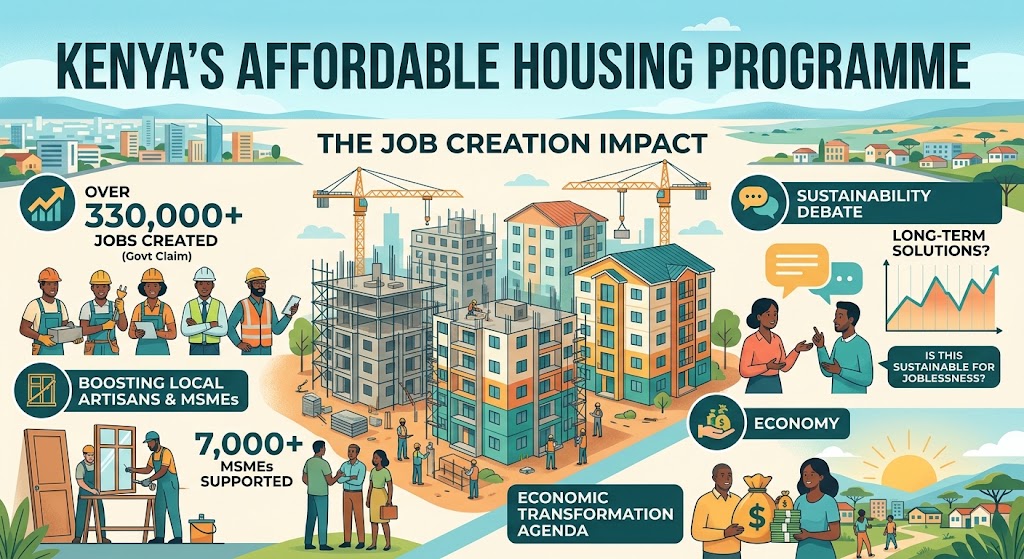
The Kenya Kwanza administration’s Affordable Housing Programme (AHP) stands as the centerpiece of President William Ruto’s Bottom-Up Economic Transformation Agenda (BETA). Marketed simultaneously as an urban regeneration effort and a massive employment scheme, the project has drawn intense national debate.
While state scorecards celebrate hundreds of thousands of new construction jobs, economic analysts and formal sector employers point to the statutory weight of the Affordable Housing Levy (AHL) and question whether temporary site labor can solve Kenya’s structural unemployment.
The Numbers Game: Government Scorecards vs. KNBS Reality
The primary selling point for the Affordable Housing Programme has been its capacity to absorb blue-collar labor. However, a significant gap exists between official state claims and national statistical data.
The Official Position
Ministry of Housing updates and state-commissioned surveys estimate that the program has generated between 428,000 and 640,000 direct and indirect jobs since its inception. In broader executive updates, state scorecards claim over 1.1 million total value-chain impacts spanning local raw material supply, transportation, and site labor. The government’s baseline model projects that every constructed unit yields roughly two jobs—one direct fundi on site and one indirect worker in the broader supply network.
The KNBS Perspective
Data from the Kenya National Bureau of Statistics (KNBS) 2026 Economic Survey presents a far more conservative trajectory. According to KNBS:
- Total employment across Kenya’s entire construction sector (spanning residential buildings, roads, and civil infrastructure) reached 728,400 workers, growing by 35,800 jobs over the previous year.
- Across the broader multi-year window since 2023, total construction employment expanded by approximately 77,000 jobs.
- Analysts note that state estimates often count temporary, site-by-site worker shifts cumulatively rather than measuring net sustained employment.
| Data Metric | Ministry & State Estimates | KNBS 2026 Economic Survey Data |
| Claimed AHP Job Impact | 428,000 – 640,000 direct/indirect jobs | Sector expanded by 35,800 jobs last year |
| Total Sector Baseline | Blended value-chain estimates | 728,400 total construction workers nationwide |
| Nature of Jobs | Cumulative site engagement | Formal & informal annual net additions |
Where the Housing Model Wins: The Jua Kali Stimulus
Despite discrepancies in top-line employment numbers, the housing initiative has delivered tangible benefits to specific segments of the informal economy.
Ring-Fenced Informal Procurement
The state’s policy of reserving specific construction inputs—such as doors, steel grilles, window frames, and mechanical fittings—for local Jua Kali artisans has directed capital into informal manufacturing clusters. For small fabrication workshops in Nairobi, Nakuru, and Kisumu, housing tenders provide guaranteed revenue and trade volume.
Vocational Up-Skilling
On-site employment offers practical trade experience for thousands of unskilled youth. Working alongside qualified engineers and master masons allows casual laborers to gain formal certification standards, upgrading the technical skills of Kenya’s artisanal workforce.
The Hidden Cost: Pressure on Formal Wages and Employers
While the program pumps capital into construction, its funding mechanism—the mandatory 1.5% employee deduction matched by a 1.5% employer contribution under the Affordable Housing Act—has created financial headwinds across non-construction sectors.
Gross Salary ---> 1.5% Employee Deduction + 1.5% Employer Match = 3.0% Total Statutory Levy
Direct Impact on Salaried Workers
Combined with statutory adjustments to the Social Health Insurance Fund (SHIF) and National Social Security Fund (NSSF) tiers, the housing levy has squeezed formal worker disposable income. Take-home pay reductions ranging from 3% to 8% have eroded household purchasing power, leading workers to reduce voluntary SACCO savings, defer personal investments, and cut back on retail spending.
Employer Overhead & Hiring Drag
For formal employers, the matching 1.5% contribution acts as an un-capped payroll tax. In labor-intensive industries like retail, private security, agriculture, and education, higher employment costs have led businesses to adopt defensive measures:
- Freezing new permanent hires in favor of contract or casual labor.
- Deferring annual salary reviews to absorb compulsory statutory compliance costs.
- Passing increased operating expenses onto consumers via higher product and service prices.
Is Construction a Sustainable Fix for Joblessness?
Relying on housing projects as a primary national employment engine presents structural limitations:
- Cyclical vs. Permanent Work: Construction jobs are site-bound. Once a block of flats is completed, on-site employment drops to zero unless immediate capital is available to break ground on a new site.
- Labor Market Dynamics: Kenya absorbs over 800,000 young entrants into the job market every year. While manual construction absorbs semi-skilled labor, it does not match the career ambitions of tertiary-educated graduates seeking professional, financial, or tech-driven roles.
- Capital Redistribution Risk: Funding public construction by taxing formal payrolls transfers money away from consumer-facing industries and private business expansion. If tax-funded public works displace private sector job creation, the net economic gain remains muted.
Looking Ahead
The Affordable Housing Programme succeeds as a targeted fiscal stimulus for civil engineering, raw material suppliers, and Jua Kali fabricators. However, framing it as a complete cure for Kenya’s unemployment overlooks macro-level economic trade-offs.
Long-term job security for Kenya’s youth cannot rest on public construction alone. It requires a balanced policy framework that relieves the tax burden on formal enterprises, nurtures export manufacturing, and fosters a predictable private-sector environment capable of sustained job growth.
Never Miss a Story: Join Our Newsletter