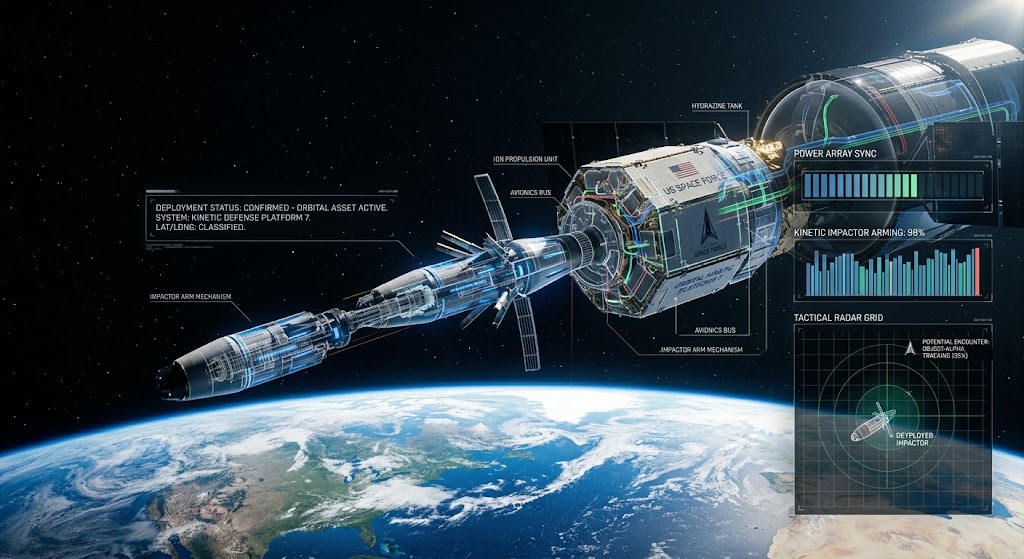
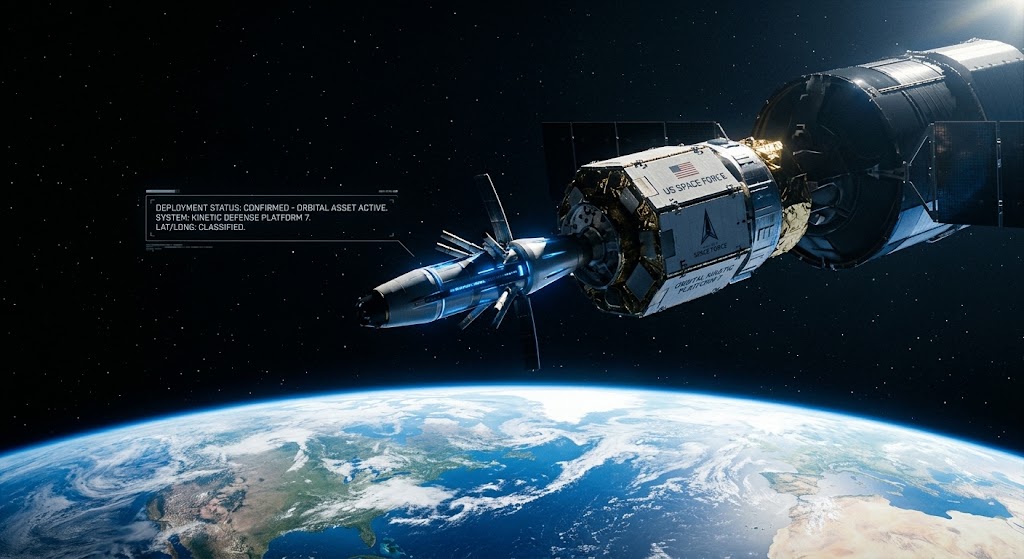
In a historic and unprecedented public admission, the United States military has confirmed that active weapons systems are currently deployed in Earth’s orbit. Speaking at the annual Air, Space and Cyber Conference, US Secretary of the Air Force Troy Meink announced that Washington maintains “on-orbit space-control weapons” designed to defend military assets and respond to evolving threats.
This disclosure marks the first time any major power has openly acknowledged maintaining offensive or defensive operational weapons permanently stationed in space.
Read Also: The Great Silicon Divide: Inside the Fractured War for Artificial Intelligence
Key Details of the Disclosure
| Feature | Official Details Disclosed |
| Announcement Source | US Secretary of the Air Force Troy Meink |
| Operational Designation | “On-orbit space-control capabilities” |
| Tactical Capabilities | Kinetic (physical interceptors/projectiles) and non-kinetic (electronic jammers/directed energy) |
| Legal Framework | Compliant with the 1967 Outer Space Treaty (which bans nuclear weapons/WMDs, but not conventional military assets) |
| Target Entities | Counterspace systems operated by adversary nations |
Why Space Control Has Shifted to Outer Orbit
Modern military infrastructure—including precision GPS guidance, missile early-warning radars, field communications, and satellite surveillance—is dependent on low-Earth and geostationary satellite networks. Disabling an adversary’s satellites can effectively blind ground forces before a terrestrial battle even begins.
- Kinetic vs. Non-Kinetic Arsenal: While officials kept exact technical details classified, Space Force spokespersons confirmed capabilities include both signal disruption (jamming radar and satellite communications) and kinetic force (physical destruction of hostile satellites).
- The Escalation Feedback Loop: Defence analysts warn that public confirmation will accelerate counter-deployments from rival superpowers. China’s Foreign Ministry responded immediately, accusing Washington of “preparing for war in outer space”.
- Orbital Debris Risks: Kinetic warfare in space carries catastrophic collateral risks, as shattered satellite fragments create dense debris fields capable of triggering a chain reaction that destroys commercial and scientific satellites.
Read Also : America’s Orbital Weapons Signal a New Era of Warfare
Global Strategic Impact
For decades, military doctrine framed outer space as an operational support domain strictly meant for intelligence gathering and positioning. Official confirmation of orbital weapon deployments establishes outer space as an active warfighting domain, where the opening salvo of future conflicts could occur hundreds of kilometers above the planet.
Never Miss a Story: Join Our Newsletter