
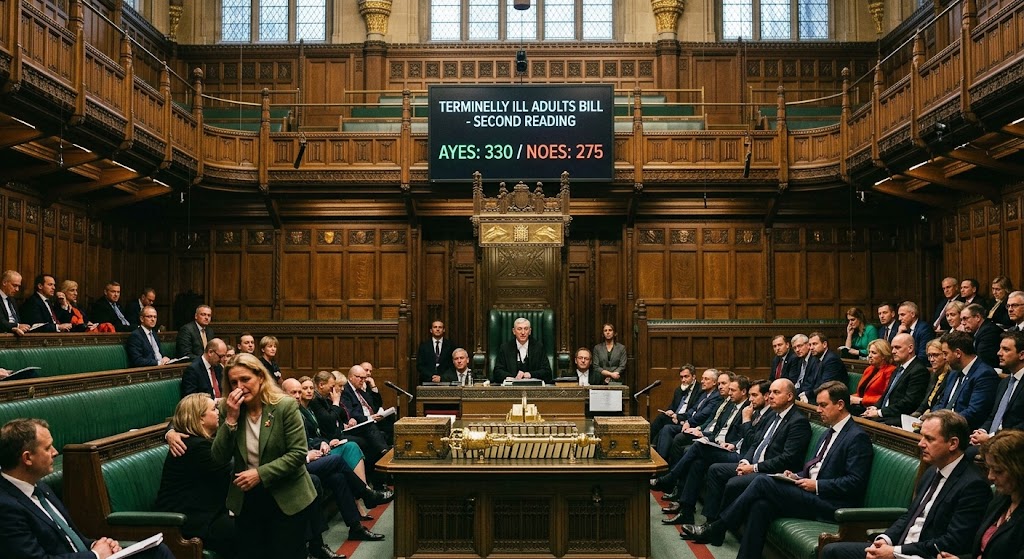
In a historic vote marking one of the most profound shifts in modern British social policy, Members of Parliament in the House of Commons voted 330 to 275 to pass the second reading of the Terminally Ill Adults (End of Life) Bill. The decision clears the first major legislative hurdle toward legalising assisted dying in England and Wales.
What Assisted Dying Means in Practice
To understand the magnitude of the debate, it is essential to clarify what “assisted dying” actually entails under the proposed legislation. At its core, assisted dying gives a terminally ill, mentally competent adult the legal option to end their life using doctor-prescribed medication, rather than enduring the final, agonizing stages of an incurable illness.
Crucially, the legislation does not apply to individuals experiencing mental health crises, chronic non-terminal conditions, or old age alone. It is strictly reserved for people who are already dying—those with a terminal diagnosis and an expected life expectancy of six months or less.
Furthermore, the bill draws a strict boundary between assisted dying and euthanasia:
- Self-Administration: The medication must be self-administered. A doctor may prescribe the lethal substance, but the patient must physically take it themselves.
- Euthanasia Remains Illegal: If a doctor directly administers a lethal injection, that constitutes euthanasia, which remains strictly prohibited.
- Control Over Suffering: The debate is not about choosing between life and death—as terminal illness makes death imminent—but about whether society should grant dying individuals autonomy over how much suffering they endure in their final days.
A Divided Chamber and a Free Vote
Because the issue touches on fundamental moral, ethical, and religious convictions, political party leadership granted a “free vote.” This allowed MPs to vote according to personal conscience rather than along strict party lines. Prime Minister Keir Starmer voted in favor of the measure, while both his Cabinet and the Opposition frontbenches split across the aisle.
Outside the Palace of Westminster, hundreds of demonstrators gathered throughout the debate. Proponents held placards reading “My Life, My Choice,” while disability rights advocates, palliative care specialists, and religious groups rallied under banners urging lawmakers to “Care, Not Kill.”
Key Safeguards Outlined in the Bill
Introduced by Labour MP Kim Leadbeater, the bill incorporates what supporters describe as the stringent legal protections:
- Age & Residency: The applicant must be aged 18 or over and registered with a GP in England or Wales for at least 12 months.
- Medical Verification: Two independent doctors must separately evaluate the patient to confirm a terminal diagnosis of six months or less and verify that the patient has the mental capacity to make a voluntary choice free from coercion.
- Judicial Oversight: A High Court judge must review the case, hear evidence from at least one evaluating doctor, and interview the patient before granting final authorization.
- Reflection Period: A mandatory waiting period is required between the initial request, judicial approval, and the prescription being fulfilled.
The Heart of the Ethical Debate
Inside the House of Commons, five hours of intense, emotional debate highlighted the deep moral complexities surrounding the bill:
- The Case for Autonomy: Supporters argued that the existing prohibition forces dying patients into unbearable physical distress or compels those with financial means to travel to Swiss clinics like Dignitas—an option unavailable to most. Proponents framed the bill as a necessary act of compassion and individual choice.
- Fears of Coercion: Opponents raised concerns that elderly, disabled, or vulnerable individuals might feel subtle societal or familial pressure to shorten their lives to avoid becoming a burden to loved ones or the NHS. Opponents maintained that Parliament’s priority should instead be improving access to underfunded hospice and palliative care systems.
Historical Context and Next Steps
The 330–275 result stands in stark contrast to the last time Parliament voted on the issue in September 2015, when MPs overwhelmingly defeated a similar proposal by 330 to 118. Public opinion in the UK has shifted significantly over the past decade, with national polling showing broad majority support for legalisation.
While the vote represents a monumental turning point, the bill is not yet law. It now advances to the committee stage, where a cross-party panel of lawmakers will conduct line-by-line scrutiny, debate proposed amendments, and consider additional safeguards. If approved in subsequent Commons votes, the legislation will proceed to the House of Lords for further debate before potentially receiving Royal Assent.
Never Miss a Story: Join Our Newsletter