




U.S. Secures Control of 65 Billion Barrels of Venezuelan Oil in ‘Historic’ Framework
U.S. President Donald Trump announced an oil agreement between the United States and Venezuela, granting Washington majority control over an estimated 65 billion barrels of proven crude oil reserves....

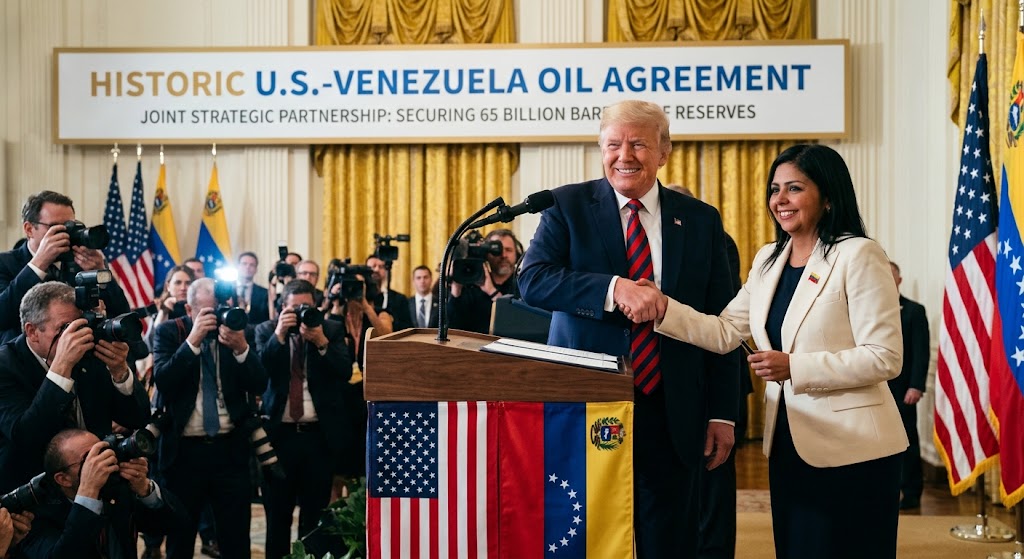
U.S. President Donald Trump announced an oil agreement between the United States and Venezuela, granting Washington majority control over an estimated 65 billion barrels of proven crude oil reserves. Characterized by the White House as the “biggest oil deal in world history,” the agreement forms a joint framework between government entities and private businesses to overhaul Venezuela’s heavily degraded energy infrastructure.
Table Of Content
Terms of the Landmark Agreement
Negotiated primarily by U.S. Secretary of State Marco Rubio, Secretary of War Pete Hegseth, and Venezuelan Interim President Delcy Rodríguez, the deal establishes a new public-private entity to operate key extraction fields.
- Reserve Access: Focuses on the immediate commercial development of 17 key Venezuelan oil fields containing roughly 65 billion barrels of proven reserves.
- Ownership and Output: The U.S. government and participating private operators will hold a combined 55% majority operational stake in the project, which includes guaranteed off-take rights to crude at production cost.
- Operational Timeline: Long-term concessions extending up to 100 years have been allocated to joint venture entities to encourage deep capital investment.
Economic Plan to Rebuild Venezuela
Venezuelan Interim President Delcy Rodríguez welcomed the signed framework, emphasizing that the incoming capital will serve as the cornerstone for restoring Venezuela’s economy following years of underinvestment and collapse.
| Metric | Target / Project Impact |
| Private Investment | Anticipated $100+ billion in capital expenditures from private energy firms. |
| National Revenue | Projected $209+ billion in tax receipts for the Venezuelan treasury over time. |
| Infrastructure Overhaul | Direct modernization of pipelines, power grids, and refining facilities. |
| Socioeconomic Goals | Local job creation, wage expansion, and funding for public infrastructure. |
“Venezuela is thus ushering in a new era of recovery, growth, production, security, and prosperity for our people,” Rodríguez noted during the announcement.
U.S. Strategic & Domestic Implications
From the Washington perspective, securing a massive, reliable energy corridor close to home addresses critical national security and economic priorities:
- Gas Price Relief: Expanding heavy crude refining supply aims to lower domestic pump prices for American consumers long term.
- Strategic Reserve Replenishment: A designated portion of the off-take crude will directly refill the U.S. Strategic Petroleum Reserve.
- Supply Chain Defense: The deal offsets geopolitical vulnerabilities and energy bottlenecks currently impacting transatlantic trade and global shipping lanes.
While energy analysts note that converting these vast subterranean reserves into active export volume will require years of rehabilitation, both capitals view the bilateral accord as a historic turning point for Western Hemisphere energy policy.
Never Miss a Story: Join Our Newsletter