Just as a cardiologist checks your pulse to gauge cardiovascular health, a gastroenterologist evaluates your stool to understand your gut health. Because roughly 60% of stool weight is microbial in origin, every bowel movement provides a direct, cost-free peak into the state of your gut microbiome.
Here is a breakdown of the 10 key insights your stool offers about your digestion, diet, and overall health.
1. Composition: It’s Mostly Bacteria
Contrary to popular belief that stool is purely undigested food waste, it is actually composed mostly of water (~75%) and living or dead gut bacteria (~60% of dry mass). This means your stool reflects the living ecosystem of your microbiome.
2. The Ideal Form: “Type 4” on the Bristol Stool Scale
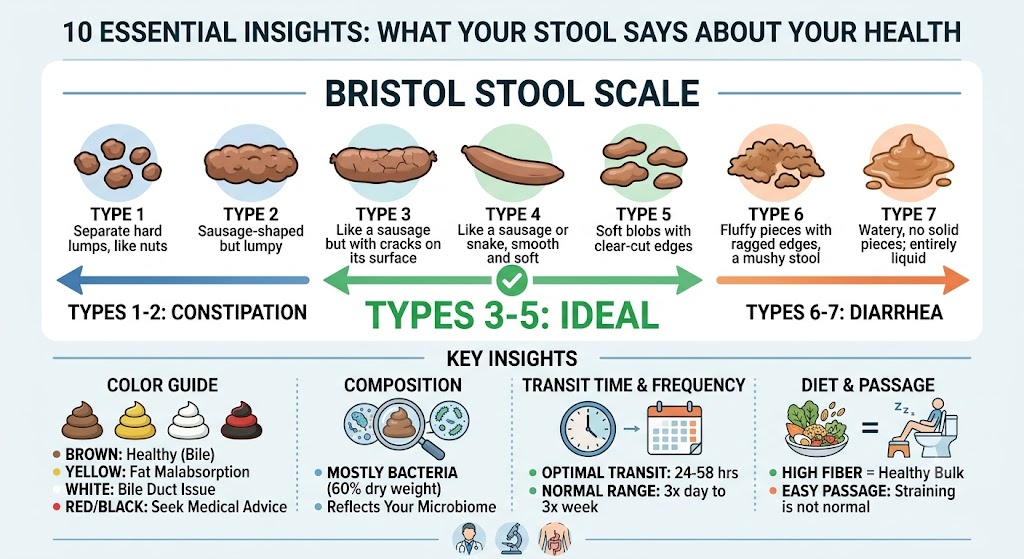
Medical professionals use the Bristol Stool Scale (Types 1–7) to evaluate bowel consistency:
- Types 1–2: Hard pellets or lumpy logs (indicates constipation / slow transit time).
- Types 3–5: Well-formed, sausage-like shapes (considered healthy).
- Types 6–7: Fluffy, mushy, or liquid stools (indicates rapid transit time / diarrhea).
The gold standard is Type 4—smooth, soft, and easy to pass.
[Type 1-2: Hard/Pellets] ──> [Type 3-5: Ideal/Smooth] ──> [Type 6-7: Loose/Liquid]
       (Constipation)             (Optimal Health)               (Diarrhea)
3. Transit Time: How Fast Food Moves Through You
Stool texture directly correlates with gut transit time—the duration it takes for food to travel from mouth to bowl:
- Slow Transit (>58 hours): The colon reabsorbs too much water, producing dry, hard pellets (Types 1–2).
- Fast Transit: Food moves too quickly for proper water and nutrient absorption, leading to loose or liquid stool (Types 6–7).
Read Also: Are You Really “Too Acidic”? A Deep Dive Into the 5 Different Acids That Control Your Health
4. Frequency: What Counts as “Normal”?
Normal bowel frequency varies significantly between individuals. Healthy bowel patterns can range from 3 times a day to 3 times a week, provided the stool is comfortable to pass and well-formed. According to UK data, the average person poops roughly 1.7 times per day.
5. Brown is Normal: The Role of Bile
Healthy stool is brown due to bile, a digestive fluid produced by the liver and stored in the gallbladder that breaks down fats. As bile travels through the digestive tract, chemical reactions transform its original greenish-yellow color into brown.
6. Color Changes: What White, Yellow, or Green Mean
- White or Clay-Colored: May indicate a bile duct blockage or liver issue preventing bile from reaching the digestive tract.
- Yellow / Greasy: Often points to fat malabsorption, celiac disease, or pancreatic issues.
- Green: Can indicate rapid transit time (bile didn’t have time to turn brown) or high intake of leafy greens / artificial dyes.
7. Alarm Colors: Red and Black Stools
- Black / Tarry (Melena): Can signal upper gastrointestinal bleeding (such as a stomach ulcer), though benign causes like Pepto-Bismol or iron supplements can also darken stool.
- Bright Red: Can indicate lower gastrointestinal bleeding (such as hemorrhoids or polyps), though harmless foods like beets can temporarily turn stool red.
Medical Note: Any persistent black, tarry, or unexplained bright red stool warrants prompt evaluation by a healthcare professional.
8. Fiber Intake Directly Shapes Your Stool
A fiber-rich, plant-heavy diet feeds beneficial gut bacteria and adds bulk to stool. Soluble fiber absorbs water to keep stool soft, while insoluble fiber adds structure to sweep waste through the digestive system efficiently.
9. Floating vs. Sinking Stools
Most healthy stools sink. A stool that floats is usually caused by excess gas trapped within it (often after consuming high-fiber foods or carbonated drinks). However, persistently floating, greasy, or foul-smelling stools can signal fat malabsorption.
10. Ease of Passage: Straining Isn’t Normal
Passing stool should be painless and require minimal effort. Chronic straining can lead to complications like hemorrhoids and pelvic floor dysfunction, and often indicates a need for increased dietary fiber, higher hydration, or altered sitting posture (such as using a footstool to optimize the anorectal angle).
Read Also: How to Make Uji Power in Kenya: A Step-by-Step Guide
Key Takeaways
- Look before you flush: Your stool is a daily health indicator.
- Aim for Type 4: Smooth, brown, and easy to pass.
- Prioritize plant fiber & hydration: These feed your gut microbiome and keep transit times optimal.
This video on 10 Things Your STOOL Says About Your Health provides deeper context on how stool analysis offers direct insights into gut health and the microbiome.
The Surprising Link Between Your Gut & Your Brain. | Gary Brecka
The Diary Of A CEO Clips · 412K views Open in The Surprising Link Between Your Gut & Your Brain. | Gary Brecka


Never Miss a Story: Join Our Newsletter