Born in the 1600s, Still Swimming Today: The Mind-Bending Science of Earth’s Oldest Vertebrate
Imagine a creature swimming through the pitch-black, freezing depths of the Arctic Ocean that was already a century old when the Mayflower landed, and lived through the rise and fall of empires, the...

Imagine a creature swimming through the pitch-black, freezing depths of the Arctic Ocean that was already a century old when the Mayflower landed, and lived through the rise and fall of empires, the Industrial Revolution, and both World Wars.
Table Of Content
- 1. How Authentic is the 400-Year Lifespan?
- The Science of the “Carbon Eye”
- 2. Where Do They Live?
- 3. How Many Are Left Today?
- 4. The Parasite in the Eye
- Summary of the Ancient of the Deep
- How do Greenland sharks survive sub-zero temperatures, and what makes their meat toxic to humans?
- 1. The Chemical Antifreeze: TMAO and Urea
- 2. Why Their Fresh Meat is Toxic to Humans
- Symptoms of Shark Sickness
- 3. The Icelandic Cure: Fermentation (Hákarl)
- How does the Greenland shark’s metabolic rate and cold environment contribute to its 400-year lifespan?
- 1. The Power of the Cold: Thermoregulation in Slow Motion
- 2. A Glacial Metabolic Rate
- 3. Flawless Cellular Repair
- What are scientists learning from the Greenland shark’s genome about aging and DNA repair that could apply to human medicine?
- 1. “Hijacking” Parasitic Genes for DNA Repair
- 2. A Superior “Guardian of the Genome” (p53)
- 3. High-Density Chromatin Compaction
- 4. Redefining “Ferroptosis” and Cell Death
- The Big Picture
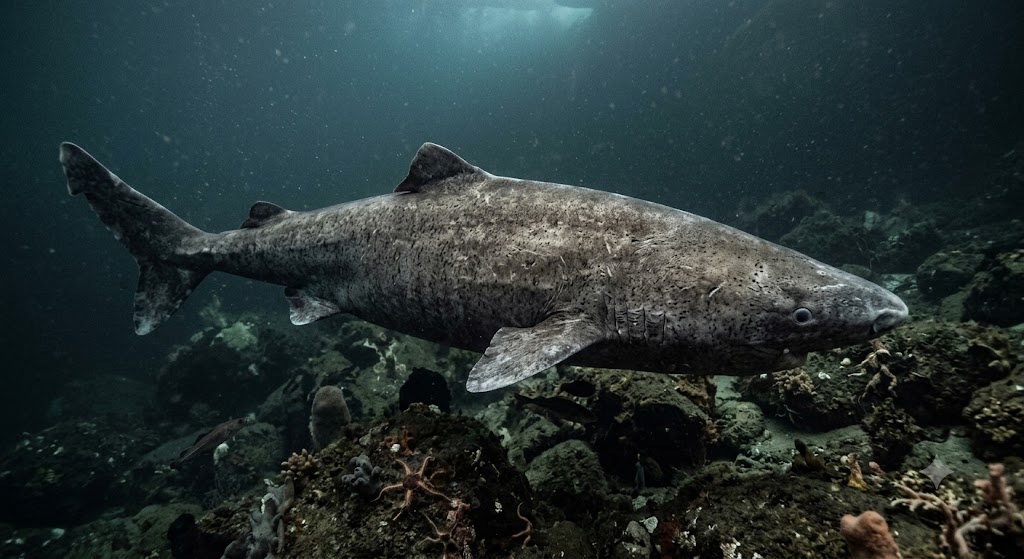
Meet the Greenland shark (Somniosus microcephalus). It is not just a survivor of the deep; it is the longest-lived vertebrate on Earth.
1. How Authentic is the 400-Year Lifespan?
For years, rumors of the Greenland shark’s ancient age were met with scientific skepticism. Sharks do not have bones; their skeletons are made of cartilage. Normally, marine biologists age sharks by counting growth rings on their calcified vertebrae or fin spines—much like counting tree rings. But the Greenland shark is so soft that it lacks these hard structures.
So, how did scientists finally prove their age? In 2016, a groundbreaking study published in the journal Science found a brilliant loophole: radiocarbon dating the sharks’ eyes.
The Science of the “Carbon Eye”
Inside the eye lens of every vertebrate is a core of proteins (the embryonic nucleus) that is formed when the animal is still in its mother’s womb. This protein is metabolically inert—meaning it never recycles or changes throughout the shark’s entire life. It is a perfect capsule of the atmospheric carbon present at the exact moment of the shark’s birth.
- The Bomb Pulse: During the late 1950s and early 1960s, thermonuclear bomb testing doubled the amount of carbon-14 in the ocean’s food chain. This sudden spike is known as the “bomb pulse”.
- The Findings: Researchers tested the eyes of 28 female Greenland sharks. Only the smallest sharks (under 2.2 meters) had the elevated carbon-14 levels of the bomb pulse.
- The Results: The largest shark in the study (measuring over 5 meters or 16 feet) was estimated to be 392 years old (with a margin of error of ±120 years).
This means she was born somewhere between 1504 and 1744. Scientists estimate that their maximum lifespan easily reaches 400 to 500 years.
Even more mind-blowing? Because they grow at a glacial pace of about 1 centimeter per year, female Greenland sharks do not even reach sexual maturity until they are about 150 years old.
:Read Also: Why Do We Forget Dreams So Fast? Neuroscience Behind the Morning Amnesia
2. Where Do They Live?
As their name suggests, these deep-sea giants reside in the freezing waters of the North Atlantic and Arctic Oceans. Their territory ranges from eastern Canada and Greenland all the way to northern Europe and Russia.
       [ Surface / Shallow Bays ] <-- Moves here during freezing winters
                   |
     ~200 m -------v-----------------------
                   |
                   |   [ Preferred Zone ]
                   |   Temps: 0.6°C to 12°C
                   |
    ~1,200 m ------v-----------------------
                   | <-- Can dive deeper than 1,800 m!
They are bathybenthic creatures, meaning they prefer the cold, high-pressure environments of continental slopes and deep-sea trenches. Because their bodies are perfectly adapted to temperatures just barely above freezing, they spend their lives slowly cruising through depths of 180 to over 1,200 meters (590 to 3,900+ feet).
3. How Many Are Left Today?
Because they live so deep under seasonal sea ice, we do not know the exact global population size of the Greenland shark. However, marine biologists are deeply concerned about their future.
The International Union for Conservation of Nature (IUCN) lists them as Vulnerable.
| Key Population Metric | Data & Estimates |
| Historical Decline | Population estimated to have dropped 11.7% to 72.9% over the last 450 years. |
| Why the Decline? | Historically targeted heavily for their liver oil (used as industrial lubricant and lamp fuel). |
| Modern Threat | Bycatch (unintentionally caught in commercial fishing nets for other species). |
| Annual Bycatch | An estimated 3,500+ individuals are caught annually in the North Atlantic alone. |
Because a female shark takes 150 years to reproduce, even moderate bycatch rates can cause a devastating, slow-motion collapse of the species. They simply cannot repopulate fast enough to keep up with modern fishing pressures.
4. The Parasite in the Eye
If a 400-year-old shark wasn’t strange enough, their relationship with a specific deep-sea parasite makes them even more bizarre.
Nearly every Greenland shark found in the Arctic has a pale, worm-like crustacean called Ommatokoita elongata anchored to its eyes. This parasite eats away at the shark’s cornea, rendering the shark almost entirely blind.
However, in the pitch-black depths of the Arctic, sight isn’t particularly useful anyway. The sharks rely on an extraordinarily sharp sense of smell and lateral lines to hunt. Some marine biologists even theorize that this relationship might be mutualistic: the parasite may bioluminesce (glow in the dark), acting as a fishing lure to attract curious prey directly toward the shark’s mouth.
Summary of the Ancient of the Deep
- They are chemical anti-freeze machines: Their tissues are saturated with high levels of trimethylamine oxide (TMAO), which keeps their bodily fluids from freezing in sub-zero water. This also makes their fresh meat highly toxic to humans unless it is heavily fermented (as in the traditional Icelandic dish, Hákarl).
- They are stealth scavengers: Despite having a top speed of only about 1.7 miles per hour, they successfully hunt sleeping seals and scavenge on carcasses of reindeer, moose, and even polar bears that fall through the ice.
- They are living time capsules: A single mature Greenland shark swimming today likely swam the oceans when Galileo first pointed his telescope at the stars.
How do Greenland sharks survive sub-zero temperatures, and what makes their meat toxic to humans?
To survive in water that is literally cold enough to freeze human blood, the Greenland shark has evolved a highly specialized chemical defense system.
This exact biological defense is the very reason why eating fresh Greenland shark meat is highly toxic—and potentially lethal—to humans.
1. The Chemical Antifreeze: TMAO and Urea
Water in the deep Arctic Ocean routinely drops below 0°C (32°F). Under these conditions, the water inside animal cells normally freezes, forming sharp ice crystals that rupture cell membranes and cause instant death.
To prevent this, the Greenland shark’s body is saturated with two key chemical compounds:
- Urea: Like other sharks, Greenland sharks retain high levels of urea in their blood and tissues. This raises their internal osmotic pressure, preventing their bodies from losing water to the highly saline ocean.
- TMAO (Trimethylamine N-oxide): This is the magic ingredient. Urea is highly damaging to proteins, but TMAO acts as a protein stabilizer (counteracting the harmful effects of urea) and serves as a highly effective natural antifreeze. It prevents water molecules inside the shark’s cells from grouping together to form ice crystals.
Together, these compounds act like industrial-grade antifreeze circulating through the shark’s veins, allowing its heart to beat and its muscles to contract in sub-zero water.
Read Also: Womb Transplants in Kenya: Should Wombs Be Taken from the Dead? Kenyan Experts Weigh In
2. Why Their Fresh Meat is Toxic to Humans
Because of this high concentration of TMAO, eating fresh Greenland shark meat triggers severe physiological distress.
When humans digest TMAO, our gut bacteria break it down into trimethylamine (TMA). TMA is a highly toxic compound. Eating raw or freshly cooked Greenland shark meat causes a condition colloquially known as “shark sickness.”
Symptoms of Shark Sickness:
- Extreme, drunken-like disorientation and lack of coordination
- Severe muscle spasms and tremors
- Hyperventilation and respiratory distress
- Nausea, vomiting, and explosive diarrhea
- In severe cases, coma or death
Arctic sled dogs that have accidentally eaten fresh Greenland shark carcass often become completely unable to stand, thrashing on the ground as if highly intoxicated.
3. The Icelandic Cure: Fermentation (Hákarl)
Despite this toxicity, the Greenland shark is the star of one of the world’s most famous—and notorious—culinary traditions: Iceland’s Hákarl.
To make the toxic meat edible, traditional Icelandic processors rely on a months-long purification process to draw out the TMAO.
[ Fresh, Toxic Meat ]
         |
         v
 [ Bury in Gravelly Soil ]
   Presses out the fluids & TMAO (6–12 weeks)
         |
         v
 [ Hang in Open-Air Shed ]
   Dries & ferments out remaining toxins (Several months)
         |
         v
 [ Edible Hákarl ]
   Smells intensely of ammonia; tastes like strong cheese
The result is a translucent, rubbery meat with an incredibly pungent, ammonia-like odor (similar to industrial cleaning products). While it is safe to eat after this grueling fermentation process, it remains a legendary test of endurance for adventurous travelers’ taste buds!
How does the Greenland shark’s metabolic rate and cold environment contribute to its 400-year lifespan?
The extraordinary lifespan of the Greenland shark is a masterclass in slow-motion living. The secret to surviving for nearly half a millennium boils down to two deeply interconnected factors: extreme cold and the slowest metabolic rate of any shark on Earth.
In the freezing depths of the Arctic, life doesn’t run; it crawls.
1. The Power of the Cold: Thermoregulation in Slow Motion
As ectotherms (cold-blooded animals), Greenland sharks cannot generate their own body heat. Their internal body temperature matches the freezing water around them, hovering between $-1.8^\circ\text{C}$ and $2^\circ\text{C}$.
According to the Arrhenius equation—a fundamental principle in chemistry—chemical reaction rates decrease exponentially as temperature drops.
$$\text{Rate} \propto e^{-\frac{E_a}{RT}}$$
By living in a permanent deep-freeze, the Greenland shark’s biochemical reactions are slowed to an absolute crawl. This cold environment acts as a natural preservation chamber, slowing down cell division, aging, and the general wear-and-tear of life.
2. A Glacial Metabolic Rate
Because of the cold, every physiological process in the Greenland shark is dialed down to the bare minimum. They possess the lowest mass-specific metabolic rate of any shark species.
- Cruising Speed: They swim at an average of just 1.2 km/h (0.74 mph), rarely exceeding 2.7 km/h even when hunting.
- Heart Rate: A Greenland shark’s heart beats only 5 to 6 times per minute. (For comparison, a human heart beats around 60–100 times per minute).
- Glacial Growth: Because their metabolism is so slow, they grow at a rate of only 0.5 to 1 centimeter per year. This is why a 5-meter-long female takes up to 150 years just to reach puberty.
The “Rate of Living” Hypothesis: First proposed in the early 20th century, this biological theory suggests that an organism’s lifespan is inversely proportional to its metabolic rate. Essentially, every creature has a “set” amount of metabolic energy to spend. Because the Greenland shark burns its energy budget at a microscopic trickle, its lifespan stretches out over centuries.
3. Flawless Cellular Repair
A slow metabolism doesn’t just mean moving slowly; it fundamentally changes how the body ages at a cellular level.
Under normal circumstances, metabolic processes produce Reactive Oxygen Species (ROS)—unstable molecules also known as free radicals. In humans and other warm-blooded animals, ROS build up over time, damaging DNA, proteins, and cell membranes, which directly leads to aging and disease (like cancer).
Because the Greenland shark’s metabolic engine runs on low-idle:
- Low Oxidative Stress: They produce far fewer free radicals to begin with, resulting in minimal daily cellular damage.
- Ultra-Efficient Genetic Maintenance: Scientists sequencing the Greenland shark’s genome have discovered unique genetic adaptations. Their cells are incredibly efficient at repairing DNA damage and clearing out degraded proteins before they can cause cellular decay.
They don’t just age slowly; their biological systems are uniquely built to resist the normal decay of time.
Read Also: Tech and Touch: How AI and Robots Are Replacing Human Interaction in Healthcare
What are scientists learning from the Greenland shark’s genome about aging and DNA repair that could apply to human medicine?
For centuries, the Greenland shark was a genetic mystery. But in late 2024, an international team of scientists successfully mapped the Greenland shark’s genome for the first time.
What they discovered has sent shockwaves through the field of biogerontology (the study of aging). The shark’s genetic blueprint is gigantic—at 6.5 billion base pairs, it is more than double the size of the human genome.
Within this massive genetic sequence, scientists have uncovered specific evolutionary tricks that could someday redefine how we treat aging, genetic instability, and cancer in humans.
1. “Hijacking” Parasitic Genes for DNA Repair
Over 70% of the Greenland shark’s genome is made up of transposable elements (often called “jumping genes” or genomic parasites).
- The Hazard: In humans, jumping genes copy and paste themselves randomly into our DNA. This disrupts healthy genes, causes genomic instability, and is a major driver of aging and cancer.
- The Shark’s Solution: Instead of letting these genomic parasites destroy them, the Greenland shark actually hijacked the molecular machinery of these jumping genes. They used this copying mechanism to duplicate their own beneficial, coding genes—specifically a massive, interconnected network of genes dedicated entirely to DNA repair.
The Human Application: Humans suffer thousands of DNA-damaging events per cell every single day. If researchers can understand how the Greenland shark silences genomic parasites while simultaneously amplifying its DNA repair toolbox, we could develop gene therapies that significantly boost DNA repair efficiency in aging human tissues.
2. A Superior “Guardian of the Genome” (p53)
One of the most exciting discoveries in the shark’s genome is a unique structural alteration in the p53 protein.
- What is p53? Often called the “guardian of the genome,” p53 is a vital tumor suppressor present in humans. When a cell detects DNA damage, p53 decides whether that cell should pause and repair itself, or self-destruct (preventing it from turning into cancer).
- The Shark’s Mutation: The Greenland shark has a unique insertion in the C-terminal region of its p53 gene. This slight modification is hypothesized to make their p53 protein exceptionally resilient, allowing it to coordinate a vastly superior cellular response to DNA damage.
The Human Application: Over 50% of all human cancers involve a mutated, malfunctioning p53 gene. Studying how the shark’s modified p53 functions could lead to novel cancer therapeutics and treatments that mimic this robust “guardian” state in human cells.
3. High-Density Chromatin Compaction
As we age, the physical structure of our DNA (chromatin) becomes loose and unraveled, exposing our genetic code to damage and causing genes to turn “on” or “off” incorrectly (epigenetic decay).
The Greenland shark genome revealed unique amino acid substitutions in a crucial protein called linker histone H1.0. These specific changes are predicted to enhance chromatin stability and compaction. Essentially, the shark’s DNA is physically packed so tightly and securely that it is physically shielded from molecular wear-and-tear.
4. Redefining “Ferroptosis” and Cell Death
The researchers also discovered a highly specialized gene repertoire linked to ferroptosis—a form of programmed cell death dependent on iron accumulation.
While uncontrolled ferroptosis is linked to neurodegenerative diseases in humans (like Alzheimer’s and Parkinson’s), the Greenland shark appears to have masterfully regulated this pathway. Scientists believe this allows them to systematically destroy compromised, iron-heavy cells before they can cause inflammation, while keeping their long-lived healthy cells entirely intact.
The Big Picture
For a long time, scientists assumed that extreme longevity was simply a passive byproduct of a cold environment. The decoding of the Greenland shark genome proves otherwise: their lifespan is an active, genetically engineered defense system.
By providing a public, open-source browser of the shark’s genome, the research team has given scientists worldwide the ability to compare human genes of interest with the shark’s ultra-resilient variants. We are looking at a living, 400-year-old library of genetic solutions to the problems of human aging.
Never Miss a Story: Join Our Newsletter