Richard Wurmbrand: The Voice of the Martyrs Who Would Not Be Silenced
Few testimonies of faith under persecution are as harrowing or as inspiring as that of Richard Wurmbrand. A Romanian pastor of Jewish descent, he spent fourteen years in Communist prisons for his...

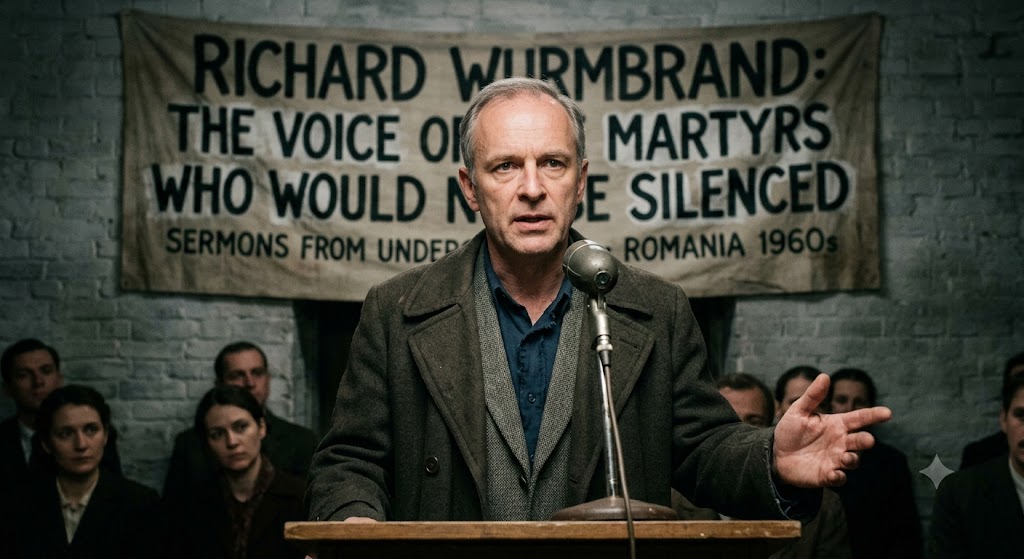
Few testimonies of faith under persecution are as harrowing or as inspiring as that of Richard Wurmbrand. A Romanian pastor of Jewish descent, he spent fourteen years in Communist prisons for his Christian faith—much of it in solitary confinement, enduring brutal torture that left eighteen scars on his body . Yet he emerged without bitterness, founded The Voice of the Martyrs, and spent the rest of his life advocating for persecuted Christians worldwide. His story is a powerful testament to the sustaining grace of God in the darkest of human circumstances.
Table Of Content
- Early Life: From Judaism to Christ
- The Communist Takeover and Underground Ministry
- Arrest and Fourteen Years of Hell
- Sabina’s Suffering: The Pastor’s Wife
- A Miraculous Release
- Testifying Before the World
- The Birth of The Voice of the Martyrs
- The Solitary Confinement That Became a Sanctuary
- A Prolific Author and Global Voice
- Death and Legacy
- Lessons from His Life
- Lasting Influence
Early Life: From Judaism to Christ
Richard Wurmbrand was born on March 24, 1909, into a Jewish family in Romania . He grew up during a time of intense anti-Semitic activity in his homeland, an experience that shaped his early understanding of suffering and persecution .
As a young man, he was sent to study Marxism in Moscow, where he became involved in Communist activities and served as an important leader within the Comintern—the international Communist organization directed by Moscow . Like many Romanian Communists of his era, he was arrested several times by Romanian authorities for his political activities .
In 1938, everything changed. Both Richard and his wife Sabina (whom he had married in 1936) became born-again Christians . This conversion would set him on a collision course with the very ideology he had once championed.
During World War II, Wurmbrand served as a pastor, preaching in bomb shelters and risking his life to rescue Jews from the Holocaust . He was ordained twice—first as an Anglican and later, after the war, as a Romanian Evangelical Lutheran priest .
The Communist Takeover and Underground Ministry
In 1944, the Soviet Union occupied Romania and began establishing a Communist regime . The new government held a policy of state atheism and implemented anti-religious legislation designed to eliminate the Church .
Wurmbrand recognized the threat immediately. He began an effective, vigorous “underground” ministry to oppressed believers, continuing to preach and witness despite the growing restrictions . He worked ecumenically with Christians of many denominations, determined to keep the faith alive .
His public declaration that Communism and Christianity were incompatible was a bold act of defiance . It would cost him everything.
Arrest and Fourteen Years of Hell
On February 29, 1948, Richard Wurmbrand was arrested by the secret police while on his way to a Divine Service . His crimes? Leading Christian worship and witnessing—both illegal under Romania’s atheistic Communist regime . He had also spoken up for Christ at a gathering of party officials and religious leaders .
What followed was fourteen years of unimaginable suffering:
- Three years in solitary confinement in a dank, windowless cell, twelve feet below the ground, completely isolated from all human contact except for his torturers .
- Brutal torture, including beatings, mutilation, burns, and being locked in a large ice box . His body bore eighteen scars from these tortures for the rest of his life .
- Imprisonment under a false name, so that no one could trace him .
After eight and a half years in prison, he was unexpectedly released. He immediately resumed his underground ministry . But his freedom was short-lived.
In 1959, he was re-arrested and sentenced to twenty-five years in prison . It appeared his life was over.
Sabina’s Suffering: The Pastor’s Wife
While Richard endured his imprisonment, his wife Sabina faced her own ordeal. She was arrested in 1950 and spent three years in a labor camp, forced to work on the brutal construction of the Danube Canal . She nearly froze to death in the harsh conditions .
Adding to her anguish, secret police posing as former prisoners repeatedly visited her, telling her that Richard had died in prison . They claimed to have attended his burial in the prison cemetery . Yet Sabina refused to believe them, clinging to the hope that her husband was still alive .
A Miraculous Release
In 1964, Richard Wurmbrand was released through a general amnesty . He had spent a total of fourteen years in prison—three in solitary confinement, eleven in group cells where the torture continued . He immediately resumed his work with the underground church .
But freedom in Romania came with a price. The Communist authorities had begun “selling” political prisoners to the West . While the average price for a prisoner was about $1,900, the government demanded $10,000 for Pastor Wurmbrand .
A group of Norwegian Christians, recognizing the danger of a third imprisonment, negotiated his family’s emigration from Romania. The ransom was paid, and the Wurmbrands were freed to the West .
Testifying Before the World
In May 1966, Richard Wurmbrand testified before the Internal Security Subcommittee of the U.S. Senate . He stripped to the waist to show the eighteen scars covering his torso from his torture wounds . His story was carried in newspapers throughout the United States, Europe, and Asia .
He was warned in September 1966 that Romania’s Communist regime planned to assassinate him, but he would not be silenced . Instead, he dedicated the rest of his life to publicizing the plight of persecuted Christians worldwide.
The Birth of The Voice of the Martyrs
In 1967, Richard and Sabina Wurmbrand founded the organization that would become his lasting legacy—The Voice of the Martyrs (VOM) . Originally called “Jesus to the Communist World,” the organization began by supporting Christians suffering under Communist persecution .
Today, VOM is an international nonprofit organization that provides practical and spiritual assistance to persecuted Christians in more than 70 countries . In 2016 alone, VOM-USA completed more than 1,500 ministry projects, providing help to over five million people .
The organization’s mission reflects Wurmbrand’s own convictions: to inspire all believers to a deeper commitment to Christ and to fulfill His Great Commission, no matter the cost .
The Solitary Confinement That Became a Sanctuary
Perhaps the most remarkable aspect of Wurmbrand’s story is how he experienced his prison years. While many would have been broken by solitary confinement, Wurmbrand viewed it as one of the most cherished seasons of his spiritual walk.
He said that his three years in solitary were among the most cherished moments of his spiritual walk because Jesus visited him, and he felt God’s love during his worst hours in the prison cell .
While completely alone, isolated from all human contact, he remained in intimate communion with God. He spent those long, lonely months contemplating the truths of God’s Word, composing poems and sermons in his mind . He composed 350 sermons while in prison, which were later published as With God in Solitary Confinement .
He never complained about his suffering. Instead, he often spoke about the many blessings that come from suffering .
A Prolific Author and Global Voice
After his release, Wurmbrand wrote more than eighteen books, translated into more than sixty languages . His most widely known work, Tortured for Christ, became a classic of modern Christian literature .
Other notable works include:
- With God in Solitary Confinement —composed in his prison cell .
- 100 Prison Meditations —reflections from his time in solitary confinement .
- The Pastor’s Wife —co-written with Sabina, telling her side of the story .
In his books, Wurmbrand did not merely recount his suffering. He offered practical guidance for persecuted believers and challenged Western Christians to remember “those in chains” .
Death and Legacy
Sabina Wurmbrand died in 2000 . Richard died peacefully on February 17, 2001, at the age of 91 .
Their legacy lives on through The Voice of the Martyrs, which continues to serve persecuted Christians in the world’s most dangerous places to follow Christ . Today, VOM provides practical relief, spiritual support, and encouragement to believers rebuilding their lives in countries where they have suffered oppression .
Lessons from His Life
Richard Wurmbrand’s story is not simply one of surviving persecution. It is a testament to the sustaining power of faith in the face of unimaginable cruelty. His life teaches profound lessons:
- Suffering can become a sanctuary. Three years in solitary confinement became three years of intimate communion with God.
- Forgiveness is not dependent on the offender. He emerged without bitterness, testifying to God’s love for all people, including his torturers.
- Courage is contagious. His testimony before the U.S. Senate inspired millions and launched a global movement.
- The gospel cannot be silenced. No prison, no torture, no regime could stop him from proclaiming Christ.
- There are blessings in suffering. He saw his suffering not as a curse but as a privilege—a way to share in Christ’s sufferings.
Lasting Influence
Today, the organization Richard Wurmbrand founded serves persecuted Christians in more than 70 countries . His books continue to inspire believers worldwide . His testimony before the U.S. Senate remains a landmark moment in the advocacy for religious freedom .
Perhaps most powerfully, his story continues to remind the world that no prison is deep enough, no torture cruel enough, and no regime powerful enough to extinguish the light of Christ in a faithful heart.
Never Miss a Story: Join Our Newsletter