The phrase “a country vanishing” used to evoke images of historical conquests or changing maps after a war. Today, the threat is entirely physical. Driven by climate change, accelerating glacial melt, and ocean thermal expansion, global sea levels are rising at a pace that directly threatens the existence of several sovereign nations.
While complete submersion under the waves might take until the turn of the next century, the timeline for these nations becoming completely uninhabitable is much shorter—realistically within the next 50 years. This is not just an environmental crisis; it is an impending geopolitical and legal puzzle.
Here is a fact-driven look at the countries most likely to vanish or become unlivable by 2076, and how they are fighting to survive.
1. Tuvalu: The Front Line of the Pacific
Tuvalu is an independent island nation comprising nine low-lying coral atolls scattered across the Pacific Ocean. With a total land area of just 26 square kilometers and an average elevation of less than two meters above sea level, it is widely considered the most vulnerable country on Earth.
- The 50-Year Reality: Projections from NASA and the UN indicate that Tuvalu will experience a massive increase in chronic high-tide flooding. By 2050, daily tidal surges will contaminate groundwater and make traditional agriculture impossible. Up to 95% of the capital, Funafuti, is projected to be flooded regularly by the end of the century.
- The Survival Strategy: Tuvalu is pursuing a dual approach:
- The Physical Barrier: With support from the United Nations Development Programme (UNDP), the Tuvalu Coastal Adaptation Project (TCAP) is artificially raising and reclaiming land to create safe zones above the rising tides.
- The Digital Nation: In a historic move, Tuvalu is replicating its geography, culture, and administrative systems inside the metaverse. This ensures that even if the physical land is lost, its history and identity remain intact.
- The Falepili Union: In late 2023, Tuvalu signed a landmark treaty with Australia, allowing Tuvaluans a special migration pathway to relocate as climate refugees. By 2025/2026, over 90% of Tuvaluans had applied for residency schemes abroad.
2. The Maldives: The Flattest Nation on Earth
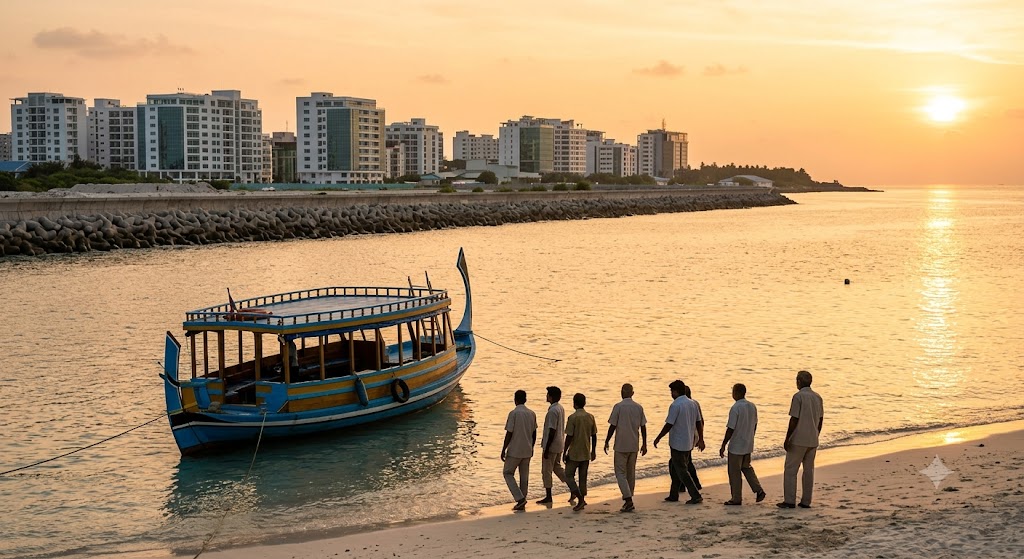
Renowned globally for its luxury tourism, the Maldives is an archipelago of nearly 1,200 coral islands in the Indian Ocean. It holds the title of the flattest country on Earth, with more than 80% of its land sitting less than one meter above sea level.
- The 50-Year Reality: The Intergovernmental Panel on Climate Change (IPCC) warns that if global greenhouse emissions continue unchecked, up to 77% of the Maldives’ land could be underwater or heavily eroded within decades. Even before total submersion, rising ocean acidity and warming water temperatures are bleaching the coral reefs that act as the islands’ natural breakwaters.
- The Survival Strategy: The Maldivian government has chosen to engineer its way out of the crisis. They have built Hulhumalé, a massive artificial island reclaimed from the sea using dredged marine sand, raised more than two meters above sea level to serve as a high-density safe haven. They are also piloting floating city concepts to adapt dynamically to changing water levels.
3. Kiribati: Buying Land Abroad
Kiribati consists of 33 low-lying coral atolls straddling the equator in the Pacific. Its capital, Tarawa, is a narrow strip of land where water rises at a rate of 1.2 centimeters per year—four times faster than the global average.
- The 50-Year Reality: King tides (exceptionally high tides) frequently breach sea walls, washing over roads, destroying homes, and flooding the shallow freshwater lenses underneath the islands with salt water. Without clean drinking water or arable soil, the islands will face a severe habitability crisis long before they are fully submerged.
- The Survival Strategy: Kiribati became one of the first nations to officially prepare for mass relocation. The government purchased 20 square kilometers of land on the island of Vanua Levu in Fiji. Originally bought for food security, this land stands as a literal insurance policy and a potential future refuge for Kiribati’s population if evacuation becomes mandatory.
4. The Marshall Islands: Fortify or Flee
Situated between Hawaii and the Philippines, the Republic of the Marshall Islands comprises 29 low-lying coral atolls. Its capital, Majuro, houses roughly half the country’s population on a strip of land that averages just a few meters in width.
- The 50-Year Reality: A one-meter rise in sea level would submerge up to 80% of Majuro. Because the land is so narrow, residents cannot retreat inland. The combination of rising seas and intensified tropical storms makes the infrastructure highly precarious.
- The Survival Strategy: The Marshall Islands benefit from the Compact of Free Association (COFA) with the United States, allowing Marshallese citizens to live, work, and study in the U.S. without a visa. This has led to a steady diaspora. Domestically, the government is focusing on aggressive adaptation, mapping out which parts of the atolls can be artificially elevated and fortified.
The Legal and Geopolitical Conundrum
If a country loses its physical territory, does it still exist?
Historically, international law defined a state as having a permanent population, a defined territory, and a government. However, the unprecedented nature of climate change is forcing a shift in global diplomacy.
A Historic Legal Precedent: In a landmark 2025 International Court of Justice (ICJ) ruling, it was clarified that the loss of physical territory due to sea-level rise does not automatically dissolve a country’s statehood or sovereignty.
This ruling means that nations like Tuvalu or Kiribati can legally maintain their seats at the United Nations, vote on international policies, and retain control over their vast Exclusive Economic Zones (EEZs)—the surrounding ocean territories rich in fisheries and underwater minerals—even if their citizens are forced to live in permanent exile across the globe.
Never Miss a Story: Join Our Newsletter