




What Would KSh 1 Billion Really Mean to an Ordinary Kenyan?
If you had KSh 1 billion and spent only KSh 4 million a year, you could theoretically take 250 years to spend it — and investment returns could make the fortune even more powerful What would you do...

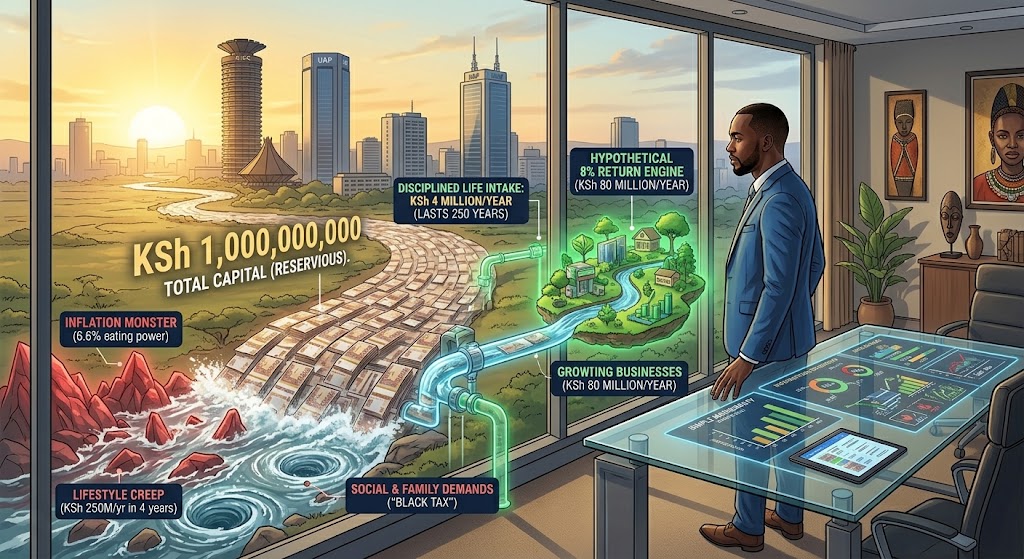
If you had KSh 1 billion and spent only KSh 4 million a year, you could theoretically take 250 years to spend it — and investment returns could make the fortune even more powerful
What would you do if you suddenly woke up one morning and discovered that you had KSh 1 billion in your bank account?
Table Of Content
- If you had KSh 1 billion and spent only KSh 4 million a year, you could theoretically take 250 years to spend it — and investment returns could make the fortune even more powerful
- KSh 1 billion divided by KSh 4 million
- What if the billionaire spends more?
- The 0.4 per cent lifestyle
- The billion starts working
- Interest versus inflation
- The astonishing part: the billionaire may not need to touch the billion
- But there is a catch: KSh 4 million today won’t remain KSh 4 million forever
- The biggest threat may not be inflation
- The Kenyan billionaire’s greatest challenge
- And then there are the relatives
- The funniest danger: becoming a millionaire many times over
- So, is KSh 1 billion really “inexhaustible”?
- The real billion-shilling question
Buy a mansion? A fleet of expensive cars? Invest in real estate? Retire immediately? Start businesses? Help your relatives? Travel around the world?
Or perhaps you would do something much more interesting: discipline yourself to spend only KSh 4 million a year.
That simple thought experiment reveals just how enormous KSh 1 billion really is.
And the mathematics is astonishing.
KSh 1 billion divided by KSh 4 million
Let’s assume, purely for the purpose of the exercise, that a Kenyan has KSh 1 billion and decides to live on KSh 4 million every year.
There are no investment returns in our first calculation. The money simply sits there, and the person withdraws KSh 4 million annually.
The calculation is remarkably simple:
KSh 1,000,000,000 ÷ KSh 4,000,000 = 250 years.
Yes.
Two hundred and fifty years.
At that rate, somebody who was 30 years old would theoretically have enough money to continue that spending pattern until they were 280 years old.
Of course, no human being is going to live for 250 years. That is precisely what makes the calculation so fascinating.
It demonstrates that KSh 1 billion is an extraordinarily large amount of money relative to a modest annual lifestyle.
And KSh 4 million a year works out to approximately KSh 333,333 a month.
For a disciplined person, that can represent a very comfortable lifestyle in Kenya.
What if the billionaire spends more?
The numbers remain revealing.
If the KSh 1 billion owner spends:
- KSh 1 million a year: 1,000 years
- KSh 2 million a year: 500 years
- KSh 4 million a year: 250 years
- KSh 5 million a year: 200 years
- KSh 10 million a year: 100 years
- KSh 20 million a year: 50 years
- KSh 50 million a year: 20 years
- KSh 100 million a year: 10 years
- KSh 250 million a year: 4 years
The lesson is not that somebody should literally plan to live for centuries.
The lesson is that the size of KSh 1 billion can be difficult to appreciate until it is converted into annual spending.
The 0.4 per cent lifestyle
There is another way of looking at our KSh 4 million example.
KSh 4 million is just 0.4 per cent of KSh 1 billion.
In other words, the person is consuming less than half of one per cent of the original capital every year.
That is an extraordinarily low withdrawal rate.
And that is where the story becomes even more interesting.
What happens if the billion isn’t sitting idle?
The billion starts working
Kenya’s current interest-rate environment provides a useful illustration.
The Central Bank of Kenya’s latest published figures show that the average commercial-bank deposit rate was 6.93 per cent in July 2026, while the average savings rate was much lower at 3.53 per cent.
So our hypothetical billionaire should not simply assume that any ordinary savings account will automatically pay 8 per cent.
But let’s nevertheless use 8 per cent as a hypothetical investment return to understand the mathematics.
Eight per cent of KSh 1 billion is:
KSh 80 million a year.
Our disciplined billionaire needs only KSh 4 million for annual living expenses.
That leaves:
KSh 76 million.
Suddenly, the original question changes.
Instead of asking:
“How long will KSh 1 billion last?”
we begin asking:
“How can I structure my finances so that I don’t have to consume the billion at all?”
That is the real power of large capital.
Interest versus inflation
But there is an important enemy that cannot be ignored:
inflation.
The Kenya National Bureau of Statistics reported annual consumer inflation of 6.6 per cent in August 2026.
This means that simply keeping money in cash for decades is not a reliable way of preserving its purchasing power.
If your money earns 8 per cent while inflation is 6.6 per cent, the difference is not a magical 8 per cent increase in your wealth.
Your approximate nominal return is 8 per cent, but inflation is eating away at purchasing power.
Before taxes, fees and other considerations, the rough real-return relationship is therefore much smaller.
This is why wealthy individuals don’t merely ask:
“How much interest am I earning?”
They ask:
“How much purchasing power is my capital retaining after inflation, taxes and costs?”
The astonishing part: the billionaire may not need to touch the billion
Imagine, purely as an illustration, that KSh 1 billion consistently generates an 8 per cent return.
At the beginning, that produces KSh 80 million.
The billionaire spends KSh 4 million.
The remaining KSh 76 million stays invested.
If returns continue and the investment compounds, the capital could potentially grow rather than shrink.
This is the fundamental difference between consuming wealth and living from the returns generated by wealth.
Someone with KSh 1 billion who spends everything they earn can eventually become poor.
Someone with KSh 1 billion who controls their lifestyle and protects the capital may potentially create wealth that lasts beyond their lifetime.
But there is a catch: KSh 4 million today won’t remain KSh 4 million forever
Our 250-year calculation is mathematically correct but economically unrealistic because it assumes prices never change.
They do.
If inflation continues, the cost of maintaining today’s lifestyle will rise.
A person who needs KSh 4 million to maintain a particular lifestyle today may require substantially more in the future to maintain the same standard of living.
That means a sensible long-term wealth strategy must consider inflation-adjusted spending, not simply today’s expenditure.
The good news is that productive investments can potentially grow alongside inflation.
The bad news is that investment returns are never guaranteed, and an 8 per cent return cannot simply be assumed for 50, 100 or 250 years.
The biggest threat may not be inflation
There is another force that can destroy KSh 1 billion remarkably quickly.
It is called lifestyle inflation.
A person accustomed to living on KSh 100,000 a month may suddenly find themselves with KSh 1 billion and decide that they can now afford a KSh 30 million car.
Then comes a KSh 100 million house.
Then perhaps several plots of land.
Then expensive holidays.
Then relatives begin calling.
Then somebody presents an “excellent business opportunity.”
Then another.
Before long, the billionaire who once thought KSh 333,000 a month was enough is spending tens of millions every year.
And that is how a fortune that looked practically inexhaustible can begin disappearing.
The Kenyan billionaire’s greatest challenge
Money changes the psychology of spending.
When someone has KSh 50,000 in the bank, losing KSh 20,000 hurts.
When someone has KSh 1 billion, KSh 20,000 can begin to feel almost meaningless.
But there is a mathematical trap hiding inside that psychology.
KSh 1 million spent casually is still KSh 1 million.
Do that 10 times and KSh 10 million has disappeared.
Do it 100 times and KSh 100 million is gone.
The billion doesn’t care whether the money was spent on an investment, a luxury car, a holiday or an impulse purchase.
It simply gets smaller.
And then there are the relatives
This is where our imaginary Kenyan billionaire enters particularly dangerous territory.
The moment word spreads that someone has KSh 1 billion, they may discover that they have far more “close relatives” than they previously knew.
Suddenly there are school fees to pay.
Medical bills.
Business proposals.
Land deals.
Wedding contributions.
Emergency loans that may never return.
And the eternal Kenyan request:
“Bro, I have a very good idea. I only need KSh 5 million to start.”
Five million here.
Ten million there.
Twenty million somewhere else.
The billionaire can find themselves funding an entire informal economy without realizing how quickly the capital is disappearing.
The funniest danger: becoming a millionaire many times over
A KSh 1 billion fortune can also create a temptation to demonstrate wealth.
The person starts buying things not because they need them but because they can afford them.
The KSh 30 million car.
The KSh 100 million house.
The expensive watches.
The overseas holidays.
The businesses whose owners promise extraordinary returns.
The multiple properties.
So, is KSh 1 billion really “inexhaustible”?
Not literally.
No amount of money is inexhaustible if spending is sufficiently high.
But relative to a disciplined lifestyle, KSh 1 billion is an extraordinarily powerful financial base.
If the money is invested prudently, if spending is controlled, if taxes and inflation are properly considered and if the owner avoids catastrophic financial decisions, the capital could potentially support a person for an extraordinarily long time.
And if the investment returns are strong enough, the owner may be able to live largely from the returns while preserving much of the original capital.
That is the difference between having money and having capital.
The real billion-shilling question
Perhaps the most interesting question isn’t:
“What would you buy if you had KSh 1 billion?”
It is:
“How little would you need to spend to make KSh 1 billion work for you for the rest of your life?”
At KSh 4 million a year, the simple arithmetic gives us 250 years.
With investment returns, the mathematics can become dramatically more favourable.
With inflation, taxes and poor investment decisions, it becomes more complicated.
And with extravagant spending?
Well…
Even KSh 1 billion can eventually say: “Boss, pole. Mimi nimeisha.”
The greatest power of a billion shillings may therefore not be the ability to spend lavishly.
It may be the freedom to stop chasing money altogether.
Note: The investment-return examples in this article are hypothetical illustrations, not investment advice. Actual returns vary by asset, product, market conditions, taxes, fees and investment period.
Never Miss a Story: Join Our Newsletter