



Thousands Trapped in Oleshky as Hunger, Mines and Drones Turn Escape Into a Death Gamble
Thousands of Ukrainian civilians are facing a worsening humanitarian crisis in the Russian-occupied city of Oleshky, where food and medicine have become increasingly scarce and the roads out have...

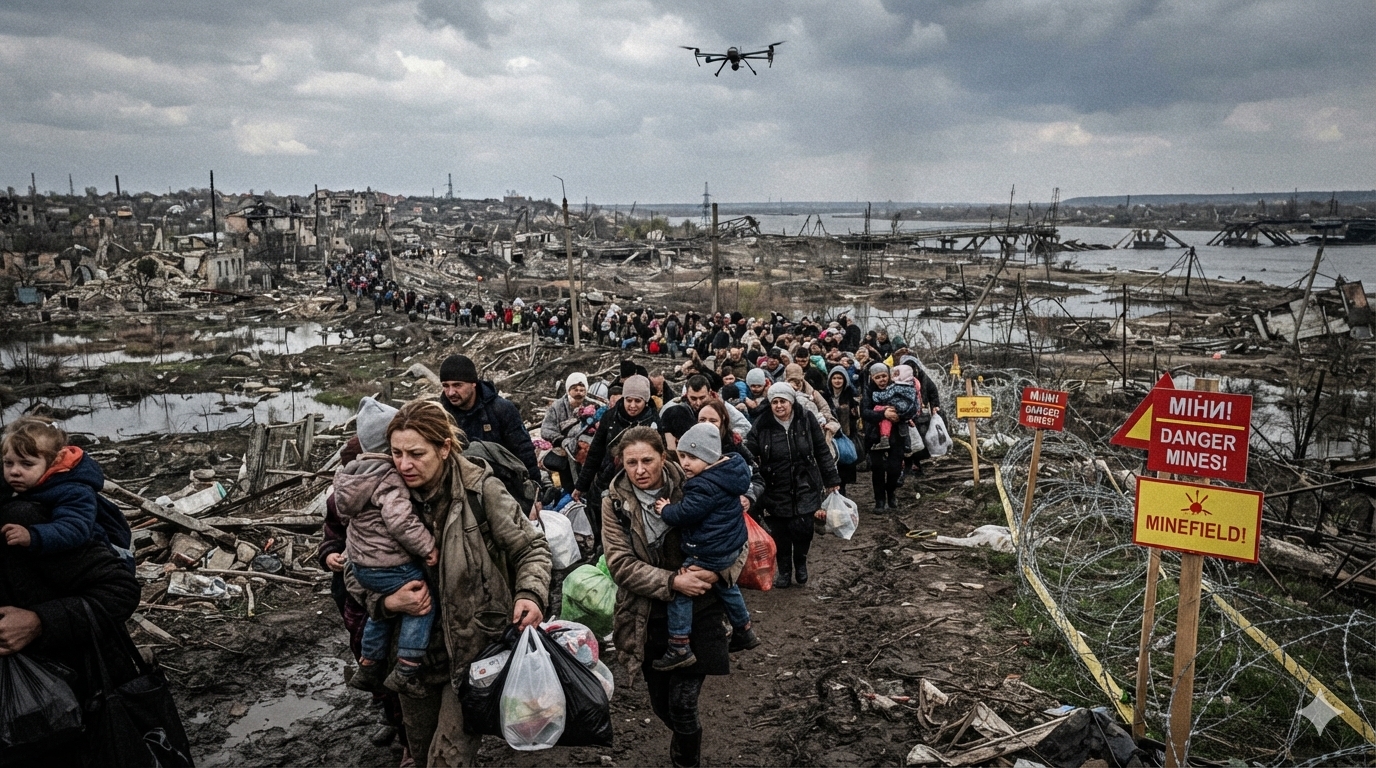
Thousands of Ukrainian civilians are facing a worsening humanitarian crisis in the Russian-occupied city of Oleshky, where food and medicine have become increasingly scarce and the roads out have turned into deadly corridors of mines and drone attacks.
Table Of Content
Oleshky, in Ukraine’s southern Kherson region, once had a population of about 24,000. Today, Ukrainian authorities estimate that roughly 2,000 people remain inside the city, including around 50 children.
Across Oleshky and nearby occupied communities on the eastern bank of the Dnipro River, the number of civilians still trapped is estimated at around 6,000.
The crisis has now reached a point where residents are reportedly desperate to leave despite the enormous risks involved.
Ukraine’s Human Rights Ombudsman, Dmytro Lubinets, said on September 16 that the civilians remaining in Oleshky “need to be saved”, describing their situation as an attempt to escape “from this hell.”
A city cut off from food
The most immediate danger is hunger.
According to reports from residents and Ukrainian officials, regular supplies of food and medicine have effectively stopped. The last successful food delivery reported by local authorities took place on May 26.
The United Nations Human Rights Monitoring Mission in Ukraine independently reported in June that no food deliveries had reached Oleshky between May 26 and June 24. Residents told UN investigators that the town’s last grocery store had stopped operating months earlier because of a lack of supplies.
Human Rights Watch subsequently documented similar accounts of severe shortages.
Former residents who managed to escape described a community where people were surviving on whatever food they could obtain from gardens, preserved supplies, barter and increasingly limited local resources.
One woman who escaped Oleshky in May told Human Rights Watch that when she saw her elderly mother after the escape, “she was so thin” because there was little food available.
The situation is particularly dangerous for elderly residents, people with disabilities, children and those requiring regular medication.
And with winter approaching, the humanitarian emergency could become even more severe.
The road out has become a deadly gamble
For those trying to escape, there is another problem: getting out alive.
Roads around Oleshky have been mined, while drones and artillery make movement extremely dangerous.
Residents have described roads leading toward Skadovsk as effectively “roads of death.”
One resident quoted by the Kyiv Independent said people were becoming so desperate that some were attempting to walk along mined roads to escape.
The danger is not theoretical.
On June 2, a convoy carrying food and humanitarian supplies toward Oleshky struck a landmine. The UN reported that one person was killed and three others were injured.
Earlier incidents have also involved vehicles attempting to evacuate civilians.
A January evacuation vehicle travelling from Oleshky toward Skadovsk reportedly hit a mine, killing its driver and seriously injuring two passengers. Subsequent attempts to move people and supplies became increasingly difficult because of mines and drone activity.
The result is a terrible calculation for civilians.
Stay inside the city and face dwindling food, medicine, electricity and basic services.
Attempt to leave and risk mines, drones, artillery and checkpoints.
The collapse of basic services
Oleshky’s humanitarian crisis goes far beyond food.
Electricity and gas supplies have largely collapsed. Residents have reportedly resorted to wood-burning stoves and alternative sources of energy to cook and obtain water.
The destruction caused by the war has also severely damaged the local health system.
Human Rights Watch reported that medical care in Oleshky is barely functioning, while the local hospital has been operating with limited capacity and emergency generator power.
Ambulances are also unable to operate normally because travelling on roads exposed to drones and mines can itself become life-threatening.
For someone suffering a heart attack, serious injury or another medical emergency, reaching proper medical treatment may therefore be almost impossible.
Civilians caught between two armies
Oleshky sits on the eastern bank of the Dnipro River, directly across from the Ukrainian-controlled city of Kherson.
Russia has occupied the city since the beginning of its full-scale invasion in February 2022.
The area remains part of an active battlefield.
Russian forces use positions on the eastern bank to launch attacks toward Ukrainian-controlled territory, while Ukrainian forces conduct strikes against Russian military positions.
That reality makes the civilian population particularly vulnerable.
The UN Human Rights Monitoring Mission reported at least 29 civilians killed and 54 injured in Oleshky and neighbouring Hola Prystan during 2026 alone. Many of the casualties were associated with short-range drone attacks. However, the UN has cautioned that it could not conclusively establish responsibility for every individual attack.
This distinction matters because civilians are living in an area where attacks come amid an active military confrontation, while access for independent humanitarian organizations is severely restricted.
A humanitarian corridor remains desperately needed
Ukrainian officials and humanitarian organizations have repeatedly called for a mechanism that would allow civilians to leave safely and allow food and medicine to enter.
The UN has said that civilians trapped in frontline communities need humanitarian assistance and safe evacuation routes. Human Rights Watch has likewise called for civilians who want to leave occupied areas of Kherson to be allowed to do so safely.
The challenge is creating a corridor that both sides respect.
Without a temporary ceasefire or another security arrangement, humanitarian vehicles face the same mines and drone threats confronting ordinary civilians.
That is why the situation in Oleshky is becoming increasingly urgent.
From 24,000 people to a few thousand
Perhaps the most striking measure of the disaster is the population collapse.
Before Russia’s full-scale invasion, approximately 24,000 people lived in Oleshky.
Today, estimates put the remaining population at around 2,000, although recent reports acknowledge uncertainty because communications with residents are extremely difficult.
The wider occupied area around Oleshky and Hola Prystan contains several thousand additional civilians.
In June, the UN estimated that up to 6,000 civilians, including more than 180 children, remained in the affected communities.
These are not simply statistics.
They represent elderly people who cannot walk long distances, families with children, people who depend on medication and residents who have already survived years of occupation and war.
The winter question
The approaching winter could turn the current emergency into an even more serious humanitarian disaster.
Food supplies are already severely restricted. Medical care is limited. Electricity and gas are unreliable or unavailable. Roads are dangerous.
And every additional month without a functioning humanitarian access route increases the pressure on civilians who have nowhere safe to go.
The international community therefore faces a difficult question: how can food, medicine and evacuation assistance reach civilians trapped behind a frontline where roads are mined and the skies are dominated by drones?
For the people still inside Oleshky, the answer cannot come soon enough.
The city that once housed 24,000 people has been reduced to a small and increasingly isolated civilian population.
For them, the road out is dangerous.
But remaining may be becoming even more dangerous.
Never Miss a Story: Join Our Newsletter