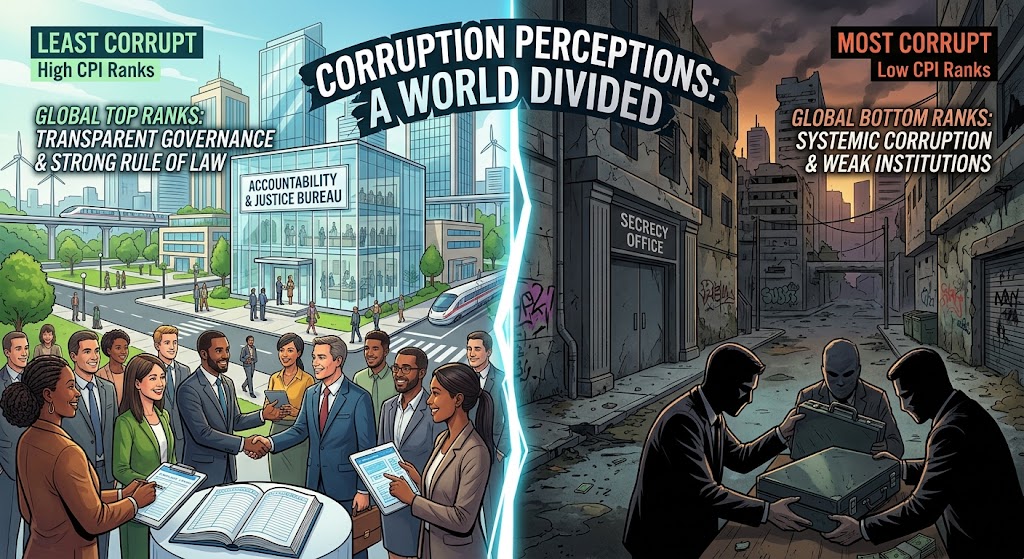
Imagine a world where a public official’s primary duty is to serve the people, not their own bank account. Now, imagine the opposite: a reality where securing basic services, from healthcare to education, requires a bribe, and where public funds vanish into the pockets of the elite. This is the stark divide illuminated by Transparency International’s Corruption Perceptions Index (CPI) for 2025.
The latest report paints a grim global picture. For the first time in over a decade, the global average score has fallen to a new low of 42 out of 100 . More than two-thirds of the 182 countries assessed—122 in total—score below 50, indicating that serious corruption problems are pervasive across most of the planet . The number of countries considered “very clean,” with scores above 80, has shrunk dramatically from twelve a decade ago to just five today . This is not just a statistic; it’s a signal that the fight against corruption is being lost in many parts of the world.
This article explores the two extremes of this spectrum: the 10 least corrupt countries, where integrity is the bedrock of governance, and the 10 most corrupt, where corruption is a chronic, debilitating disease. This exploration is based on the CPI, which, while a perception-based index, remains the most comprehensive global measure of public-sector corruption.
Read Also: If Lee Kuan Yew Became Kenya’s President in 2027, What Would He Do About Corruption?
The Pinnacle of Integrity: The 10 Least Corrupt Countries
The top of the CPI is dominated by a familiar group of nations, primarily in Western Europe and the Asia-Pacific. These are countries where the rule of law is strong, independent judiciaries are the norm, and a free press holds power to account. Their scores consistently hover near the top, demonstrating that low corruption is an achievable and sustainable goal.
Here are the top 10 least corrupt countries in the world, according to the 2025 CPI .
| Rank | Country | CPI Score 2025 |
|---|---|---|
| 1 | Denmark | 89 |
| 2 | Finland | 88 |
| 3 | Singapore | 84 |
| 4 | New Zealand | 81 |
| 4 | Norway | 81 |
| 6 | Sweden | 80 |
| 6 | Switzerland | 80 |
| 8 | Luxembourg | 78 |
| 8 | Netherlands | 78 |
| 10 | Germany | 77 |
| 10 | Iceland | 77 |
Note: Scores are out of 100, where 0 is highly corrupt and 100 is very clean.
1. Denmark (89)
For the eighth consecutive year, Denmark reigns supreme as the world’s least corrupt country . Its consistently high score is a testament to a deeply ingrained culture of transparency and trust. Danish society is built on a foundation of strong civic institutions, an independent judiciary, and a robust legal framework that emphasizes accountability. The public sector is renowned for its efficiency and professionalism, with a clear separation between public and private interests.
2. Finland (88)
Hot on Denmark’s heels is Finland, a country that regularly tops global rankings for education, happiness, and now, integrity. Finland’s success is rooted in a combination of historical factors and a modern, transparent governance system. Its public administration is highly decentralized, and citizen participation is encouraged. A strong legal framework and a free press ensure that any misconduct is quickly exposed and dealt with, reinforcing the public’s trust in their institutions.
3. Singapore (84)
Singapore is the undisputed leader in Asia and a global outlier. It’s a testament to the idea that a nation can achieve high levels of prosperity and cleanliness without being a Western democracy. Singapore’s approach is one of zero tolerance, underpinned by strict laws, a powerful anti-corruption agency (the Corrupt Practices Investigation Bureau, CPIB), and a judiciary that is fiercely independent . Political will at the highest level of government has been a key driver, making it an unattractive environment for corrupt practices.
4. New Zealand & Norway (81)
Tied for fourth place, these two countries represent different paths to the same destination.
- New Zealand: Often praised for its political stability and vibrant civil society, New Zealand is a model of transparency. The country’s public sector is characterized by openness and a culture of service. Its legal framework and strong media scrutiny effectively deter corruption.
- Norway: With its vast oil wealth, Norway has successfully managed to avoid the “resource curse” that has plagued other nations. Its success is due to robust governance, strong institutions, and a high degree of transparency in how public funds, especially oil revenues, are managed. The sovereign wealth fund is a global benchmark for ethical investment and transparency.
6. Sweden & Switzerland (80)
Both Swedish and Swiss societies are built on a bedrock of trust and accountability. Sweden’s long tradition of openness in government and a strong social contract creates an environment where corruption is seen as a severe breach of public trust. Switzerland, with its intricate financial systems, maintains a robust legal framework to combat money laundering and financial crime. Its high score shows that a strong regulatory environment is crucial for maintaining integrity.
8. Luxembourg & Netherlands (78)
These two small, prosperous European nations demonstrate that high integrity can be maintained alongside strong financial centers. They benefit from highly transparent governance, effective rule of law, and a culture that stigmatizes corruption. The Netherlands, in particular, is known for its proactive approach to transparency and open data.
10. Germany & Iceland (77)
Germany, the largest economy in Europe, and Iceland, a small island nation, both rank highly, showing that size is not a barrier to integrity.
- Germany: A stable democracy with an independent judiciary and a federal structure that allows for checks and balances. The country’s strong economy is supported by a legal system that effectively prosecutes white-collar crime.
- Iceland: This Nordic nation’s high score is consistent with the regional trend of transparency and institutional strength. It’s characterized by a free press, a strong rule of law, and a direct democracy that empowers citizens to hold leaders accountable.
Read Also: Zimbabwe Economic Crisis: How the Country Collapsed and Where Its Economy Stands Today
The Abyss of Corruption: The 10 Most Corrupt Countries
At the other end of the spectrum lies a world where corruption is not just an occasional misdeed but a systemic feature of governance. These countries are often characterized by conflict, authoritarian rule, or extreme poverty, where the state is weak, and the rule of law is non-existent. The consequences are devastating: public funds are stolen, essential services fail, and citizens are trapped in a cycle of deprivation.
Here are the 10 most corrupt countries in the world, according to the 2025 CPI . Note the exceptionally low scores.
| Rank (Lowest) | Country | CPI Score 2025 |
|---|---|---|
| 181 | Somalia | 9 |
| 181 | South Sudan | 9 |
| 180 | Venezuela | 10 |
| 172 | Syria | 15 |
| 172 | North Korea | 15 |
| 170 | Myanmar | 16 |
| 169 | Cambodia | 20 |
| 168 | Sudan | 14 |
| 168 | Eritrea | 13 |
| 168 | Libya | – |
Note: Ranking is based on the provided data. Some scores and exact rankings for the bottom 10 are not fully detailed in the search results, but the general order is clear.
The Bottom of the Barrel: Somalia & South Sudan (9)
Tied for the title of the world’s most corrupt country, Somalia and South Sudan serve as stark warnings of what happens when state authority collapses. Both nations are ravaged by conflict and political instability . In Somalia, the government’s control is limited, and the country has been plagued by warlordism and clan-based factions for decades . In South Sudan, a prolonged civil war has created a humanitarian crisis where public resources are systematically looted by a political elite to fund the conflict, while the vast majority of the population survives on the brink of famine .
The Failing State: Venezuela (10)
Once one of the wealthiest nations in Latin America, Venezuela’s descent into chaos is a textbook case of the “resource curse” combined with authoritarian governance . The collapse of democratic institutions under a repressive regime has allowed for the systematic looting of the state, most notably its oil giant, PDVSA . The political elite has controlled all branches of government and the economy, creating a system where corruption is the primary mechanism for the regime to maintain its grip on power and enrich its allies. The result is an economic and humanitarian disaster .
The Brutal and Isolated: Syria & North Korea (15)
Both Syria and North Korea are ranked at 15, representing the extreme end of state repression and isolation.
- Syria: Over a decade of brutal civil war has shattered the country’s infrastructure and governance. The Assad regime has relied on a shadow economy and criminal networks to survive, making corruption an integral part of its survival strategy . Allegations of drug trafficking and the manipulation of humanitarian aid are widespread.
- North Korea: In this totalitarian state, corruption is woven into the fabric of daily life. The state’s inability to provide for its citizens has forced many to rely on black markets, where bribery and extortion are the norm . The regime itself is involved in illicit activities to fund its nuclear and missile programs, making it a state sponsor of criminality.
The Struggling Nations
Myanmar (16) has seen its already fragile situation worsen dramatically following the military coup, which reversed a decade of democratic reforms and opened the door to economic mismanagement and corruption. Cambodia (20) continues to struggle under a regime that stifles dissent and independent media, leading to endemic corruption in its judiciary and public services . Sudan and Eritrea are consistently at the bottom in Africa .
- Sudan: Plagued by conflict and instability, its institutional collapse has paved the way for widespread corruption.
- Eritrea: One of the world’s most repressive states, it offers no independent oversight or press freedom, allowing for the unchecked abuse of state power. Libya, a failed state riven by civil war since the fall of Gaddafi, is a country where competing militias and factions plunder state resources with impunity.
The Cost of Corruption and the Path to Integrity
These two lists illustrate a powerful and troubling reality. The CPI 2025 report highlights a strong correlation between political systems and corruption. Fully functioning democracies, with their checks and balances, score an average of 71 on the CPI, while authoritarian regimes languish at an average of just 32 . This 39-point gap is not a coincidence; it is a structural difference.
Countries with free press, independent judiciaries, and active civil societies create an environment where corruption is much harder to hide. They make it easier for citizens to demand accountability. As the CPI shows, when political will aligns with strong institutions, integrity can flourish.
However, the 2025 index also sounds a powerful alarm. The global average is declining, and even established democracies are showing signs of backsliding . This serves as a crucial reminder that the fight against corruption is never won; it must be fought every day, in every country, by every citizen.
For the nations at the bottom, the path forward is long and fraught with challenges. It requires not just the implementation of laws, but a fundamental shift in how power is exercised and controlled. It requires building independent judiciaries, allowing for a free press, and creating a civic space where citizens can speak out without fear. The struggle against corruption is ultimately a struggle for a more just, equitable, and prosperous world. The divide between Denmark and Somalia is not just about scores; it’s about the very nature of the relationship between a government and its people.
Never Miss a Story: Join Our Newsletter