The Bird That Never Lands: 10 Months Aloft with the Common Swift
Beyond their incredible 10-month non-stop flight, the Common Swift (Apus apus) possesses a suite of adaptations that make it a true master of the skies. Its very name, Apus, is Greek for...

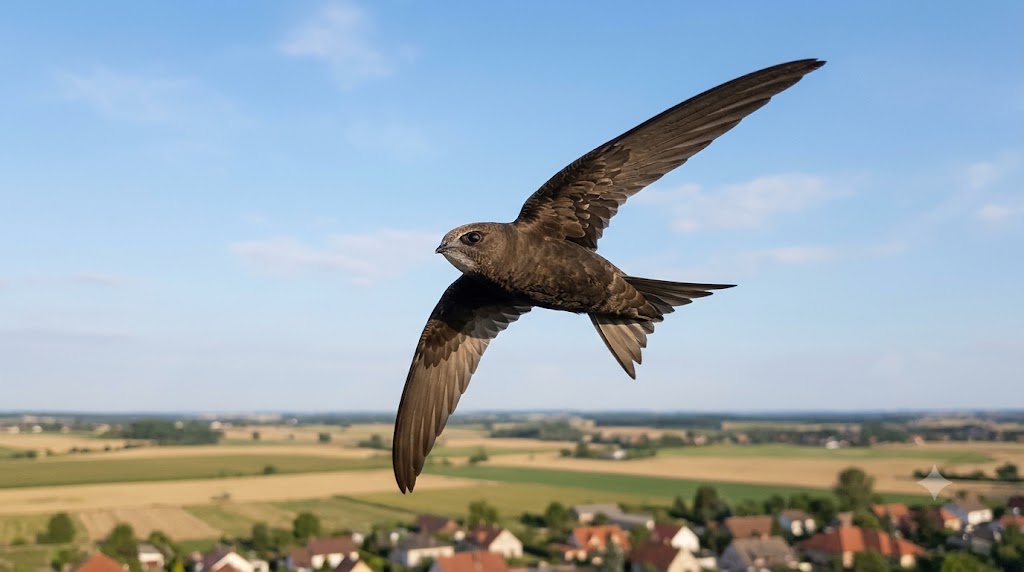
Beyond their incredible 10-month non-stop flight, the Common Swift (Apus apus) possesses a suite of adaptations that make it a true master of the skies. Its very name, Apus, is Greek for “without feet,” hinting at a life so adapted to the air that the ground is almost foreign territory .
Table Of Content
Built for the Air, Not the Ground
The swift’s body is a perfect example of evolutionary engineering for efficiency. Its extremely long, narrow, and rigid wings are shaped like a scythe or a crescent moon . This design, with a wingspan of 38–40 cm compared to a body length of just 16–17 cm, provides exceptional lift and minimizes drag, making flight incredibly energy-efficient .
To further reduce drag, the swift has a streamlined, “cigar-shaped” body and eyes set in shallow depressions on the side of its head . The trade-off for this aerial perfection is that their legs are extremely short and atrophied. They cannot walk or perch on branches. Instead, their tiny feet, with all four toes pointing forward, are only useful for clinging to vertical surfaces like walls or cliffs . If they find themselves on flat ground, they are incredibly clumsy and vulnerable to predators .
How to Sleep, Eat, and Drink on the Wing
Living in the air for months requires innovative solutions to basic needs.
- Sleep: Scientists believe swifts sleep while flying, using unihemispheric sleep. This allows one half of their brain to rest while the other remains alert to control flight and avoid collisions . Data suggests they may sleep during slow, gliding descents at high altitudes, often at dawn and dusk .
- Eating: They are entirely insectivorous, catching flying insects like flies, aphids, and beetles in their wide-gaped beaks . A pair feeding young can catch an astounding 20,000 insects in a single day . They even collect nesting material, like twigs and feathers, while in flight, gluing it together with their sticky saliva .
- Mating and Molting: The swift’s airborne lifestyle is so complete that they are also known to mate on the wing . They even molt their feathers gradually, one by one, ensuring they are never rendered flightless .
An Epic Journey and a Changing World
The swift’s 10-month marathon is largely a continuous migration and wintering period spent over sub-Saharan Africa . They travel thousands of kilometers, covering 570–800 km a day at speeds of up to 111 km/h, crossing vast landscapes from tropical forests to moist savannahs in search of insect-rich air .
This amazing bird is now facing serious threats. Populations in parts of Europe have declined by over 65% in the last 25 years . The main reasons are:
- Loss of Nesting Sites: Modern building practices seal up the crevices and gaps under eaves where swifts traditionally nest .
- Loss of Food: Widespread pesticide use reduces the abundance of flying insects, making it harder for swifts to find food .
- Climate Change: Shifting weather patterns can affect insect populations and disrupt the swifts’ breeding cycle .
The Common Swift is a testament to nature’s ability to craft an organism perfectly suited to its extreme environment, but its future depends on our willingness to protect the nesting sites and insect populations it relies on.
Never Miss a Story: Join Our Newsletter