
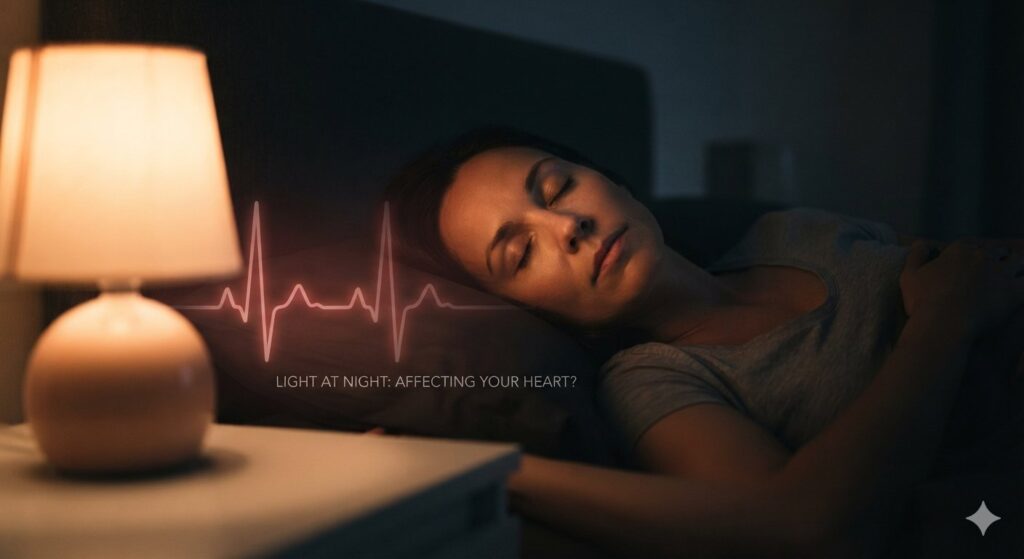
Many people fall asleep with a bedside lamp on, a television playing in the background, a smartphone glowing beside the pillow or light coming through the bedroom window. It may seem harmless, especially when the room is only dimly illuminated, but new research suggests that nighttime light exposure could be associated with changes in the heart.
Researchers studying more than 11,000 adults without known heart disease found that people exposed to higher levels of light while sleeping tended to show structural differences in their hearts several years later.
The findings do not prove that sleeping with a light on directly causes heart disease. However, they add to growing scientific evidence that the body’s response to light does not stop when we close our eyes at night.
What the researchers found
The study involved more than 11,000 people who wore wrist-based sensors for approximately one week. The devices recorded the amount of light participants were exposed to during their sleeping hours.
Researchers later examined the participants using MRI scans, approximately three years after the light measurements were taken.
People who experienced more than three lux of light during sleep were found to have thicker walls in the heart’s left ventricle compared with those exposed to darker sleeping conditions.
Three lux is not particularly bright. It can be comparable to the level of illumination produced by bright moonlight, meaning that the issue is not necessarily a bedroom flooded with artificial light.
The researchers also found that the heart muscle in people exposed to greater nighttime light appeared less flexible during the heartbeat.
These changes are important because the left ventricle is the main chamber responsible for pumping oxygen-rich blood around the body.
Why does a thicker heart wall matter?
The heart is a muscular pump, and like other muscles, its structure affects how effectively it performs its job.
The left ventricle contracts to push blood into the body’s main artery. It then needs to relax properly so that it can fill with blood before the next heartbeat.
When the muscular wall becomes abnormally thick, the chamber can become less flexible and may have less room to fill. Over time, structural changes of this kind can be associated with conditions such as high blood pressure, abnormal heart rhythms and heart failure.
Scientists refer to these structural adaptations as cardiac remodeling.
Importantly, however, finding thicker heart walls in people exposed to more nighttime light does not mean that every person who sleeps with a lamp on will develop heart disease.
The study shows an association rather than establishing a direct cause-and-effect relationship.
Your bedroom may be brighter than you think
One reason nighttime light can be easy to overlook is that people often become accustomed to it.
A digital alarm clock may produce a small but constant glow. A television can illuminate an otherwise dark bedroom. Smartphones and tablets can remain beside the bed throughout the night, while outdoor security lights, streetlights and illuminated buildings can send light through curtains.
In many African cities, including Nairobi, bedroom lighting can also come from outdoor security lighting, nearby businesses, apartment compounds and street illumination.
Even when the room appears dark to the human eye, there may still be measurable light reaching the sleeping person’s eyes and skin.
Light may also interfere with sleep
The researchers suggested that reduced sleep duration could account for a substantial proportion of the relationship between nighttime light exposure and changes in the heart.
This is particularly important because sleep is not simply a period when the body switches off.
During healthy sleep, the body undergoes changes in heart rate, blood pressure, hormones and nervous-system activity. Persistent disruption of these processes may place additional stress on the cardiovascular system.
People in the study who experienced greater nighttime light exposure also tended to sleep for fewer hours, averaging roughly five to six hours.
That raises an important possibility: some of the cardiovascular effects associated with nighttime light may occur indirectly because light interferes with normal sleep.
How dark should your bedroom be?
The researchers recommended reducing nighttime light exposure as much as reasonably possible and suggested keeping bedroom illumination below one lux.
For most people, that does not mean turning the bedroom into a completely lightless room or becoming anxious about every tiny source of illumination.
Simple measures can make a difference.
Close curtains or blinds to block outdoor light. Turn off unnecessary lamps and electronic displays. If a device must remain in the bedroom, position its display away from the bed or reduce its brightness.
A phone should ideally not be the brightest object in the room when you are trying to sleep.
If complete darkness is impossible, especially in an urban environment, an eye mask can provide another practical option.
What about a night light?
For adults, a dark bedroom is generally preferable if it is comfortable and safe.
However, some people need a small amount of illumination to move around safely at night. Older adults, children and people who frequently get out of bed may benefit from very dim, strategically positioned lighting rather than attempting to navigate a completely dark room.
The goal is to avoid unnecessary bright light directly reaching the eyes during sleep.
The bigger lesson
The study adds to a broader understanding of the relationship between modern lifestyles, sleep and cardiovascular health.
For many people, improving sleep does not require expensive equipment or complicated routines. It can begin with something as simple as examining what is happening inside the bedroom after the lights are supposedly “off.”
A darker, quieter and cooler sleeping environment may help support normal sleep, while reducing exposure to phones, televisions and other bright screens before bedtime may make it easier for the body to transition into sleep.
The new findings should not be interpreted as proof that a small bedside light will cause a heart attack or stroke. Rather, they suggest that nighttime light exposure deserves more attention as researchers continue investigating how the modern environment affects sleep and cardiovascular health.
For millions of people who routinely sleep with artificial light around them, switching off unnecessary sources may be one simple change worth considering.
Never Miss a Story: Join Our Newsletter