




Male Birth Control Pill: How Far Have Scientists Come Since 2019?
In 2019, Newsly reported on promising tests of a male birth control pill, raising hopes that men could soon have another option for preventing unwanted pregnancies. Seven years later, scientific...

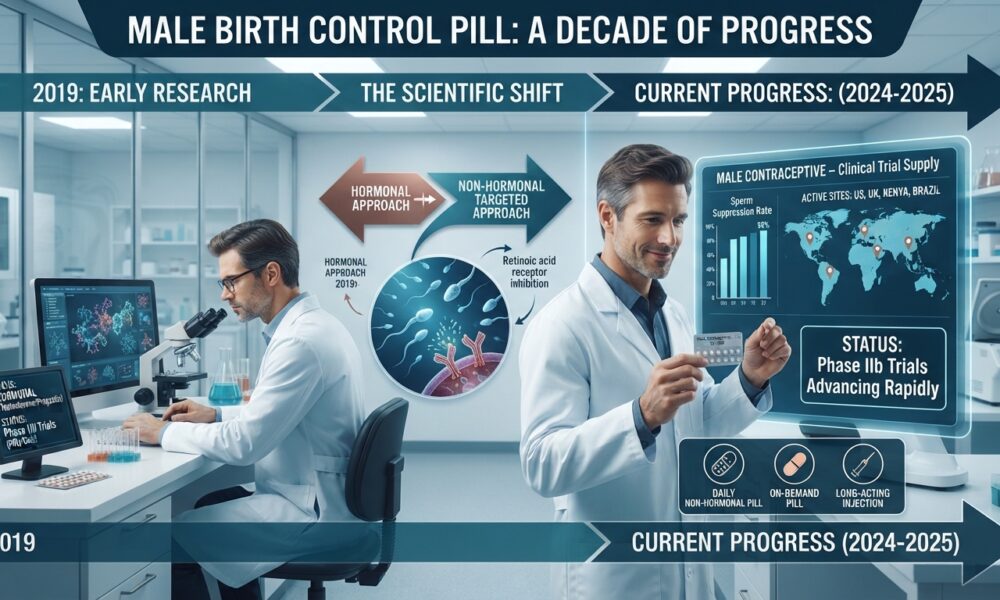
In 2019, Newsly reported on promising tests of a male birth control pill, raising hopes that men could soon have another option for preventing unwanted pregnancies. Seven years later, scientific research has made significant progress, with experimental contraceptives advancing through human clinical trials.
Table Of Content
- YCT-529: A New Approach to Male Contraception
- What Has Happened Since the First Human Tests?
- Scientists Are Also Developing Male Contraceptives That Do Not Require Daily Pills
- ADAM: An Experimental Hydrogel Implant
- NES/T: A Hormonal Contraceptive Gel
- Why Has a Male Birth Control Pill Taken So Long?
- When Could Men Finally Get a Male Contraceptive Pill?
- What Could This Mean for Kenya and Africa?
- The Verdict: Research Has Advanced, but the Wait Is Not Over
However, the long-awaited male contraceptive pill is not yet available for general use. Scientists are still working to establish the safety, effectiveness and reversibility of the leading candidates before they can be considered for regulatory approval.
One of the most promising developments is YCT-529, an experimental non-hormonal contraceptive pill that could eventually give men an alternative to condoms and vasectomy.
YCT-529: A New Approach to Male Contraception
Unlike traditional hormonal approaches, YCT-529 targets a biological pathway involving vitamin A that plays an important role in sperm production.
The experimental drug blocks the activity of retinoic acid receptor alpha, a protein involved in the reproductive process. By interfering with this pathway, researchers aim to reduce sperm production without significantly altering testosterone or other reproductive hormones.
The approach could address one of the longstanding challenges in male contraception: developing an effective method that does not cause unwanted hormonal changes.
In 2025, researchers published findings from the first human safety trial of YCT-529 in the journal Communications Medicine. The study involved 16 healthy male volunteers who received single doses of the experimental drug.
The findings were encouraging. Researchers reported that the doses tested were generally well tolerated, with no significant changes in testosterone, other measured reproductive hormones, sexual desire or mood.
However, the study was designed primarily to assess safety and how the drug behaves in the body. It did not establish that taking the pill prevents pregnancy in men.
The results provided a foundation for further research involving repeated doses over longer periods.
What Has Happened Since the First Human Tests?
The next stage of research involves administering YCT-529 repeatedly to investigate its safety and determine whether it produces the intended changes in sperm production.
A clinical trial registered as NCT06542237 was designed to investigate daily dosing over periods of 28, 90 or 180 days. Researchers are assessing safety, tolerability, drug exposure and possible effects on sperm parameters, sexual function and mood.
The publicly available trial information I could verify was last updated in February 2026 and listed the study as recruiting. Although its estimated completion date was July 2026, I could not verify publicly released results confirming that the study had been completed or that the drug had demonstrated contraceptive effectiveness in men.
This distinction is important. A drug can pass an initial safety assessment without necessarily proving that it prevents pregnancy reliably or can be used safely over an extended period.
Researchers must also establish whether normal sperm production and fertility return after treatment is stopped.
Scientists Are Also Developing Male Contraceptives That Do Not Require Daily Pills
While YCT-529 attracts attention as a potential daily pill, other research programmes are exploring longer-acting methods that could reduce the need for regular medication.
ADAM: An Experimental Hydrogel Implant
ADAM, developed by Contraline, is a non-hormonal contraceptive approach that uses an injectable hydrogel placed in the vas deferens, the tubes that transport sperm from the testicles.
The material is designed to block sperm passage without permanently cutting the tubes, as happens in a conventional vasectomy. The procedure is intended to be minimally invasive, and the hydrogel is designed to break down over time.
Early human research has reported encouraging findings, including evidence that the approach can block sperm passage in some participants. However, longer-term effectiveness and the reliable restoration of fertility remain important questions for further clinical testing.
The first human study was completed, and information published in 2026 indicated that the developers were preparing for the next stage of research.
ADAM is not a pill, but it represents another possible direction for men seeking a long-acting contraceptive that is intended to be reversible.
NES/T: A Hormonal Contraceptive Gel
Another candidate, known as NES/T, combines a synthetic progestin called Nestorone with testosterone in a gel applied to the shoulders or upper arms.
The treatment is intended to suppress sperm production while maintaining testosterone levels.
In February 2026, the Population Council announced a licensing agreement transferring the programme to Contraline, which would lead its further development. The announcement said the programme had completed a global Phase 2b trial involving 462 couples and that planning for a Phase 3 clinical programme was underway.
The gel is investigational and has not been approved by the US Food and Drug Administration or other regulatory authorities.
Although it is not a pill, NES/T is significant because it has advanced beyond the earliest stages of human research and is being developed as another potential option for male contraception.
Why Has a Male Birth Control Pill Taken So Long?
For decades, women have had access to several contraceptive methods, including pills, implants, injections and intrauterine devices. Men’s choices have remained comparatively limited, particularly for those seeking a reversible method they can control themselves.
Condoms remain widely used, while vasectomy offers a highly effective long-term option but must be approached as a potentially permanent method. Withdrawal is another option, although it is less reliable than many established contraceptive methods.
Developing a male contraceptive presents scientific challenges. A successful method must suppress or prevent the fertilising ability of sperm while maintaining acceptable safety, sexual function and, for reversible methods, the ability to regain fertility.
Researchers must also demonstrate effectiveness in preventing pregnancy, not merely show that sperm counts have fallen.
The commercial development process presents another challenge. Even after promising clinical findings, a contraceptive must undergo appropriate trials, regulatory review, manufacturing preparation and decisions about affordability and access.
When Could Men Finally Get a Male Contraceptive Pill?
There is no confirmed date for the public release of YCT-529.
The next important milestone is the publication of results from repeated-dose human studies. Researchers need evidence that the drug can reliably produce the intended contraceptive effect, that it is acceptably safe with continued use, and that fertility can recover after treatment ends.
Further clinical trials may then be necessary before regulatory authorities can consider approval.
The same caution applies to experimental gels and hydrogel implants. Promising early results are encouraging, but they do not guarantee that a product will eventually receive approval or become commercially available.
Men should therefore continue to rely on established contraceptive options rather than treating experimental candidates as available alternatives.
What Could This Mean for Kenya and Africa?
A safe, effective and reversible male contraceptive could expand family-planning choices for couples in Kenya and across Africa.
It could give men a more direct role in preventing unintended pregnancies and allow couples to share contraceptive responsibility according to their preferences and circumstances.
However, scientific success would be only part of the journey. Availability in Kenya would depend on regulatory approval, registration, pricing, supply and access through appropriate healthcare services.
Public education would also be essential. Men and women would need clear information about how a new contraceptive works, its effectiveness, possible side effects and whether it protects against sexually transmitted infections.
A contraceptive pill designed to prevent pregnancy should not be assumed to provide protection against HIV or other sexually transmitted infections. Condoms would remain important for that purpose.
For African health systems, affordability and equitable access would be central considerations if these products eventually reach the market.
The Verdict: Research Has Advanced, but the Wait Is Not Over
Since Newsly’s 2019 report, male contraception research has moved forward, with scientists investigating both non-hormonal pills and alternative methods designed to be reversible.
YCT-529 stands out because it has entered human testing and offers a different approach from conventional hormonal contraception. Meanwhile, the NES/T gel and ADAM hydrogel illustrate how researchers are exploring options that could give men greater control over family planning.
Nevertheless, the most important question remains unanswered: can these experimental methods prevent pregnancy reliably while maintaining acceptable safety and, where intended, reversibility?
Until that evidence is established and the relevant regulatory approvals are obtained, the male birth control pill remains a developing scientific possibility rather than a product available for routine use.
For men who have waited years for more contraceptive choices, the progress is encouraging. The next major breakthrough will be evidence that a method works reliably in practice, not simply that it performs well in an early trial.
Sources and further reading
- Communications Medicine: Safety and pharmacokinetics of the non-hormonal male contraceptive YCT-529
- Clinical trial record: YCT-529 repeated-dose study, NCT06542237
- Population Council: NES/T male contraceptive gel development announcement
- Newsly’s original report: The Male Birth Control Pill Passes the Test
Never Miss a Story: Join Our Newsletter


