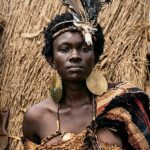
Elijah Masinde wa Nameme: The Prophet Who Defied Empires
The Footballer Who Kicked a Ball to Heaven In 1942, in the rolling hills of Kimilili in western Kenya, a remarkable event supposedly occurred. Elijah Masinde, then in his early thirties, was playing...


The Footballer Who Kicked a Ball to Heaven
In 1942, in the rolling hills of Kimilili in western Kenya, a remarkable event supposedly occurred. Elijah Masinde, then in his early thirties, was playing football—a game he loved and excelled at. He struck the ball with such force that, according to legend, it soared into the sky and never came back down. His followers would later claim the ball had gone to heaven.
Table Of Content
- The Footballer Who Kicked a Ball to Heaven
- The Making of a Prophet
- Born into Tradition
- A Christian, Then a Rebel
- The Prophet’s Calling
- Dini ya Musambwa: Religion as Resistance
- The Message
- The Appeal
- The Response
- The Prison Years: Defiance Behind Bars
- Mathare Mental Hospital: A Colonial Weapon
- From Lamu to Kapenguria
- The Kolloa Massacre: Blood on the British Hands
- The Movement Spreads
- The Affray
- The Aftermath
- Independence and Betrayal
- A New Enemy
- 15 Years in Detention
- The Legacy: A Neglected Freedom Fighter
- Death and Prophecy
- The Fight for Recognition
- A Life of Defiance: The Man and the Myth
- The Legend
- The Revolutionary
- The Contradiction
- Conclusion: The Prophet Who Would Not Bow
- References
Whether this story is literally true or a metaphor for something deeper, it captures something essential about the man. Elijah Masinde was someone who operated on a different plane—a man whose ambitions, visions, and defiance seemed to transcend earthly limitations. Before he became a prophet, a rebel, and the founder of one of Kenya’s most radical anti-colonial movements, he was simply a talented footballer who represented Kenya in the Gossage Cup against Uganda around 1930. But life had far more extraordinary plans for him.
The Making of a Prophet
Born into Tradition
Elijah Masinde wa Nameme was born around 1910-1912 in Kimilili, in present-day Bungoma County, Kenya. He belonged to the Bukusu people, a sub-ethnic group of the larger Luhya community in western Kenya. His full name was Elijah Masinde wa Nameme okhwa Mwasame, and he was initiated into the Machego age-set, a rite of passage that marked his transition from boyhood to manhood.
Like all Bukusu boys, Masinde underwent circumcision without anesthesia—a ritual that emphasized courage, stoicism, and communal responsibilities. The experience shaped him, as it did all Bukusu men, but in Masinde, it perhaps planted something deeper: a profound connection to ancestral traditions that would later define his life’s mission.
A Christian, Then a Rebel
His early adult life took him into the world of the very people he would eventually fight against. Masinde grew up under Christian missionaries and worked for them as a “process server” attached to the native court. The missionaries also gave him a plot on their land where he built a house and lived. He became an adherent of the Friends’ Africa Mission, embracing Christianity and even partaking in the Holy Communion.
But this relationship would not last. Masinde’s decision to marry a second wife was the breaking point. The missionaries, who viewed polygamy as a grave sin, expelled him from the church and stopped him from partaking in the Holy Communion. This personal rejection became a political awakening. Masinde began to see the missionaries not as bearers of divine truth but as agents of a system designed to spiritually and economically subjugate Africans.
He first shifted to the Anglican African Israel Church before splitting to form his own Judah Israel Church. But even this was not radical enough. Masinde was moving toward something far more revolutionary.
The Prophet’s Calling
By the early 1940s, Masinde had risen to the rank of a junior elder within his community. But he was also increasingly anti-colonial. He began having visions and hearing voices that he interpreted as divine revelations. He regarded himself as a seer, a prophet called to liberate his people.
The path was clear. Masinde would found a new movement, one that rejected the white man’s religion, the white man’s laws, and the white man’s domination. It would be called Dini ya Musambwa—”Religion of the Ancestors” or “Religion of the Spirits”. Founded in 1948 in Maeni village, Kimilili Sub-County, it would become one of the most significant protest movements in Kenya’s colonial history.
Read Also: The Richest Man Who Ever Lived: A Deep Dive into the Life, Wealth, and Legacy of Mansa Musa
Dini ya Musambwa: Religion as Resistance
The Message
Dini ya Musambwa was far more than a religious sect. It was a bold protest movement against British colonial rule and the missionary churches that sought to suppress African traditions. The movement emerged during World War II, at a time when the British Empire was stretched thin but still determined to maintain control over its African possessions.
Masinde’s teachings were simple yet powerful:
- Africans must resist Western Christianity, education, and legal systems, which he saw as instruments of spiritual and economic subjugation.
- Africans must reclaim their cultural and religious independence.
- The colonial policies of land alienation, forced labor, taxation, and destruction of African shrines and customs must be opposed.
He urged his followers to burn their identity cards, stop paying taxes, and reject forced labor. He also encouraged them to shun schools and hospitals, which he argued were manifestations of “the white man’s civilization”.
Masinde regularly sojourned to Mount Masaaba (Mount Elgon), Sangalo Hills, and Maeko Hills for his religious pilgrimages. He equated Mount Elgon with Mount Zion, offering sacrifices there and calling it “Sayoni”.
The Appeal
The message resonated deeply. Thousands of followers flocked to Masinde across western Kenya and parts of Uganda. For a people who had seen their land seized, their traditions disparaged, and their labor exploited, Masinde offered a vision of restoration. He promised a return to ancestral ways, a rejection of foreign domination, and the restoration of dignity.
The combination of cultural pride and political defiance made Dini ya Musambwa a direct threat to colonial order. The British authorities, accustomed to dealing with resistance through divide-and-rule tactics, found themselves facing a movement that united people across ethnic lines under a banner of spiritual and political liberation.
The Response
The British response was swift and brutal. They labelled Masinde a “dangerous rebel” and a “witch doctor”—a common colonial strategy to discredit African spiritual leaders. In 1948, the movement was proscribed after the Malakisi Massacre in which some 11 people died. The survivors were either jailed or heavily fined.
Masinde himself was arrested multiple times, detained, and harassed. His confrontations with colonial authorities were legendary. At one point, he engaged in a physical fight with a colonial administrator for refusing to kneel before him. He would not bow to any man, white or black, if it meant compromising his dignity or his mission.
The Prison Years: Defiance Behind Bars
Mathare Mental Hospital: A Colonial Weapon
In one of the most shameful episodes of colonial rule, the British authorities declared Masinde “insane” and detained him in Mathare Mental Hospital for two years, from 1945 to 1947. This was no coincidence. Under colonial rule, mental health laws were frequently used politically to suppress rebellion and detain individuals or groups whom the colonial establishment viewed as threats to its control.
Masinde was not mentally ill. He was inconvenient. By labelling him insane, the British hoped to discredit his message and neutralize his influence. But the strategy backfired. Masinde emerged from Mathare more determined than ever, and his legend only grew.
From Lamu to Kapenguria
Masinde was moved from prison to prison as the authorities desperately tried to contain his influence. He was detained in Lamu, the island prison off the Kenyan coast, where he remained until 1960. He was also held at Kapenguria, among other locations. But even behind bars, Masinde continued to preach his liberation message. He became so effective at “indoctrinating” fellow prisoners that the authorities kept moving him from location to location to limit his reach.
The Kolloa Massacre: Blood on the British Hands
The Movement Spreads
Masinde’s teachings did not remain confined to the Bukusu of western Kenya. A Pokot leader named Lukas Pkech brought Masinde’s preachings to West Suk and Baringo in the north-western region around 1950. Pkech was a prominent leader who took Masinde’s message seriously, using it to preach against the colonial government in the Kolloa area.
The colonial administration watched the growing influence of Dini ya Msambwa in the region with alarm. British District Commissioner Arthur Simpson and a contingent of tribal police and British officers led by Alan Stevens moved to quell the movement. Their intention, as some have suggested, was most likely to kill its leader.
The Affray
On April 24, 1950, over 300 Dini ya Msambwa followers, armed mainly with spears, faced off against colonial security forces at the Kolloa trading centre. Survivors describe the gathering as a peaceful one. The British saw it differently—a potential uprising to be crushed.
What followed was one of the deadliest single-day incidents of colonial violence in Kenya. When the smoke cleared:
- Lukas Pkech and at least 28 followers lay dead
- Alan Stevens, two other British nationals, and an African askari (soldier) were also killed
- At least 176 Dini ya Msambwa members were imprisoned
- Seven of them were executed for their involvement
Oral testimonies suggest the death toll was even higher—between 44 and 50 people killed, with 15 to 20 succumbing later to wounds sustained in the fighting.
The Aftermath
The colonial response was savage. The administration confiscated over 5,600 cattle—a devastating blow to the pastoralist Pokot community. A special police force was deployed in the region, and residents were forced into hard labour on district roads as communal punishment. Hundreds of adherents were thrown into colonial jails and detention camps near the district administrative centre, Kapenguria.
The fine imposed on the Pokot was to be paid in cattle, amounting to 5,000 head. The District Commissioner cynically noted that this would render “a great service towards destocking” to the district. Disarmament followed, leaving the Pokot vulnerable to cattle raids from rival communities like the Turkana.
To this day, the British government has never publicly apologized for the Kolloa massacre. Families of the victims continue to seek justice and recognition, but they face legal, political, and historical roadblocks. In 2025, researchers at Newcastle University working on the “Afterlives of Colonial Incarceration” project noted that Britain’s recognition of the massacre would be “not just a matter of historical record” but about acknowledging that “the group’s pain is real, their loss unjust and their struggle worth remembering”.
Read Also: The Immortal Count? The Astonishing Mystery of Count St. Germain
Independence and Betrayal
A New Enemy
When Kenya finally gained independence in 1963, Masinde should have been celebrated as a freedom fighter. Instead, he found himself facing a new enemy: the government of Jomo Kenyatta.
The new administration, like the old colonial regime, viewed Masinde as a threat. He continued to speak against land injustices, which he felt were being betrayed by the new leaders. He questioned post-independence Kenya’s government on issues of land distribution and citizen rights. He insisted that religious and economic freedom should have been part of the 1963 independence package, and he was deeply disappointed that it was not.
Masinde had once encouraged Kenyatta to be radical, arguing that “that was the language the white man would understand”. He had identified with the philosophies of Kenyatta and Jaramogi Oginga Odinga for the political, economic, educational, and religious independence of Kenyans. Now, he felt betrayed.
15 Years in Detention
The Kenyatta government, perhaps fearing that Masinde’s radicalism could destabilize the young nation, detained him for almost 15 years. He was accused of fomenting religious hatred. In 1968, the Dini ya Musambwa was once again banned after its leader was accused of inciting people against the government.
Masinde was released in 1978 under President Daniel arap Moi’s amnesty to political prisoners. But his defiance did not end. He soon clashed with traffic policemen in Webuye and Kitale, leading to Moi briefly sending him back to jail. He remained defiant until the very end, always questioning authority, always fighting for what he believed was right.
The Legacy: A Neglected Freedom Fighter
Death and Prophecy
Elijah Masinde died in 1987 at the age of approximately 75-79. His death, like his life, was shrouded in mystery and prophecy.
Prior to his death, an ailing Masinde predicted his own demise. He showed his son the exact burial place—under a tree inside his compound. When he died, the elders initially ignored his wish and dug the grave at a different spot. But they stumbled upon a human skeleton, which they interpreted as a bad sign. They chose to uphold Masinde’s wish, burying him in a sitting position under the tree.
The gravesite was later built into a mausoleum. Thousands of pilgrims of his Dini ya Musambwa faith still pay homage to the shrine every June, feasting and praying while facing Mount Elgon.
The Fight for Recognition
For decades, Elijah Masinde has been considered a “neglected freedom fighter”. His contribution to Kenya’s liberation struggle has remained largely unrecognized by the state. But that may be changing.
In August 2023, Nairobi Senator Edwin Sifuna nominated Masinde for recognition as a National Hero through the National Heroes Council. Sifuna argued that Masinde’s liberation struggle against the colonial government qualifies him for recognition, noting that he “used his indigenous religious ideologies as a tool to fight for freedom and emancipate the black man”.
The nomination has sparked renewed interest in Masinde’s life and legacy. In the biography titled Elijah Masinde, author Vincent Simiyu paints the picture of a man with extraordinary powers—a prophet who could predict death and whose spiritual authority terrified both colonial and post-colonial governments.
Read Also: The Philosopher Who Owned Nothing Yet Humiliated Kings: The Extraordinary Life of Diogenes of Sinope
A Life of Defiance: The Man and the Myth
The Legend
The stories told about Elijah Masinde often blur the line between history and mythology. Beyond the football that allegedly went to heaven, there are other tales:
On a bright sunny day at Kimilili, Masinde reportedly pointed at a shopkeeper, declaring that he would be dead by the time the rain that was yet to start was over. True to his word, witnesses say, rain started falling. The shopkeeper fell, rolled three times in his shop, and was dead when the rain stopped—just as Masinde had prophesied.
These stories, whether literally true or metaphorically meaningful, speak to the power of Masinde’s reputation. He was a man who inspired both awe and fear, devotion and terror. His followers saw him as a prophet, a vessel of the ancestors, a man who could speak to God. His enemies saw him as a dangerous fanatic, a rebel, a threat to order.
The Revolutionary
What is undeniable is Masinde’s impact. Dini ya Musambwa was not just a religious movement; it was a form of rural rebellion, a “counter-society” that rejected both colonial rule and post-colonial betrayal. Scholars have examined it as a millenarian movement, a protest movement, and a cultural revival.
Masinde understood something that many political leaders of his time failed to grasp: that true liberation required more than just political independence. It required cultural independence, spiritual independence, and economic independence. It required a people who could stand on their own, without the crutch of the white man’s religion or the white man’s laws.
The Contradiction
Yet Masinde remains a controversial figure. He was a polygamist who rejected Christian morality, yet he adopted elements of Christian theology—particularly from the Old Testament—in his teachings. He condemned Western education, yet he had worked for missionaries and served in native courts. He was a prophet who claimed divine revelation, yet his prophecies often served very worldly political purposes.
These contradictions do not diminish Masinde; they make him more human. He was a man of his time, a man caught between worlds, a man who found a path through the chaos of colonialism and the confusion of independence. He was not always consistent, but he was always defiant.
Conclusion: The Prophet Who Would Not Bow
Elijah Masinde lived a life of extraordinary defiance. He refused to kneel to colonial administrators, refused to accept the white man’s religion as superior to his ancestors’ faith, refused to accept that independence meant the end of the struggle. He was imprisoned by both the colonial government and the independent government, labelled a madman by the British and a troublemaker by the Kenyans. Yet he never wavered.
His movement, Dini ya Musambwa, continues to this day. While the exact number of followers is hard to assess—many choose to remain discreet for their own safety—the growing visibility of branches like Dini ya Roho Mafuta Pole ya Africa (“African Religion of the Gently Anointing Spirit”) indicates the movement’s enduring significance in western Kenya and beyond.
As Kenya continues to grapple with issues of land injustice, economic inequality, and cultural identity, Masinde’s message remains relevant. He spoke against land alienation when it was politically dangerous to do so. He spoke against political betrayal when it was politically dangerous to do so. He insisted that true liberation meant more than just replacing white rulers with black rulers—it meant reclaiming African dignity, African spirituality, and African sovereignty.
Elijah Masinde was a prophet, a rebel, a footballer, a prisoner, a freedom fighter, and a man who refused to bow. His story is Kenya’s story—a story of resistance, betrayal, survival, and hope. It is a story that deserves to be told, and retold, until it is finally given its proper place in Kenya’s national memory.
Read Also: The Philosopher Who Owned Nothing Yet Humiliated Kings: The Extraordinary Life of Diogenes of Sinope
References
- “Masinde, Elijah.” Encyclopaedia Africana, 2026.
- “Kolloa massacre: Dini ya Msambwa seeks closure, Britain mum 74 years later.” Daily Nation, 14 August 2025.
- “Elijah Masinde.” Wikipedia, 2005.
- “Senator Sifuna nominates Elijah Masinde as national hero.” The Star, 31 August 2023.
- Buijtenhuijs, Robert. “Dini Ya Msambwa: rural rebellion or counter-society.” AfricaBib, 1985.
- “A History of Dini Ya Musambwa in Bungoma County, Kenya 1940-2017.” AJESS, Kenyatta University.
- “Elijah Masinde: Why colonialists hated Dini Ya Msambwa founder.” The Standard, 2 July 2024.
- “Kenya’s Troubled 60-Year Mental Health Journey.” Human Rights Watch, 9 December 2023.
- “East Africa & Rhodesia no. 1411.” UCLA Digital Library, 25 October 1951.
- “This luhya legend hit a ball, it disappeared into the sky.” The Standard, 29 September 2016.
- “Kolloa massacre revisited.” Hivisasa, 20 October 2017.
Never Miss a Story: Join Our Newsletter