

Understanding Currency Pairs: Major, Minor and Exotic Pairs Explained
One of the first things beginners notice when learning Forex trading is that currencies are displayed in pairs, such as EUR/USD, GBP/USD and USD/JPY. These combinations may look confusing at first,...

One of the first things beginners notice when learning Forex trading is that currencies are displayed in pairs, such as EUR/USD, GBP/USD and USD/JPY. These combinations may look confusing at first, but they are simply a way of comparing the value of one currency against another.
Table Of Content
In our previous lesson, we explained that Forex trading involves buying one currency while selling another. In this lesson, we take the next step by exploring the three main categories of currency pairs: major, minor and exotic pairs.
Understanding these categories will help beginners become more familiar with the language used in the Forex market.
What Is a Currency Pair?
A currency pair shows the exchange rate between two currencies. For example, EUR/USD represents the euro against the US dollar.
If EUR/USD is quoted at 1.10, it means one euro is worth 1.10 US dollars at that exchange rate. If the rate rises, the euro has strengthened against the dollar. If it falls, the euro has weakened against the dollar.
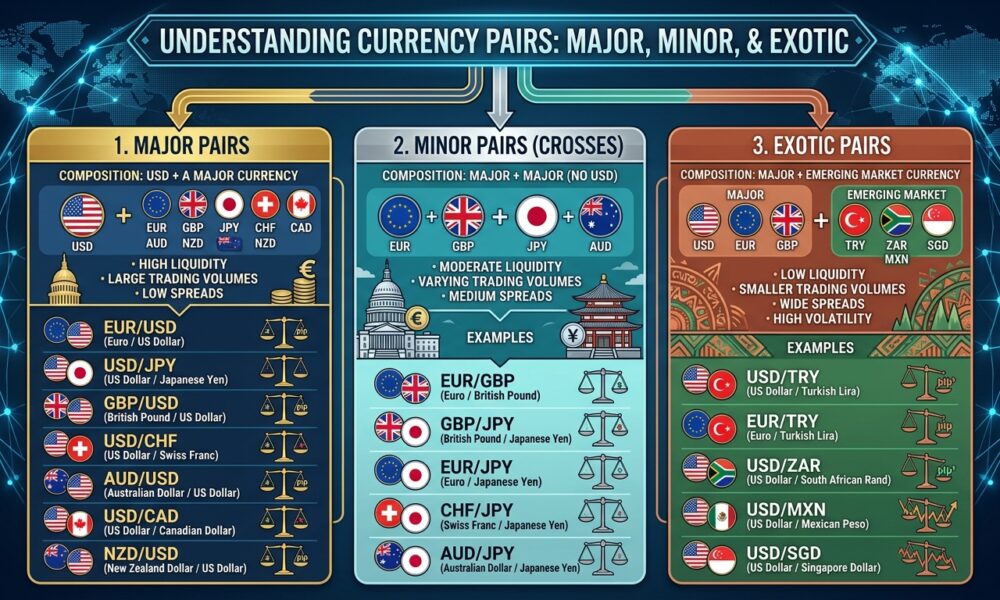
Currency pairs are generally grouped into three categories: major pairs, minor pairs and exotic pairs. The main difference is the currencies involved and how actively the pair is traded.
1. Major Currency Pairs
Major currency pairs are among the most actively traded pairs in the global Forex market. They all include the US dollar paired with another major currency.
Examples include:
- EUR/USD — Euro and US dollar
- GBP/USD — British pound and US dollar
- USD/JPY — US dollar and Japanese yen
- USD/CHF — US dollar and Swiss franc
- AUD/USD — Australian dollar and US dollar
- USD/CAD — US dollar and Canadian dollar
- NZD/USD — New Zealand dollar and US dollar
These pairs generally benefit from high trading activity and often have relatively tight spreads during liquid market conditions. However, trading costs and price movements vary depending on the broker, market conditions and time of day.
Beginner takeaway: Major pairs are a useful starting point for learning currency codes and understanding how exchange rates work. They are not risk-free, and high trading activity does not guarantee profits.
2. Minor Currency Pairs
Minor currency pairs, sometimes called cross-currency pairs, combine major currencies without including the US dollar.
Examples include:
- EUR/GBP — Euro and British pound
- EUR/JPY — Euro and Japanese yen
- GBP/JPY — British pound and Japanese yen
- EUR/CHF — Euro and Swiss franc
- AUD/JPY — Australian dollar and Japanese yen
For example, EUR/GBP compares the value of the euro with the British pound. A trader studying this pair is interested in how the two currencies perform against each other, rather than directly comparing either currency with the US dollar.
Minor pairs can have different trading costs and liquidity levels from major pairs. Some may also experience sharp price movements.
Beginner takeaway: Minor pairs allow traders to study the relationship between two major currencies without the US dollar being part of the pair.
3. Exotic Currency Pairs
Exotic currency pairs usually combine a major currency, such as the US dollar or euro, with a currency from a smaller or emerging-market economy.
Examples include:
- USD/KES — US dollar and Kenyan shilling
- USD/TRY — US dollar and Turkish lira
- USD/ZAR — US dollar and South African rand
- USD/MXN — US dollar and Mexican peso
For Kenyan readers, USD/KES is a familiar example because it represents the exchange rate between the US dollar and the Kenyan shilling.
However, there is an important distinction: the USD/KES exchange rate is relevant to ordinary currency exchange, but its availability as a retail Forex trading pair depends on the broker and product offered. Not every Forex platform provides it.
Exotic pairs can have wider spreads, lower liquidity and greater sensitivity to local economic or political developments. These factors can make them more expensive or difficult to trade.
Beginner takeaway: Exotic pairs involve a major currency and a currency from a smaller or emerging-market economy. Beginners should understand their additional risks before considering them.
What Is the Difference Between Major, Minor and Exotic Pairs?
| Category | Currencies involved | Example |
|---|---|---|
| Major | US dollar and another major currency | EUR/USD |
| Minor | Two major currencies, excluding the US dollar | EUR/GBP |
| Exotic | Major currency and a smaller or emerging-market currency | USD/ZAR |
These categories help traders describe currency pairs, but they do not tell you whether a trade will be profitable. Every currency pair can rise or fall, and losses are possible in all three categories.
Which Currency Pairs Should Beginners Learn First?
For someone starting from zero, major currency pairs are often a practical place to begin studying Forex. They are widely discussed in educational materials, and there is usually plenty of information available about the economies behind them.
EUR/USD is one example worth understanding first. Learn which currencies it represents, what its exchange rate means and how changes in the rate reflect the relative strength of the euro and US dollar.
Do not rush to trade several pairs at once. First, understand the terminology and practise reading exchange rates. A demo account can help you practise without risking real money, although simulated trading does not fully reproduce the emotions of live trading.
What Have We Learned?
Currency pairs compare the value of one currency against another. Major pairs include the US dollar and another major currency; minor pairs combine major currencies without the US dollar; and exotic pairs combine a major currency with a currency from a smaller or emerging-market economy.
Learning these categories gives beginners a stronger foundation for understanding Forex market terminology.
Coming Next: What Does It Mean to Buy or Sell a Currency Pair? Understanding Forex Trade Directions.
Educational disclaimer: This article is for general educational purposes only. It is not financial or investment advice, or a recommendation to buy or sell any financial instrument.
Never Miss a Story: Join Our Newsletter