Understanding the Different Financial Markets: Forex, Stocks, Commodities, Indices and Cryptocurrencies
After learning what trading is, the next step for any beginner is to understand the different financial markets. You may have heard people talk about Forex trading, buying shares, trading gold or...

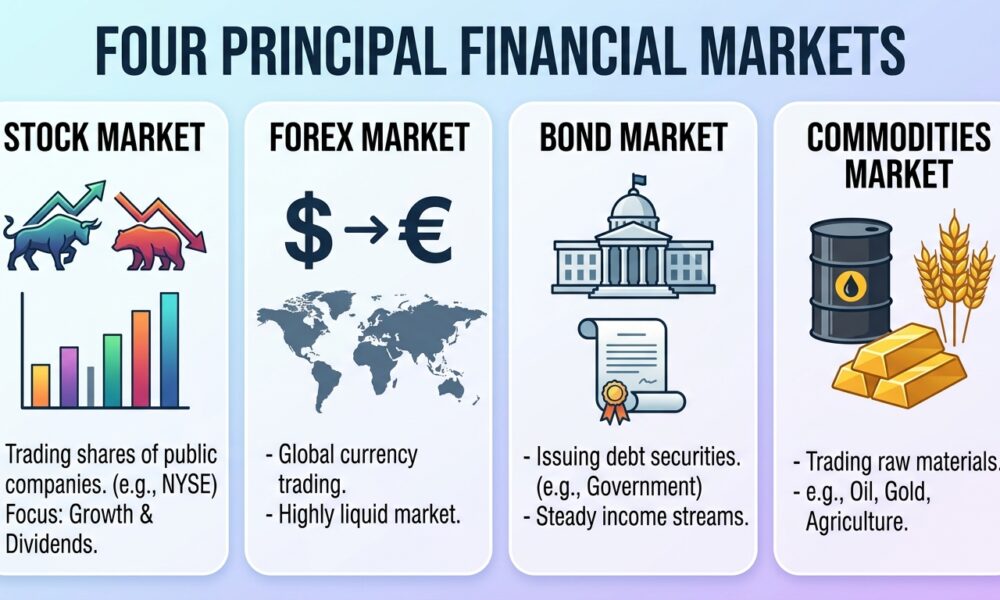
After learning what trading is, the next step for any beginner is to understand the different financial markets. You may have heard people talk about Forex trading, buying shares, trading gold or investing in Bitcoin. Although these activities all involve financial markets, they do not work in exactly the same way.
Table Of Content
- What Are Financial Markets?
- 1. Forex: The Foreign Exchange Market
- 2. Stocks: Buying Shares in Companies
- 3. Commodities: Trading Gold, Oil and Other Raw Materials
- 4. Indices: Tracking a Group of Stocks
- 5. Cryptocurrencies: Trading Digital Assets
- How Do These Five Markets Differ?
- Which Financial Market Should a Beginner Learn First?
- What Have We Learned?
Understanding these differences is important before deciding which market to study. For beginners in Kenya, the aim at this stage should be to learn the basics rather than rush into opening an account or depositing money.
What Are Financial Markets?
Financial markets are places or systems where financial assets are bought and sold. They connect buyers and sellers and allow prices to change according to factors such as supply, demand and market expectations.
Different markets deal with different assets. Some involve currencies, others involve company shares, while others focus on commodities or groups of stocks.
Let us examine five major markets that beginners are likely to encounter when learning about trading.
Read Also: What Is Trading? A Beginner’s Guide to Understanding How Trading Works
1. Forex: The Foreign Exchange Market
Forex is short for foreign exchange. It is the market where currencies are exchanged and traded against one another.
For example, when someone exchanges Kenyan shillings for US dollars before travelling abroad, they are participating in a currency exchange. Forex traders also deal with currencies, but they may try to profit from changes in exchange rates rather than simply obtain money for spending.
A Forex trader might study the relationship between the US dollar and the euro and try to anticipate whether one currency will strengthen or weaken against the other.
Currency prices are influenced by factors such as interest rates, inflation, economic reports and political developments.
Beginner takeaway: Forex trading involves currencies. In later lessons, we will explore how currency pairs work and how traders attempt to profit from exchange-rate movements.
2. Stocks: Buying Shares in Companies
Stocks, also called shares or equities, represent ownership in a company. When you buy shares in a publicly listed company, you acquire an ownership interest in that business.
For example, an investor can buy shares in a company listed on the Nairobi Securities Exchange (NSE). If the share price rises, the investor may sell at a profit. Some companies also pay dividends to shareholders, although dividends are not guaranteed.
Stock trading involves buying and selling shares, often with the aim of benefiting from price changes. However, share prices can fall, and investors may lose money.
It is also important to distinguish between owning actual shares and trading financial products that merely track share prices. These products can have different costs and risks.
Beginner takeaway: Stocks represent ownership in individual companies, while stock trading involves buying and selling shares.
3. Commodities: Trading Gold, Oil and Other Raw Materials
Commodities are basic goods and raw materials used in everyday life and industry. Examples include gold, silver, crude oil, coffee, wheat and maize.
Their prices can change because of supply and demand, weather conditions, wars, transportation disruptions and changes in global economic activity.
For example, a disruption in global oil supplies may affect oil prices. Similarly, changes in gold demand can influence the price of the precious metal.
However, trading commodities does not always mean buying and storing the physical product. Depending on the market and trading platform, a person may trade contracts linked to commodity prices instead.
Beginner takeaway: Commodities trading involves goods such as gold and oil, but the method of trading determines what you actually own or are exposed to.
4. Indices: Tracking a Group of Stocks
A stock market index measures the performance of a selected group of shares according to a particular method.
Think of an index as a scoreboard that helps people understand how a section of the stock market is performing. Instead of looking at one company alone, an index provides a broader picture of a group of companies.
For example, the S&P 500 tracks a selection of large publicly listed companies in the United States. In Kenya, the Nairobi Securities Exchange also publishes indices that measure the performance of selected shares listed on the local market.
Traders can gain exposure to index price movements through certain financial products offered by brokers. Depending on the product, they may not own the underlying shares.
An index can rise or fall depending on the performance of its constituent companies and the way the index is calculated.
Beginner takeaway: A stock is linked to an individual company, while an index measures the performance of a group of stocks.
Read Also: Understanding your brain function for successful trading
5. Cryptocurrencies: Trading Digital Assets
Cryptocurrencies are digital assets that use cryptographic technology. Bitcoin and Ethereum are among the best-known examples.
Unlike traditional national currencies issued by central banks, many cryptocurrencies operate on decentralised networks. Their prices can change sharply in response to investor demand, regulation, technological developments and market sentiment.
Some people buy cryptocurrencies and hold them, hoping their value will increase. Others trade them more frequently to try to benefit from price movements.
Cryptocurrency markets carry substantial risks. Prices can be extremely volatile, and traders may face cybersecurity threats, fraud, platform failures and regulatory uncertainty.
Beginner takeaway: Cryptocurrency trading involves digital assets, and their prices can experience significant fluctuations.
How Do These Five Markets Differ?
The table below summarises the main differences.
| Market | What is traded or tracked? | Example |
|---|---|---|
| Forex | Currencies | Euro and US dollar |
| Stocks | Shares in individual companies | Shares listed on the NSE |
| Commodities | Raw materials and basic goods | Gold and crude oil |
| Indices | A measure of a group of stocks | S&P 500 |
| Cryptocurrencies | Digital assets | Bitcoin |
Although these markets differ, they share one important characteristic: prices can move up or down, and trading decisions can result in either profits or losses.
The way you access a market also matters. Buying actual shares or cryptocurrency is not the same as using a leveraged contract that tracks the price of an asset. Before trading, beginners should understand exactly what a broker is offering.
Which Financial Market Should a Beginner Learn First?
There is no single market that is best for every beginner. The right starting point depends on your interests, learning goals, available resources and understanding of risk.
Someone interested in exchange rates may want to study Forex. A person interested in business ownership may prefer to learn about stocks, while someone curious about precious metals may want to understand commodity markets.
If you are taking a trading course, concentrate on understanding one market at a time. Learning about every market simultaneously can create unnecessary confusion, especially when you are still becoming familiar with basic trading terminology.
In Kenya, anyone considering investing through a stockbroker or another regulated capital-markets intermediary should check the relevant licensing requirements and verify the provider’s status with the Capital Markets Authority (CMA). Do not borrow money to begin trading, and never risk money needed for essential household expenses.
What Have We Learned?
Financial markets provide different ways to buy and sell assets. Forex focuses on currencies, stocks involve shares in individual companies, commodities include raw materials such as gold and oil, indices measure groups of stocks, and cryptocurrencies are digital assets.
You do not need to master all five markets at once. The first goal is to understand what each market represents and how it differs from the others.
In our next lesson, we will take a closer look at Forex trading: what it means, how currency trading works and why currencies are traded in pairs.
Educational disclaimer: This article is intended for general educational purposes only. It is not financial or investment advice, or a recommendation to buy or sell any financial instrument.
Never Miss a Story: Join Our Newsletter