
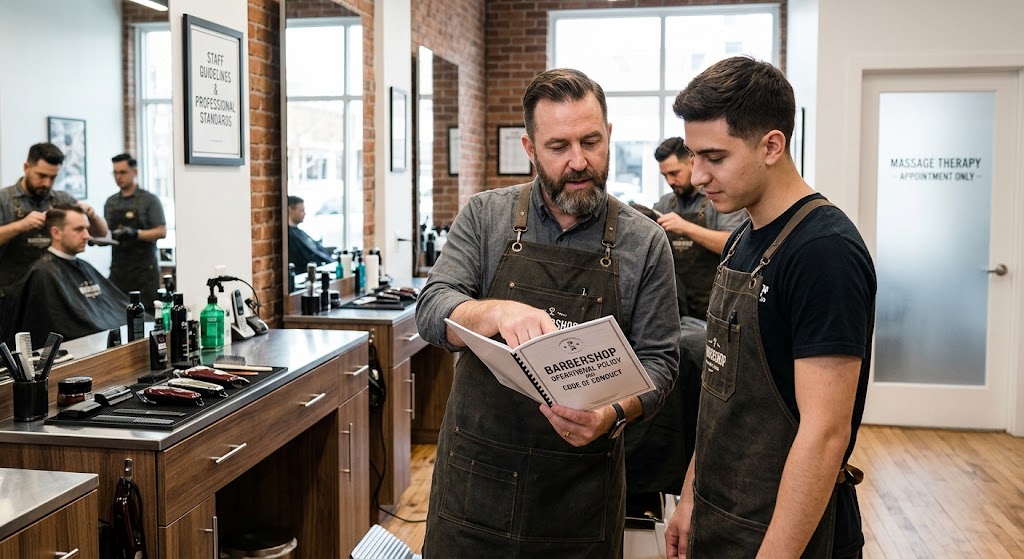
In the contemporary male grooming market, the classic barbershop has undergone a dramatic transformation. What was once a simple space for a quick haircut and a straight-razor shave has expanded into an all-inclusive wellness experience. Today’s high-end grooming lounges offer facials, manicures, scalp treatments, and full-body massages. On paper, this modern hybrid model represents a sophisticated evolution of personal care. Prominently framed on reception walls are official codes of conduct, licensing credentials, and stern zero-tolerance policies explicitly forbidding any illicit or non-professional activity.
Yet across urban centers worldwide, a stark divide exists between corporate posture and operational reality. Once the massage room door swings shut, those framed rules on the wall often cease to exist. Driven by financial desperation, predatory ownership, and client demand, many dual-service barbershops slip into a double life—operating as legitimate grooming spaces up front, while functioning as disguised brothels behind closed doors. Understanding how this transition occurs requires looking closely at the economic incentives, structural design failures, and systemic enforcement breakdowns that allow “money to talk” louder than professional ethics.
Read Also: When Anger Becomes Dangerous: Understanding What Happens in the Brain and Body
The Paper Shield: Rules as Plausible Deniability
In many dual-service establishments, workplace guidelines do not exist to protect employees or enforce ethics; they exist to insulate ownership from legal liability. This practice—often termed “plausible deniability”—allows business owners to construct a paper trail of compliance while actively encouraging, or turning a blind eye to, lucrative illicit operations.
+-------------------------------------------------------------------+
|                        OFFICIAL POLICY                            |
|  • Zero Tolerance for Unprofessional Conduct                     |
|  • Certified Therapists Only                                      |
|  • Standard Draping Mandatory                                     |
+-------------------------------------------------------------------+
                                 │
                                 ▼ (Behind Closed Doors)
+-------------------------------------------------------------------+
|                       OPERATIONAL REALITY                         |
|  • Under-the-Table Extra Fees ("Money Talks")                     |
|  • Unregulated Room Rentals & Wage Exploitation                  |
|  • Intentional Management Blindness                               |
+-------------------------------------------------------------------+
When local authorities or code enforcement officers inspect a venue, the business owner points to the signed employee handbooks, framed policy posters, and standard intake forms. The paperwork paints a picture of flawless compliance. However, management rarely invests in the active supervisory mechanisms required to uphold these standards—such as room audits, professional intake protocols, or clear reporting channels for staff facing harassment.
By keeping the rules strictly on paper, management creates a convenient narrative: if an illicit act is exposed, the blame is instantly shifted onto the individual worker as an isolated bad actor violating company policy, preserving the business owner’s license and investment.
The Economic Engine: When “Money Talks”
The breakdown of workplace boundaries is fundamentally driven by economics. The financial dynamics within hybrid barbershop-massage lounges often create an environment where adherence to professional boundaries becomes financially punitive for the worker.
1. Wage Exploitation and Commission Models
Many barbershops offering massage services do not employ certified massage therapists on standard salaried rates. Instead, they utilize predatory commission structures or “chair/room rental” models.
- Therapists are often paid minimal base wages—or no hourly base at all—relying entirely on a split of the massage fee.
- After the shop takes a 50% to 70% cut of the listed service price, the worker is left with an income that barely covers basic living expenses.
- Under severe financial pressure, staff become vulnerable to client offers of large cash tips in exchange for illicit services.
2. The Power Dynamic of Tipping
When a client offers a cash tip that equals two or three times the legal payout of a standard 60-minute massage, the economic balance shifts entirely. The client realizes that cash grants them power over the room, effectively converting a professional wellness service into a transactional negotiation. Owners who are aware of this dynamic frequently tolerate it because high-earning workers generate more foot traffic, accept lower base compensation, and pay higher room rental fees.
3. Client Entitlement and Boundary Erosion
The shift from a professional interaction to an illicit one is rarely instantaneous; it is an incremental process. It often begins with subtle verbal testing, deliberate boundary pushing, or small extra cash offers. When a business fails to actively back its staff or ban abusive clients, workers quickly realize that reporting inappropriate behavior will result in lost revenue or even termination. Over time, the boundary erodes completely, and the expectation of “extra services” becomes normalized within the room.
The Architecture of Secrecy
The physical layout of a dual-service barbershop plays a crucial role in enabling illicit operations. Unlike traditional physical therapy clinics or clinical spas designed with visibility and safety in mind, many hybrid barbershops build massage rooms that favor total isolation.
- Deadened Acoustics and Lockable Doors: While client privacy is a legitimate requirement for therapeutic massage, solid deadbolted doors, heavy soundproof padding, and loud white-noise machines eliminate any operational transparency.
- Clandestine Facilities: Environments featuring dim, ambient mood lighting, private ensuite shower facilities, and isolated rear entrances allow clients to enter and exit without passing through the main reception floor.
- The “Front-and-Back” Split: The main barbershop floor remains brightly lit, energetic, and completely professional, serving as a clean visual facade. The massage area, tucked away down a dark hallway, operates under an entirely different set of unwritten rules.
This spatial segregation ensures that traditional customers waiting for a haircut remain entirely unaware of what occurs in the back rooms, shielding the business’s public reputation while preserving its illicit revenue stream.
The Impact on Workers and Legitimate Wellness
The transformation of massage services into disguised commercial sex work has damaging consequences for legitimate wellness professionals and the broader grooming industry.
┌─────────────────────────────────────────────────────────────────┐
│                      SYSTEMIC IMPACTS                           │
├───────────────────────────────┬─────────────────────────────────┤
│ For Professional Therapists   │ Industry & Public Perception    │
├───────────────────────────────┼─────────────────────────────────┤
│ • Devaluation of credentials  │ • Wellness reduced to euphemism │
│ • Exposure to harassment      │ • Legitimate shops lose trust   │
│ • Burnout & industry exit     │ • Regulatory crackdowns hit all │
└───────────────────────────────┴─────────────────────────────────┘
Devaluation of Professional Qualifications
LMTs (Licensed Massage Therapists) undergo hundreds of hours of rigorous training in anatomy, physiology, and pathology. When barbershops hire uncertified personnel willing to perform sexual services under the guise of “massage,” it commodifies and degrades the entire profession. Qualified therapists who apply for jobs in good faith often find themselves forced into unsafe environments or pressured to compromise their ethics to keep their jobs.
Normalization of Workplace Harassment
In establishments where rules are ignored, boundaries disappear. Staff who refuse client solicitations are routinely subjected to verbal abuse, boundary violations, and physical harassment. Because management has established an environment where “money talks,” victim reporting is discouraged, leaving workers with zero institutional support or protection.
Public Stigmatization
As more dual-service barbershops gain reputations for hidden services, public trust in male grooming and wellness establishments degrades. Genuine therapeutic treatments—such as sports recovery, deep tissue therapy, or stress management—become tainted by association, making male clients hesitant to seek legitimate bodywork and forcing authentic wellness businesses to fight constant public skepticism.
The Regulatory Gap: Why Enforcement Fails
Why do municipal authorities and licensing boards fail to curb this issue? The answer lies in the massive gap between static regulatory frameworks and real-world operations.
| Regulatory Deficit | Operational Reality | Impact |
| Outdated Licensing Categories | Businesses register under standard “Barbershop” or “Personal Care” permits, bypassing strict health and spa oversight. | Minimal initial vetting or operational checks. |
| Predictable Inspections | Code inspectors perform daytime audits, focusing on sanitation, towel warmers, and physical paperwork. | Nighttime and closed-door operations remain completely uninspected. |
| High Burden of Proof | Law enforcement requires resource-intensive undercover operations to establish illegal activity inside private rooms. | Small-scale operations easily evade detection or simply relocate when targeted. |
Because municipal enforcement agencies are chronically understaffed and focused on high-level criminality, dual-service barbershops operating in gray areas rarely face serious legal consequences. At most, an exposed business faces a minor fine or forfeits its license, only to reopen weeks later under a new business name or a relative’s registration.
Reclaiming Integrity: Moving Beyond Paper Boundaries
Eliminating disguised operations and establishing genuine safety requires moving past framed policy posters and implementing structural, unyielding operational standards. A barbershop that genuinely wishes to offer professional massage services without compromising its ethics must implement concrete, structural guardrails:
- Architectural Transparency: Replacing solid wooden doors with door panels featuring frosted vision glass or high-level view windows. This preserves client modesty while ensuring that interior lighting levels and general room activities remain visually verifiable from common hallways.
- Fair Wage Guarantees: Discontinuing commission-only or high-rent models for massage staff. Paying certified therapists a competitive, guaranteed hourly wage eliminates the economic desperation that makes workers vulnerable to client financial coercion.
- Strict Credential Verification: Requiring all massage staff to hold verified state or national professional bodywork licenses, complete with verified continuing education in professional ethics and draping protocols.
- Active Client Management: Implementing a strict, immediate lifetime ban for any client who solicits inappropriate services or crosses verbal boundaries, supported by zero-tolerance policies that management actively enforces.
- Clear Reporting Channels: Providing staff with direct access to anonymous whistleblowing or reporting pathways, ensuring that safety complaints are reviewed by independent oversight rather than profit-driven store managers.
A workplace rule is only as real as the management’s willingness to enforce it when money is on the line. Until business owners prioritize human dignity, professional standards, and legal compliance over easy cash, framed codes of conduct will remain nothing more than modern decor—a thin paper shield hiding an uncomfortable truth behind closed doors.
Enforceable Standards & Operational Guidelines for Hybrid Grooming Establishments
An enforceable workplace policy shifts your rules from vague ethical statements into non-negotiable operational controls, financial guardrails, and explicit termination triggers.
Core Modules for the Policy Manual
1. Qualifications and Compensation Architecture
- Verified Licensing: Require all bodywork staff to hold accredited massage therapy certifications and active state or national registration prior to onboarding.
- Guaranteed Base Pay: Pay therapists a competitive hourly base rate in addition to service splits. Removing complete reliance on tips eliminates the financial desperation that enables boundary exploitation.
- Reception-Only Financial Transactions: All payments, additions, and tips must be handled at the front desk. Zero cash or electronic payment exchanges are permitted inside treatment rooms.
2. Physical Environment and Door Protocols
- Locking Restrictions: Treatment room doors must remain unlocked during sessions or fitted with emergency-override commercial locks accessible by management at all times.
- Acoustic & Visual Inspections: Install vision panels (frosted glass at shoulder height) or door-status indicator lights. Management reserves the right to perform unannounced room welfare checks.
- Prohibited Items: Personal smartphones, secondary lockboxes, and unapproved lighting or dimming equipment are banned inside massage suites.
3. Clinical Draping and Client Intake
- Mandatory Draping: Require professional, full-body draping protocols. Only the specific area of the body being actively worked on may be exposed at any time.
- Pre-Service Waiver: Every client must sign a zero-tolerance agreement before their first appointment, acknowledging that any inappropriate comment or physical advance results in immediate termination without refund.
- Boundaries of Service: Explicitly define banned service requests (e.g., groin area work, non-standard positioning) directly in the employee manual.
Policy Operational Matrix
| Operational Area | Standard Requirement | Violation Trigger | Direct Enforcement Action |
| Payment Handling | 100% processed at reception desk. | Cash accepted or solicited inside treatment room. | Immediate suspension pending financial audit. |
| Client Behavior | Strict professional boundary maintained. | Verbal solicitation, touching, or exposure by client. | Immediate session cancellation, client lifetime ban, full therapist pay preserved. |
| Draping Compliance | Full sheet/towel coverage at all times. | Inadequate draping or working on unexposed areas. | Written warning on 1st offense; termination on 2nd. |
| Room Safety | Unlocked or emergency-accessible door. | Deadbolted door or obstructed view/entry. | Immediate room entry by management; formal investigation. |
Enforcement Protocol: Protecting Staff and Management
Step 1: The “Walk-Out” Empowerment Clause
Explicitly state in the handbook that staff have full legal and managerial backing to stop a session, step out of the room, and notify security or management the moment a client crosses a verbal or physical boundary. The therapist receives 100% of their commission for the scheduled time.
Step 2: Incident Reporting and Audit Trail
Maintain a digital, timestamped Incident Log. Any boundary violation must be documented within 2 hours of occurrence, detailing:
- Client name and contact details.
- Therapist statement and exact behavior reported.
- Management action taken (e.g., immediate removal, police notification, permanent blacklist entry).
Step 3: Immediate Termination Clause for Staff
To ensure zero ambiguity, list automatic termination triggers for employees:
- Accepting off-book cash payments inside the room.
- Locking treatment doors from the inside without authorization.
- Falsifying client intake records or skipping mandatory draping.
- Failure to report client solicitations to management immediately.
Step 4: Regular Mystery Audits
Contract independent, professional mystery shoppers or industry compliance auditors to book services quarterly. Audits assess draping standard adherence, reception processing, payment compliance, and professional demeanor.
Never Miss a Story: Join Our Newsletter