You walk into a barbershop with one simple objective: get a haircut, trim your beard, pay your KSh 1,500, and leave.
Then the machinery of modern male grooming kicks in.
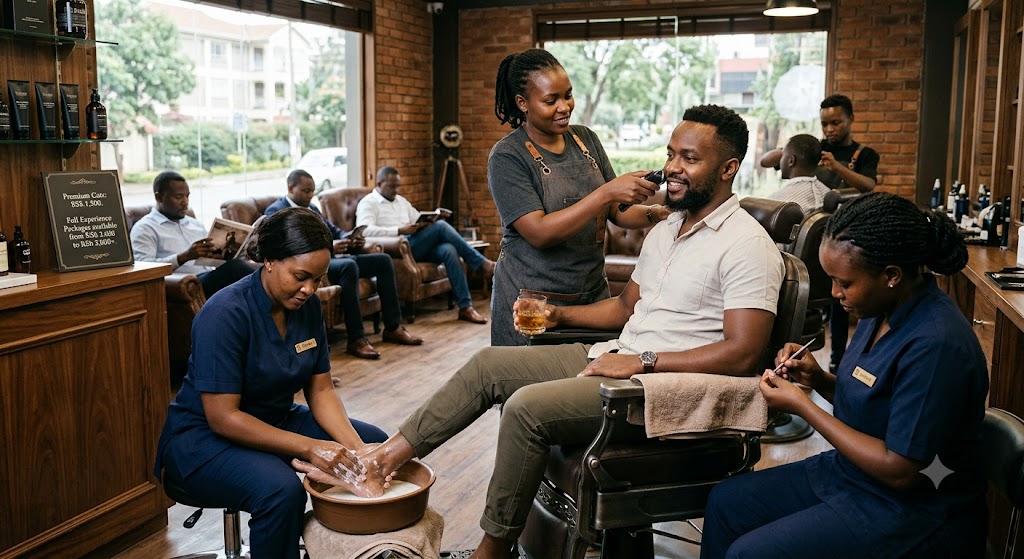
Before you realize it, you are leaning back in a hydraulic leather chair while one attendant fades your sides, another begins a foot soak, and a third works on your cuticles. There is ambient music, smooth conversation, a hot towel treatment, and a subtle nudge toward a private treatment room down the hall.
You expected to spend KSh 1,500. You walk out having spent KSh 5,000—or more.
Strangely enough, you aren’t angry. In fact, you’re already calculating when you need your next line-up.
This transformation from basic utility to high-end lifestyle experience is reshaping Nairobi’s urban service economy, raising fundamental lessons about consumer psychology, modern upselling, and customer retention.
Read Also:The Richest Man Who Ever Lived: A Deep Dive into the Life, Wealth, and Legacy of Mansa Musa
1. Beyond the Cut: Selling an Experience
Traditionally, the barbershop business model was strictly transactional. You sat down, got your hair cut, shaved or shaped your beard, paid, and exited.
Today, Nairobi’s high-end grooming lounges operate on an entirely different economic philosophy: the haircut is no longer the main product—it is the gateway.
The haircut opens the door to a broader suite of personal care, relaxation, and wellness options. A client seeking a routine trim is smoothly introduced to manicures, pedicures, deep-cleansing facials, and shoulder massages.
This fundamentally shifts the unit economics of the salon:
- Traditional Model: 1 Client × 1 Service (Haircut) = KSh 1,500
- Experience Model: 1 Client × Multi-Service Package = KSh 3,500 to KSh 5,000+
The business increases average order value (AOV) not by inflating the baseline price of a haircut, but by expanding the basket of services the customer willingly consumes in a single sitting.
2. The Escalating Battle for Differentiation
As Nairobi’s premium grooming market grows increasingly crowded—from Kilimani and Westlands to Lavington and Karen—competency is no longer a differentiator.
When five nearby establishments offer sharp fades, sterile equipment, and comparable price points, technical skill alone cannot guarantee loyalty. The battleground shifts entirely to customer experience (CX):
- Hospitality: How is the client greeted upon entry? Is there a complimentary coffee, juice, or whiskey?
- Pacing & Comfort: How long is the wait time, and how ergonomic are the stations?
- Atmosphere: What is the lighting, acoustics, and interior aesthetic?
- Efficiency: Can the client complete four distinct grooming routines in under an hour?
When baseline quality is equal, perceived value is dictated by how the service makes the client feel.
3. The “Three-Attendant” Operational Model
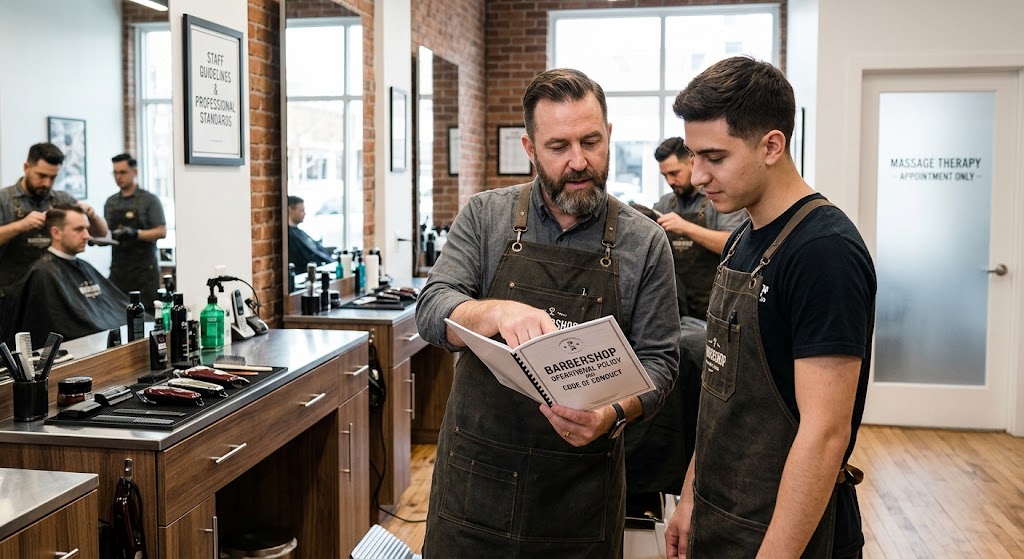
One of the most striking operational innovations in high-end Nairobi barbershops is multi-attendant service delivery.
Instead of a linear process where one staff member performs tasks sequentially, a team coordinates simultaneously:
- Primary Barber: Focuses on hair, beard shaping, and line-ups.
- Pedicurist: Manages foot care and lower-leg massages.
- Manicurist/Esthetician: Handles hand care or facial prep.
[ Traditional Sequential Workflow ]
Cut (30m) ➔ Shave (15m) ➔ Wash (10m) = 55 Mins (1 Service focus)

[ Simultaneous Multi-Attendant Workflow ]
Barber (Hair/Beard)  \
Pedicurist (Feet)    ├─ Concurrent Execution = 45 Mins (3+ Services delivered)
Manicurist (Hands)   /
From a business standpoint, this maximizes revenue density per chair per hour. From a psychological standpoint, receiving simultaneous care creates an unmistakable sensation of luxury and personal importance. Attention has commercial value, and clients pay premium rates for it.
Read Also:Lamine Yamal: The Barcelona Prodigy Who is Taking the World by Storm
4. Experience-Based Selling vs. Pressure Selling
There is a delicate boundary between high-converting upselling and uncomfortable pressure selling.
| Strategy | Execution | Client Perception |
| Pressure Selling | Aggressive pitches, hidden add-on costs, pushy staff. | Exploitative; reduces repeat visits. |
| Experience-Based Selling | Introducing add-ons when the client is already relaxed and engaged. | Natural, helpful, and high-value. |
Once a client is comfortable, in a soothing environment, and actively receiving quality service, the marginal cost of adding a KSh 1,000 manicure feels small compared to the immediate pampering benefit. The purchase feels self-initiated rather than forced.
5. The Dynamics of the Service Environment
There is also a social dimension to the service design in modern men’s lounges, including the strategic deployment of highly trained female attendants for spa and grooming procedures.
While surface-level observations might attribute higher spending to gender dynamics, the underlying driver is broader: attentive, detailed, and hospitality-focused service delivery.
Whether through polite conversation, active listening, or immaculate attention to detail, clients return to environments where they feel treated with care and respect. Gender dynamics may form part of a brand’s aesthetic positioning, but hospitality principles dictate long-term retention.
6. The Danger of the “Upsell Trap”
For experience-based selling to build a sustainable business, operational transparency must remain intact.
- Clear Pricing: Add-ons must be clearly stated before work begins to avoid surprise bills.
- Optionality: Upgrades must feel genuinely optional, never forced.
- Core Competency First: No amount of complimentary espresso or foot massages can compensate for a ruined hairline.
If a customer leaves feeling tricked into spending KSh 5,000, they will not return. The ultimate goal is for the client to review their KSh 5,000 receipt and think: “That was worth every shilling.”
7. Strategic Takeaways for Service Businesses
Nairobi’s evolving male grooming market offers core lessons for any service-based entrepreneur:
- Leverage the Entry Product: Use your primary, high-demand service as a low-friction hook to introduce higher-margin offerings.
- Compress Time to Value: Deliver multiple services simultaneously to save the client time while increasing revenue per visit.
- Optimize for Lifetime Value (LTV): A client spending KSh 1,500 every two weeks for two years (KSh 78,000) is far more valuable than a one-time visitor forced into a KSh 6,000 bill who never returns.
- Sell the Feeling, Perfect the Utility: Atmosphere creates the initial upsell, but technical execution secures the repeat visit.
Never Miss a Story: Join Our Newsletter