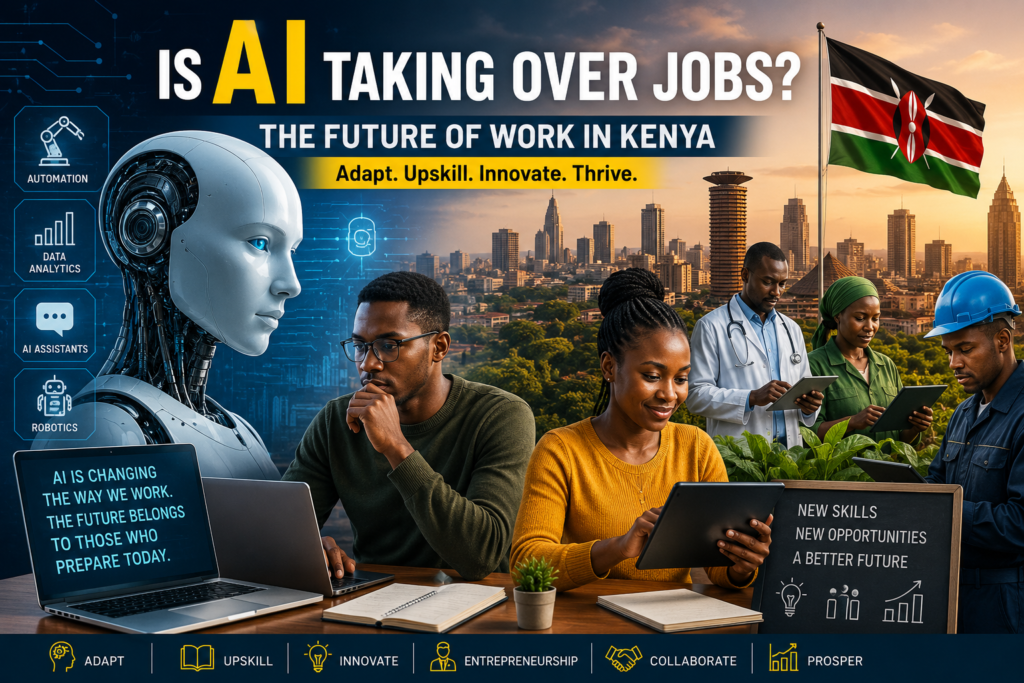
This is arguably the defining economic question of the 21st century. The debate is often framed incorrectly as “Will AI take our jobs?” The more accurate question is:
Which jobs will AI transform, which will disappear, and who will benefit from the enormous wealth AI creates?
Using Kenya as a case study makes the discussion even more compelling because the country has one of Africa’s youngest populations, a rapidly expanding digital economy, but also high unemployment and a large informal sector. Those three factors make Kenya both highly vulnerable and uniquely positioned in the AI revolution.
AI Is Not Taking All Jobs—It Is Taking Tasks
One of the biggest misconceptions is that AI simply replaces entire professions.
History suggests something different.
- Tractors didn’t eliminate farming.
- ATMs didn’t eliminate banking.
- Computers didn’t eliminate accountants.
- The internet didn’t eliminate journalism.
Instead, technology removes specific tasks, reducing the number of people needed to perform them while creating new roles elsewhere.
AI is doing exactly that—but much faster.
The problem is not that jobs disappear overnight.
The problem is that productivity rises dramatically, meaning companies need fewer employees to produce the same output.
Imagine a Kenyan insurance company that previously employed:
- 120 customer service agents
- 40 claims processors
- 25 data analysts
After deploying AI:
- AI chatbots answer 90% of customer questions.
- AI processes claims automatically.
- AI generates reports in seconds.
The company may only need:
- 35 customer service specialists
- 12 claims experts
- 8 analysts
The work still exists.
Far fewer people are required.
Why This Revolution Is Different
Previous industrial revolutions mainly replaced physical labor.
AI replaces mental labor.
That changes everything.
For the first time in history, software can:
- write articles
- analyze legal documents
- diagnose diseases
- compose music
- write software
- design advertisements
- interpret X-rays
- prepare contracts
- answer customer questions
- conduct research
These were considered “safe” white-collar professions only a few years ago.
Jobs Most at Risk in Kenya
1. Customer Care
Kenya has thousands of people working in:
- banks
- SACCOs
- telcos
- insurance companies
- e-commerce
Modern AI chatbots now answer customers in English and Kiswahili, 24 hours a day.
Instead of hiring 300 agents, companies may only require 60 supervisors.
2. Call Centres
Kenya has invested heavily in becoming a Business Process Outsourcing (BPO) destination.
Ironically, AI is beginning to automate the very work BPO companies sell.
Voice AI now sounds remarkably human.
Some international firms already use AI receptionists.
3. Journalists
This one deserves careful analysis.
AI cannot replace investigative journalism.
But it can produce:
- sports reports
- financial summaries
- election updates
- weather reports
- breaking news rewrites
A newsroom that once employed twenty writers may need only eight journalists plus AI-assisted editors.
The journalists who remain will focus more on:
- investigations
- interviews
- analysis
- exclusive stories
Routine reporting becomes increasingly automated.
4. Graphic Designers
Simple posters…
Social media graphics…
Flyers…
Product mockups…
These now take minutes with AI.
Only highly creative designers will command premium rates.
5. Translators
Kenya has growing demand for:
- English
- Kiswahili
- French
- Chinese
AI translation quality has improved dramatically.
Human translators increasingly focus on sensitive legal, literary, or technical work.
6. Software Developers
Ironically, programmers are among AI’s biggest users.
AI writes code incredibly well.
Junior coding positions are likely to shrink.
Senior software engineers who can architect systems, review AI-generated code, and solve complex problems remain in high demand.
Jobs That Become More Valuable
History shows technology rarely eliminates work altogether.
Instead, it shifts value.
The biggest winners will be people who combine AI with uniquely human capabilities.
Examples include:
- electricians
- plumbers
- mechanics
- nurses
- physiotherapists
- therapists
- teachers
- entrepreneurs
- sales professionals
- AI system managers
- cybersecurity experts
These jobs rely on physical presence, trust, judgment, or complex interpersonal interaction.
Kenya’s Biggest Challenge
Kenya graduates tens of thousands of university students every year.
Many seek office-based employment.
Unfortunately, office work is precisely where AI has the greatest impact.
If graduates continue training only for routine administrative jobs, competition will intensify while opportunities decline.
Education Is Already Becoming Outdated
Many university courses were designed decades ago.
Students still spend years memorizing information.
AI retrieves information instantly.
The future rewards people who can:
- solve problems
- think critically
- lead teams
- innovate
- communicate effectively
- build businesses
Memorization is becoming less valuable than judgment and creativity.
The Gig Economy May Expand
Many Kenyans already earn income through:
- freelancing
- digital marketing
- YouTube
- TikTok
- online tutoring
- affiliate marketing
AI lowers barriers to entry.
One person can now create:
- videos
- websites
- marketing campaigns
- business plans
- advertising copy
Tasks that once required a team.
This empowers entrepreneurs but also increases competition.
Read Also: Womb Transplants in Kenya: Should Wombs Be Taken from the Dead? Kenyan Experts Weigh In
Will AI Increase Unemployment?
Potentially, yes.
Especially during the transition.
Imagine 100 companies each reducing staff by 20%.
Thousands lose jobs.
Yet entirely new industries also emerge.
The challenge is timing.
Workers often lose old jobs before new opportunities become widespread.
That transition can be painful.
Wealth Could Become More Concentrated
Perhaps the biggest issue isn’t unemployment.
It’s inequality.
Suppose one entrepreneur uses AI to run a business that previously required 100 employees.
Profits rise sharply.
Costs fall.
The owner becomes wealthier.
But many former employees lose income.
AI can therefore widen the gap between capital owners and workers unless economic policies and education adapt.
Kenya’s Youth: Opportunity or Crisis?
Kenya has one of Africa’s youngest populations.
This can become either:
A demographic dividend
if young people learn:
- AI
- robotics
- automation
- data science
- entrepreneurship
or
A demographic crisis
if education remains disconnected from labor market realities.
Countries that adapt quickly are likely to benefit most.
Agriculture May Be Transformed
Agriculture still employs a significant share of Kenyans.
AI can help farmers through:
- drone monitoring
- disease detection
- weather forecasting
- precision irrigation
- market price prediction
Rather than replacing farmers, AI can improve productivity and profitability.
Healthcare
Doctors are unlikely to disappear.
But AI increasingly assists with:
- medical imaging
- patient triage
- administrative documentation
- drug discovery
- clinical decision support
Doctors who use AI effectively may deliver faster and more accurate care.
Small Businesses Could Benefit Most
One surprising outcome is that AI can level the playing field.
A Nairobi entrepreneur can now compete with much larger firms by using AI for:
- accounting
- customer service
- advertising
- bookkeeping
- marketing
- website creation
This dramatically lowers startup costs.
Government and Public Service
Governments may increasingly deploy AI for:
- tax administration
- fraud detection
- permit processing
- document verification
- citizen support
If implemented well, this could improve efficiency. However, it also raises important questions about privacy, transparency, accountability, and the need for workers to transition into new roles.
What Skills Will Matter Most?
Technical skills remain important.
But surprisingly, human skills become even more valuable.
The future belongs to people who can:
- Learn continuously.
- Ask insightful questions.
- Think critically.
- Communicate persuasively.
- Lead and collaborate.
- Solve complex, unfamiliar problems.
- Use AI as a productivity partner rather than seeing it only as a competitor.
AI is excellent at generating answers.
Humans still excel at deciding which questions matter.
Could AI Eventually Replace Most Jobs?
Some economists believe that advanced AI could automate a very large share of today’s work over the coming decades.
Others argue that, as with previous technological revolutions, entirely new industries and occupations will emerge that are difficult to predict today.
The honest answer is that no one knows with certainty. What is clear is that the pace of change is faster than in previous industrial revolutions, making adaptation more urgent for individuals, businesses, and governments.
Final Thoughts: Kenya’s Defining Economic Test
Artificial intelligence is unlikely to make human work obsolete in the foreseeable future. Instead, it is reshaping how work is done, who performs it, and how the rewards are distributed. For Kenya, the greatest risk is not the technology itself but failing to prepare people for an economy where routine work is increasingly automated.
The country’s greatest asset is its youthful population. If education, training, and public policy equip young people to work alongside AI—building businesses, solving local problems, and creating new industries—Kenya could emerge as a regional leader in the digital economy. If not, the country risks rising unemployment, widening inequality, and social tension.
The central lesson is simple: AI is unlikely to replace everyone, but workers and businesses that embrace AI are increasingly likely to outperform those that do not. The challenge for Kenya is ensuring that the benefits of this technological revolution are shared broadly rather than concentrated in the hands of a few.
Never Miss a Story: Join Our Newsletter