Elisabeth Elliot: The Woman Who Chose Forgiveness Over Revenge
Few Christian testimonies have challenged the world’s understanding of forgiveness as profoundly as that of Elisabeth Elliot. She was a young missionary in Ecuador when members of a violent...

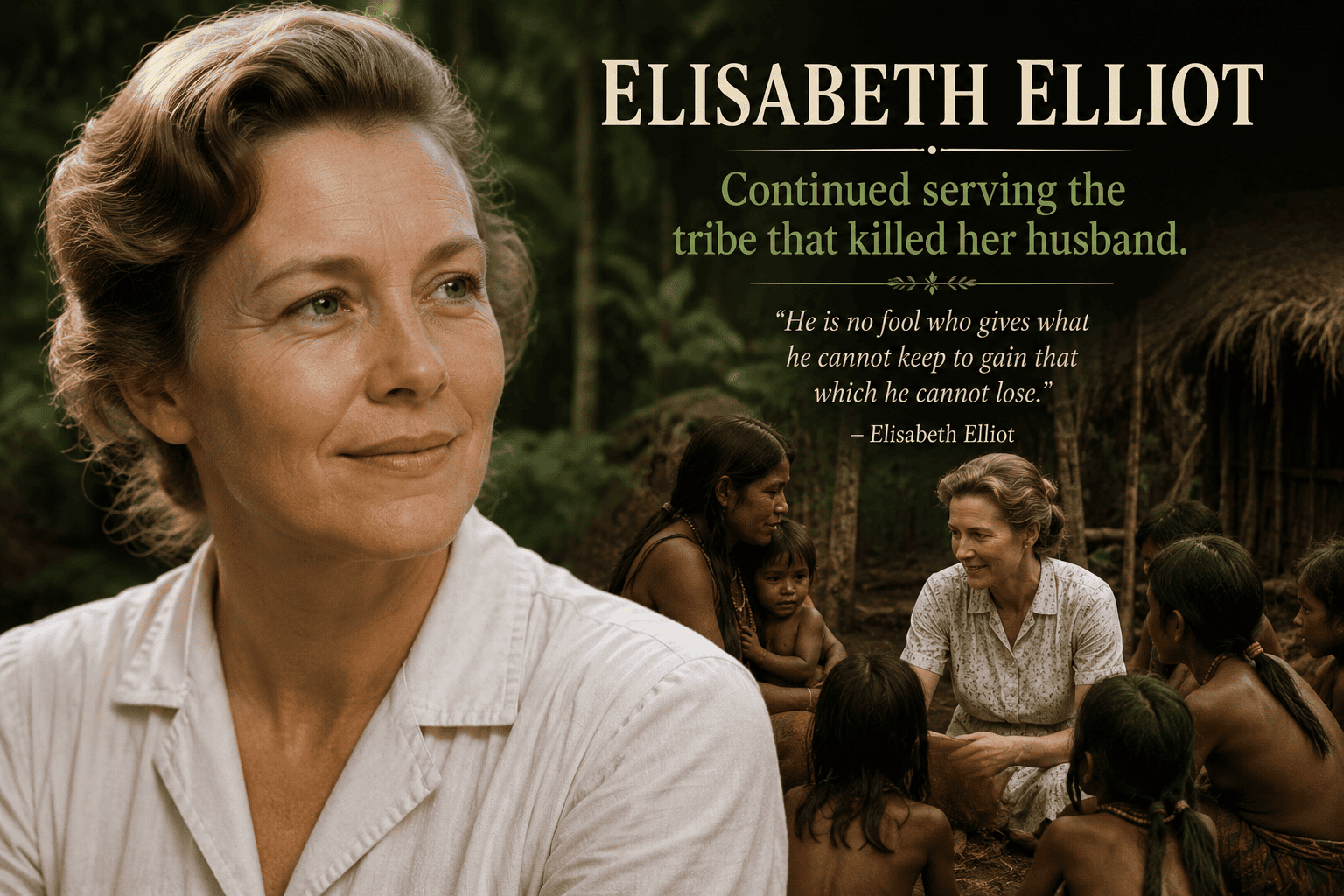
Few Christian testimonies have challenged the world’s understanding of forgiveness as profoundly as that of Elisabeth Elliot. She was a young missionary in Ecuador when members of a violent Amazonian tribe savagely speared her husband Jim and his four colleagues to death . Incredibly, prayerfully, Elisabeth took her toddler daughter, snakebite kit, Bible, and journal, and went to live in the jungle with the Stone-Age people who killed her husband . Her choice to forgive, rather than retaliate, sparked a change in a tribe known for the highest rates of homicide ever recorded in a human society, inspiring millions around the globe .
Table Of Content
Early Life and Calling
Elisabeth Howard was born on December 21, 1926, in Brussels, Belgium, to missionary parents Philip and Katherine Howard . Soon after her birth, the family moved to the United States, eventually settling in the Germantown neighborhood of Philadelphia, where her father served as editor for the Sunday School Times .
She grew up in a home filled with hymns, Scripture, and missionaries on furlough—including the likes of Betty Stam, whose later martyrdom would deeply mark her faith . At an early age, Elisabeth made a personal profession of faith and felt God’s call to be a missionary .
In 1944, she enrolled at Wheaton College, studying Classical Greek because she wanted to translate the Bible for remote peoples of the world . It was at Wheaton that she met Jim Elliot, a fellow student with a similar calling for missions . They shared a long romance, though they did not begin serving together immediately.
Courtship and Marriage
After graduation, Elisabeth completed a year of specialized post-graduate studies at Prairie Bible Institute in Alberta, Canada, where a campus prayer chapel was later named in her honor . In 1952, both she and Jim traveled independently to Ecuador to work as missionaries with different tribes .
A year later, Jim joined her in Quito, where he proposed marriage. Elisabeth accepted his proposal on one condition: that they learn the Ecuadorian Quichua language before they married . They married in Quito, Ecuador, in 1953 .
Jim had a growing burden for an unreached tribe known as the “Aucas” (now called the Waorani or Waodani), a fierce group whom no outsider had ever contacted and survived . In 1955, their daughter Valerie was born .
The Martyrdom at Palm Beach
In January 1956, Jim and four other missionaries—Nate Saint, Peter Fleming, Roger Youderian, and Ed McCully—made contact with the Waorani . After a seemingly friendly initial encounter, the tribe suddenly attacked, and all five men were speared to death . The news sent shockwaves around the world .
Elisabeth was left alone with her 10-month-old daughter Valerie, her husband dead in the jungle, murdered by a people she had never met .
The Impossible Choice
In the aftermath of the tragedy, Elisabeth could have returned to the safety of the United States. Instead, she continued her work with the Quichua tribe for two more years . During that time, a remarkable door opened. Two Waorani women, including a young woman named Dayuma, had fled the tribe and were living among the Quichua .
Dayuma taught Elisabeth and fellow missionary Rachel Saint the Waorani language . When Dayuma eventually returned to her people, she created an opening for peaceful contact .
In October 1958, Elisabeth made the decision that stunned the world: she took her three-year-old daughter Valerie and Rachel Saint and went to live with the Waorani tribe that had killed her husband .
She later explained why she went. After learning the Waorani language, she discovered that the tribesmen had killed her husband because they were afraid outsiders would come and take away their freedom. She wrote: “The Auca was trying to preserve his own way of life, his own liberty. He believed the foreigners were a threat to that liberty, so he feels he had every right to kill them. In America, we decorate a man for defending his country” .
Life Among the Waorani
For two years, Elisabeth, Valerie, and Rachel lived with the Waorani . The tribe gave Elisabeth the name Gikari, meaning “Woodpecker”—a reference to her tall height . She used her linguistic skills to help create a writing system for the Waorani language, which had previously only been communicated orally .
The Waorani had the highest rates of homicide ever recorded in a human society, with violence fueled by a culture of unending family vendettas . Elisabeth’s living demonstration of forgiveness to the very men who had slain her husband began to break that cycle . Many in the tribe eventually came to faith in Christ .
Literary Career and Global Influence
Elisabeth left the Waorani in 1960 and returned to the United States in 1963 . She then launched a prolific career as a writer and speaker that lasted for decades .
Her books were considered staples in evangelical homes . Through Gates of Splendor, the story of the five missionaries killed by the Waorani, became a bestseller and was ranked number nine on Christianity Today’s list of the Top 50 books that have shaped evangelicals . Shadow of the Almighty: The Life and Testament of Jim Elliot was also a bestselling account of his life and work . Other notable titles include The Savage, My Kinsman, about her life among the Waorani, and later works such as Passion and Purity and Let Me Be a Woman .
For thirteen years, Elisabeth hosted a twelve-minute radio program called Gateway to Joy, aimed at women. She opened each episode with her signature words: “You are loved with an everlasting love. That’s what the Bible says. And underneath are the everlasting arms. This is your friend, Elisabeth Elliot” .
Later Years and Final Sorrows
In 1969, Elisabeth married Addison Leitch, a professor of theology at Gordon Conwell Seminary in Massachusetts. He died in 1973 . She married a third time in 1977 to Lars Gren, who remained with her until her death .
Elisabeth stopped speaking publicly in 2004 as her health declined and she began suffering from dementia. Her husband Lars observed that she handled dementia just as she had the deaths of her husbands: “She accepted those things, [knowing] they were no surprise to God. It was something she would rather not have experienced, but she received it” .
Elisabeth Elliot died peacefully on June 15, 2015, at the age of 88 . Her daughter Valerie, eight grandchildren, and husband Lars survived her .
Legacy
Elisabeth Elliot’s story is far more than a dramatic missionary account—it is a testament to the transformative power of forgiveness. She was a woman who “steadfastly demonstrated what it meant to simply ‘trust and obey'” . Her central question in life was not, “How does this make me feel?” but rather, “Is this true?” and if so, “What do I need to do about it to obey God?” .
Biographer Ellen Vaughn writes that her most noble accomplishment was “practicing—through both the high dramas and the low, dull days that constitute any human life—the daily self-death required for one’s soul to flourish” . Elisabeth herself once wrote: “Would you like to have the story of Daniel without the lions’ den? Would you like to have the story of Joseph without all his trials and tribulations?” . Her life answered the question she posed.
Her legacy lives on through the Elisabeth Elliot Foundation, her more than twenty books, and countless lives touched by her witness . Today, the Waorani have largely left behind the cycle of violence, and many are part of thriving Christian communities. The story that began with five speared bodies in a jungle clearing transformed into one of the most powerful testimonies of forgiveness in modern history.
Never Miss a Story: Join Our Newsletter