President Donald Trump has repeatedly blamed Nicolás Maduro for the surge of Venezuelan migrants entering the United States.. Estimates suggest that nearly eight million Venezuelans have fled the country since 2013, driven by economic collapse and political repression. Trump has accused Maduro of “emptying his prisons and insane asylums” and “forcing” inmates to migrate to the U.S., though no independent evidence has substantiated these claims.
In addition to migration concerns, Trump has focused on the flow of drugs—particularly fentanyl and cocaine—into the United States. He has labeled two Venezuelan criminal groups, Tren de Aragua and Cartel de los Soles, as Foreign Terrorist Organizations (FTOs). Trump has even alleged that Maduro leads the Cartel de los Soles himself.
Analysts caution that the Cartel de los Soles is not a hierarchical organization, but rather a term used to describe corrupt officials who allow cocaine to transit through Venezuela. Nonetheless, Trump doubled the reward for information leading to Maduro’s capture and announced plans to designate Maduro’s government as an FTO.
Maduro has vehemently denied any involvement in drug trafficking, accusing the U.S. of using the “war on drugs” as a pretext to seize Venezuela’s vast oil reserves.
What Is the Cartel de los Soles?
The Cartel de los Soles is a loosely defined network of corrupt officials rather than a traditional organized criminal group. While the U.S. has labeled it a terrorist organization, counternarcotic experts argue that Venezuela is primarily a transit country, not a major producer of cocaine. Most cocaine reaching the U.S. originates in Colombia, and the majority of fentanyl enters via Mexico, not Venezuela.
U.S. Pressure on Venezuela
Since Trump began his second term in January 2025, the administration has intensified pressure on Maduro’s government:
- The reward for information leading to Maduro’s capture was doubled.
- In September 2025, U.S. forces began targeting vessels allegedly carrying drugs from South America to the U.S.
- More than 30 strikes have occurred in the Caribbean and Pacific, reportedly killing over 110 people.
- The administration claims these operations constitute a non-international armed conflict with alleged drug traffickers conducting irregular warfare.
Legal experts have raised concerns. Many argue that the strikes do not target lawful military objectives and constitute a planned, systematic attack against civilians during peacetime. In response, the White House maintains that the operations comply with the laws of armed conflict and aim to prevent cartels from “bringing poison to American shores.”
Additionally:
- In October 2025, Trump authorized CIA covert operations inside Venezuela.
- He threatened land strikes against “narco-terrorists”, noting that the first occurred on December 24, targeting a dock used to load vessels allegedly transporting drugs.
- The U.S. has imposed a total naval blockade on all sanctioned Venezuelan oil tankers, aiming to further weaken Maduro’s revenue streams.
U.S. Military Deployment in the Caribbean
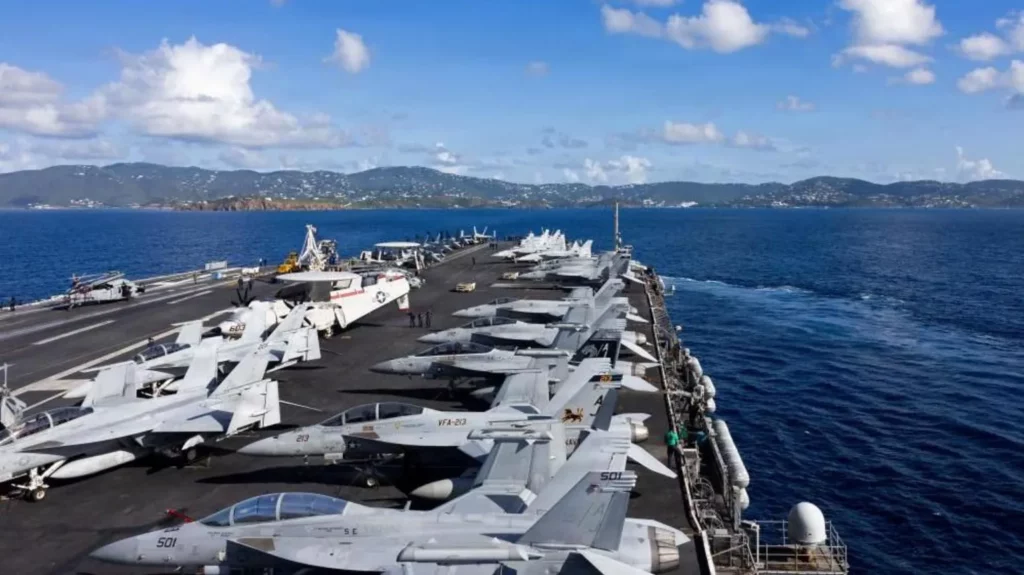
The U.S. has deployed 15,000 troops along with aircraft carriers, destroyers, and amphibious ships, including the USS Gerald R. Ford, the largest aircraft carrier in the world.
Helicopters from the Ford reportedly took part in seizing an oil tanker off Venezuela on December 10, which the U.S. said was transporting sanctioned oil from Venezuela and Iran. Venezuela described the action as “international piracy.” Two more tankers have since been targeted.
Is Venezuela Really Flooding the U.S. With Drugs?
Counternarcotic experts stress that Venezuela is a minor player in global drug trafficking. Cocaine mainly originates in Colombia, while fentanyl production occurs primarily in Mexico, entering the U.S. almost exclusively via land. According to the DEA’s 2025 report, only a small fraction of cocaine reaches the U.S. through Venezuela, most via the Pacific.
Despite Trump’s claims that vessels were “stacked with white powder, mostly fentanyl,” available evidence suggests that Venezuela is not a primary source of the drugs causing the opioid crisis in the U.S.
Maduro’s Rise to Power
Nicolás Maduro came to prominence under Hugo Chávez, a left-wing leader of the United Socialist Party of Venezuela (PSUV). Maduro, a former bus driver and union leader, became president in 2013 after Chávez’s death.
Over the past 26 years, the PSUV has consolidated control over key institutions, including the National Assembly, judiciary, and electoral council.
In 2024, Maduro was declared the winner of a contested presidential election, despite opposition tallies suggesting Edmundo González had won by a landslide. González replaced María Corina Machado on the ballot after she was barred from running. Machado later received the Nobel Peace Prize in 2025 for her efforts toward a peaceful democratic transition.
Venezuela’s Oil and Its Global Significance
Oil is Venezuela’s main source of government revenue, accounting for more than half of its budget. Despite having the world’s largest proven crude oil reserves, mismanagement and sanctions have reduced production.
- In 2023, Venezuela produced just 0.8% of global crude oil, exporting about 900,000 barrels per day, primarily to China.
- Maduro has long accused the U.S. of trying to seize Venezuela’s oil, pointing to Trump’s comment after the first tanker seizure: “I assume we’re going to keep the oil.” U.S. officials deny that Maduro’s removal is motivated by oil.
Trump’s targeting of Venezuela combines concerns over migration, drugs, and alleged criminal networks with strategic pressure on Maduro’s oil-dependent government. While Venezuela’s role in the U.S. drug crisis is limited, the administration has justified military action and sanctions as a defense of American lives and economic security.
Meanwhile, Maduro frames the U.S. campaign as a pretext to seize Venezuela’s resources, highlighting the ongoing tension between sovereignty, international law, and geopolitical ambitions in Latin America.
Never Miss a Story: Join Our Newsletter