
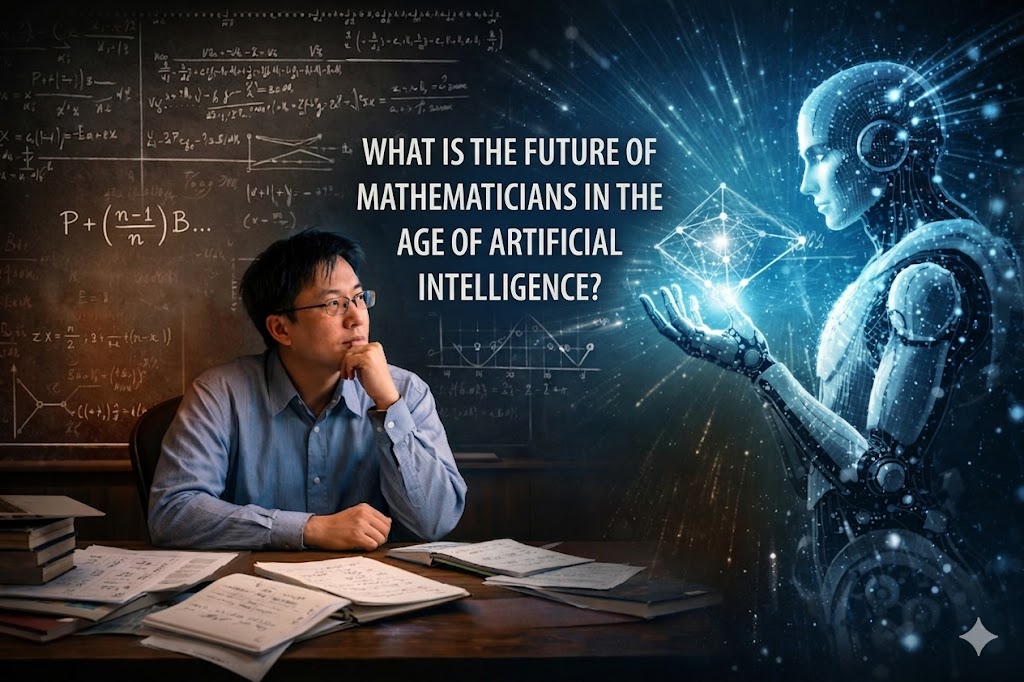
The rise of artificial intelligence has triggered a profound re-examination of many intellectual professions, but few face as deep and existential a questioning as mathematics. For centuries, mathematics has stood as the pinnacle of human reasoning—precise, logical, and seemingly immune to the ambiguities that characterize other fields of knowledge. Yet today, machines are beginning to operate convincingly within this domain. They can solve equations, verify proofs, detect patterns across vast datasets, and even propose conjectures that humans might not immediately see.
This development has led to a quiet but persistent anxiety: if machines can “do mathematics,” what becomes of mathematicians? More pointedly, what happens to the identity, relevance, and intellectual authority of the great figures in the field—individuals such as Terence Tao, whose work represents the highest levels of human mathematical achievement?
To answer this question meaningfully, one must move beyond surface-level assumptions about mathematics as mere problem-solving and engage with its deeper philosophical nature.
Mathematics as Understanding, Not Just Output
It is tempting to equate mathematics with the production of correct answers. In educational settings, success is often measured by arriving at the right solution. In research, proofs establish truth, and truth is the ultimate goal. From this perspective, artificial intelligence appears poised to dominate, as it excels in accuracy, speed, and scalability.
However, this view captures only one dimension of mathematics. At its core, mathematics is not simply about producing truths; it is about understanding them. A proof is valuable not only because it confirms a statement but because it explains why the statement must be true. It reveals structure, uncovers relationships, and often provides insight that extends far beyond the original problem.
Artificial intelligence can generate correct proofs, but correctness alone does not constitute understanding. A machine may traverse logical steps flawlessly without possessing any awareness of the concepts it manipulates. Humans, by contrast, seek coherence and meaning. They are not satisfied with truth in isolation; they desire connection, interpretation, and clarity.
This distinction is critical. If mathematics were purely about output, then the rise of AI would indeed threaten to render mathematicians obsolete. But because mathematics is also about insight, the human role remains indispensable.
The Historical Pattern of Disruption
To place the current moment in context, it is useful to consider earlier technological shifts. The introduction of calculators was once met with concern that students would lose their ability to perform basic arithmetic. The advent of computers raised fears that mathematicians would become redundant as machines took over complex calculations.
In both cases, these fears proved misplaced. Rather than diminishing mathematics, these tools expanded its scope. They allowed researchers to explore new territories, tackle previously intractable problems, and develop entirely new fields. The discipline did not contract; it evolved.
Artificial intelligence represents a more advanced stage of this trajectory, but it follows a similar pattern. It does not eliminate the need for human thought; it changes where that thought is directed. Tasks that are repetitive or procedural are increasingly automated, while tasks that require creativity, judgment, and vision become more central.
The Transformation of Mathematical Work
As AI systems grow more capable, the day-to-day activities of mathematicians are likely to change significantly. The traditional image of a mathematician laboring over lengthy calculations or intricate symbolic manipulations may gradually fade. In its place emerges a new model of intellectual engagement—one that emphasizes direction over execution.
In this evolving landscape, mathematicians may find themselves focusing more on:
- Identifying meaningful and impactful problems rather than merely solving predefined ones
- Interpreting and contextualizing results generated with the assistance of AI systems
- Building conceptual frameworks that guide both human and machine exploration
These shifts do not diminish the role of the mathematician; they elevate it. The emphasis moves from technical proficiency to intellectual leadership. The mathematician becomes less a technician and more a navigator of ideas.
Great Minds in an AI-Enhanced World
The question of whether leading mathematicians will feel threatened or displaced by AI is both practical and psychological. On one hand, individuals who have built their identities around exceptional problem-solving ability may experience a sense of unease as machines encroach on this domain. On the other hand, those who operate at the highest levels of abstraction are less likely to be affected in this way.
Figures such as Terence Tao exemplify a form of mathematical excellence that extends beyond raw computational skill. Their contributions lie in their ability to see connections across disparate areas, to frame problems in novel ways, and to guide the direction of research. These are not tasks that can be easily automated.
Indeed, for such individuals, AI may serve as a powerful ally. By handling routine aspects of research and offering new avenues for exploration, it allows them to operate more efficiently and creatively. Rather than diminishing their relevance, AI has the potential to amplify their impact.
The Emergence of “Opaque Truths”
One of the more intriguing and philosophically challenging consequences of AI in mathematics is the possibility of results that are correct but not fully understood by humans. If a machine produces a proof that is too complex or too unfamiliar for human comprehension, does that proof constitute knowledge?
Traditionally, mathematics has been a communal enterprise. A result gains acceptance not only because it is logically valid but because it can be understood, verified, and appreciated by others. AI challenges this norm by introducing the possibility of “opaque truths”—statements that are demonstrably correct yet remain beyond human grasp.
This raises fundamental questions about the nature of knowledge itself. Is knowledge defined by truth alone, or does it require understanding? If the latter, then human mathematicians retain a crucial role as interpreters and translators of machine-generated insights. They become the bridge between raw correctness and meaningful comprehension.
Redefining Value in Mathematics
The increasing capabilities of AI also force a reconsideration of what is valued in mathematical work. Historically, difficulty has often been equated with importance. Problems that are hard to solve are seen as more significant, and those who solve them are accorded greater recognition.
However, as AI reduces the effort required to solve many problems, this association may weaken. The value of mathematical work is likely to shift toward qualities that machines cannot easily replicate—depth, elegance, and conceptual richness.
This shift is not entirely new. Even before the rise of AI, mathematicians have often prized simplicity and beauty over brute complexity. A short, elegant proof is typically regarded as more valuable than a long, cumbersome one. AI may accelerate this trend by making it easier to generate solutions while leaving the appreciation of their quality largely in human hands.
Identity and the Human Experience of Thinking
Beyond practical considerations, the rise of AI touches on deeper questions of identity. For many mathematicians, their work is not just a profession but a defining aspect of who they are. The ability to solve challenging problems provides a sense of accomplishment and purpose.
As machines take over some of these tasks, there is a risk that individuals may feel a loss of identity or relevance. This is not unique to mathematics; it is a broader phenomenon affecting many fields in the age of automation.
Yet this moment also offers an opportunity for redefinition. If mathematical identity shifts from being centered on problem-solving speed to being rooted in curiosity, creativity, and understanding, it may become more resilient rather than less. The essence of mathematics lies not in outperforming others, whether human or machine, but in engaging deeply with ideas.
AI as a Partner in Discovery
Rather than viewing AI as a competitor, it may be more productive to see it as a collaborator. This partnership has the potential to expand the boundaries of mathematical knowledge in ways that would be difficult or impossible for humans alone.
AI can explore vast spaces of possibilities, identify patterns that might escape human notice, and test hypotheses with remarkable efficiency. Humans, in turn, provide direction, interpretation, and meaning. Together, they form a complementary system in which each enhances the capabilities of the other.
This collaborative model suggests a future in which mathematics becomes more dynamic and expansive. New fields may emerge at the intersection of human intuition and machine computation, leading to discoveries that neither could achieve independently.
The Enduring Human Role
Despite the transformative impact of AI, certain aspects of mathematics remain inherently human. These include the ability to ask profound questions, to recognize significance, and to appreciate beauty. Machines can assist in these processes, but they do not replace the human experience of engaging with ideas.
The future mathematician is therefore not an obsolete figure but an evolved one. Their role is less about performing calculations and more about shaping the intellectual landscape. They guide inquiry, interpret results, and ensure that mathematics remains a meaningful human endeavor.
The emergence of artificial intelligence marks a turning point in the history of mathematics, but it does not signal the end of the discipline or the obsolescence of its practitioners. Instead, it initiates a transformation—one that shifts the focus from computation to understanding, from execution to vision, and from isolation to collaboration.
Mathematicians, including leading figures such as Terence Tao, are unlikely to become irrelevant or disgruntled. On the contrary, they are poised to play an even more critical role in navigating this new landscape. As the volume of mathematical knowledge grows and the tools for exploring it become more powerful, the need for human insight, judgment, and creativity only increases.
In the end, the question is not whether AI will replace mathematicians, but how mathematicians will redefine themselves in response to AI. The answer, as history suggests, is not one of decline but of evolution. Mathematics will continue to thrive—not as a purely mechanical enterprise, but as a deeply human pursuit enriched by the tools of a new age.
Never Miss a Story: Join Our Newsletter